Sell Stop Order
A conditional pending order placed below the prevailing market price that activates an aggressive market sell order once the designated stop price is touched, utilized either to limit losses on an existing long position or to initiate a new short position on a downward breakout.
What Is a Sell Stop Order?
A sell stop order is a conditional order type configured to sell a financial instrument at a specified price below the current market price. When the asset’s market price declines and reaches or breaches the specified trigger price (the stop price), the order automatically transforms into an unpriced market order, instructing the broker or exchange matching engine to sell the specified quantity immediately at the best available bid prices.
Sell stop orders serve two fundamental strategic functions in institutional and retail trading:
- Defensive Risk Mitigation (Stop-Loss Protection): An investor holding an existing long position places a sell stop below their entry price to automatically liquidate the trade if the market turns adverse, capping capital losses at an acceptable threshold.
- Offensive Momentum Entry (Breakout Trading): A technical trader anticipating a sharp bearish acceleration places a sell stop just below a major support level. If price breaches that support barrier, the order triggers automatically to enter a new short position in the direction of the breakdown.
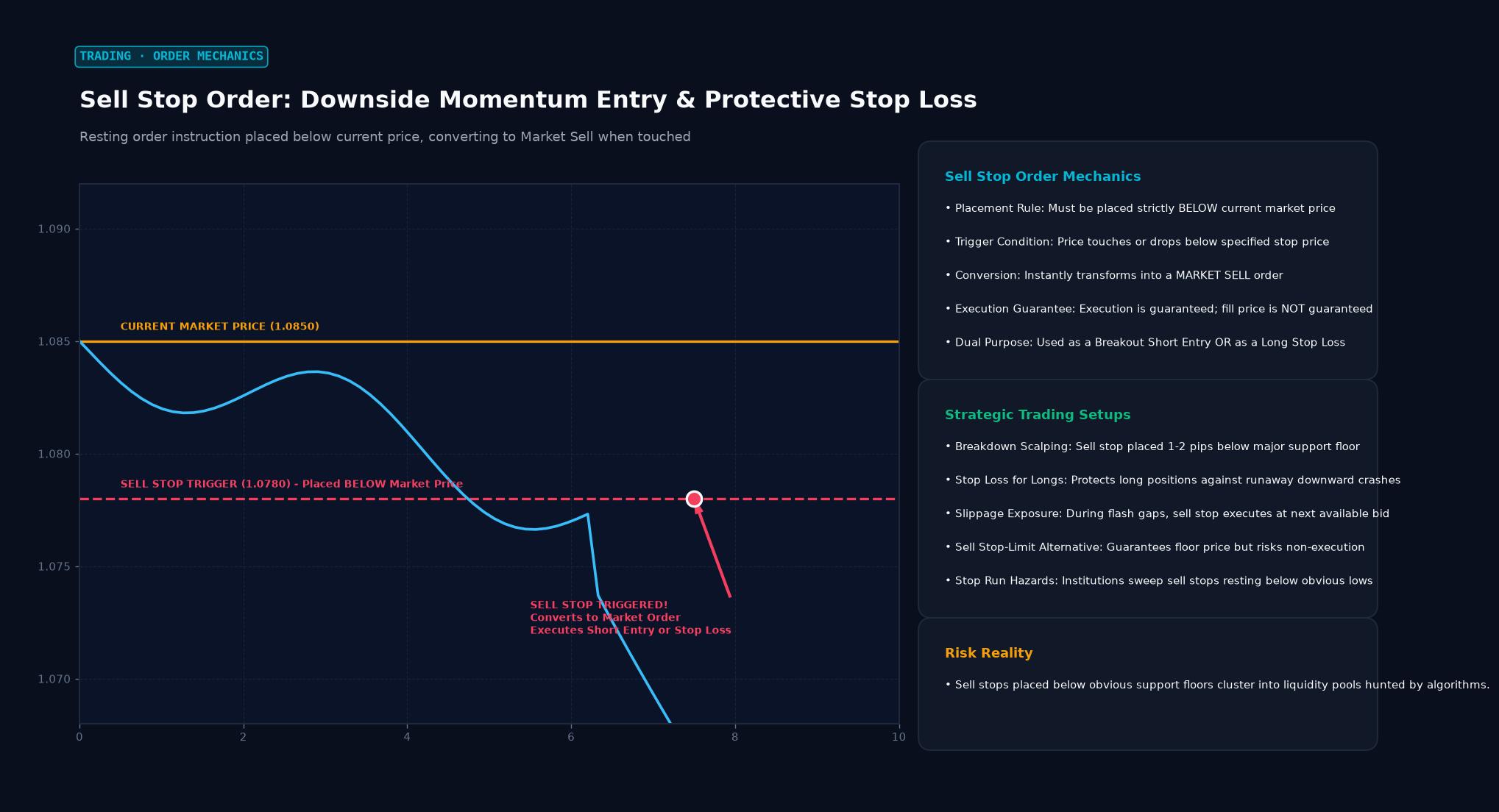 Figure: Resting order instruction placed below current price, converting to Market Sell when touched
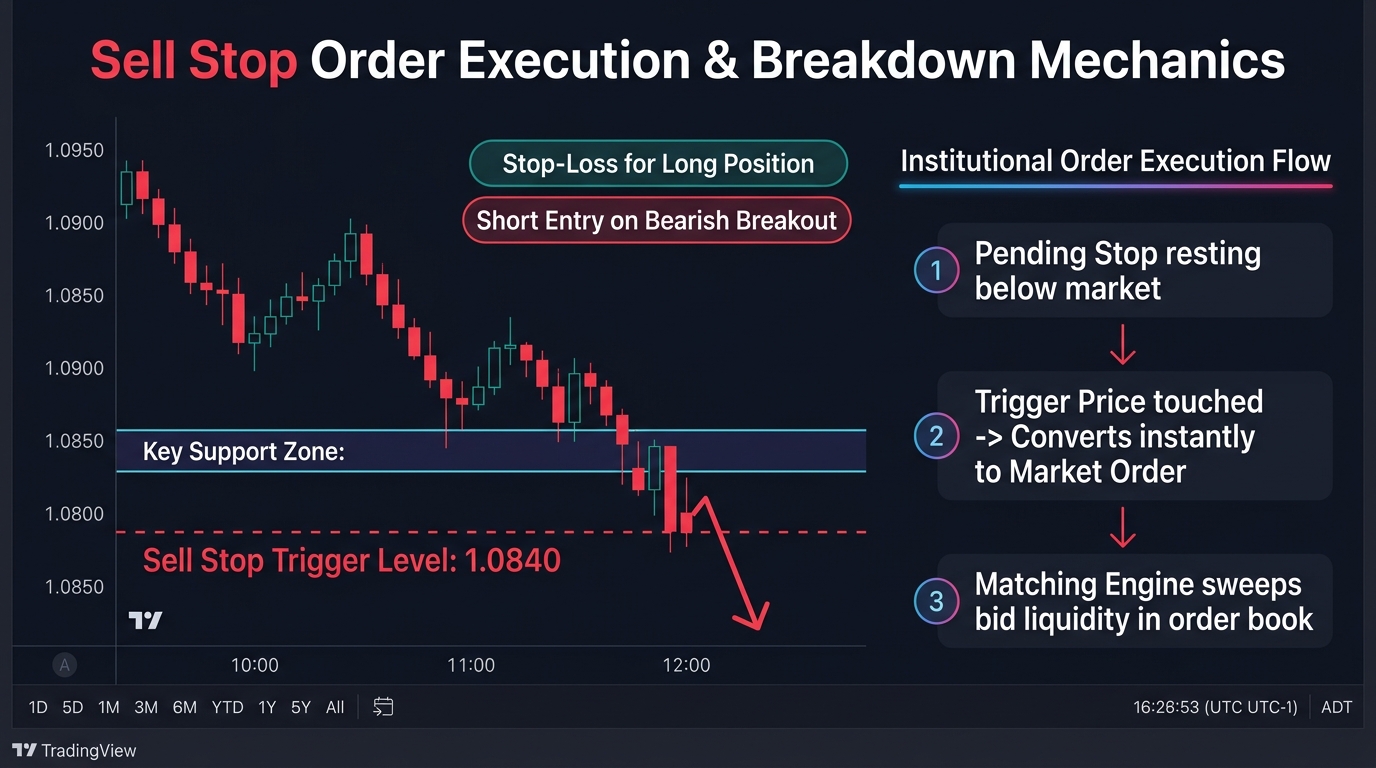
Sell Stop Order vs. Sell Limit Order vs. Stop-Limit Order
Understanding order execution requires distinguishing between how stop and limit orders interact with the order book:
| Order Type | Placement Relative to Market | Trigger Behavior | Execution Guarantee | Price Guarantee |
|---|---|---|---|---|
| Sell Stop Order | Placed BELOW current market price | Converts into an aggressive Market Order once stop price is touched | Yes (Order will execute as long as liquidity exists) | No (Subject to negative slippage in fast markets) |
| Sell Limit Order | Placed ABOVE current market price | Remains a passive limit order waiting for buyers to lift the offer | No (Will not execute if price never reaches limit) | Yes (Fills only at limit price or better) |
| Sell Stop-Limit Order | Placed BELOW current market price | Converts into a passive Limit Order once stop trigger price is touched | No (If price collapses rapidly below limit, order remains unfilled) | Yes (Will not fill below the secondary limit threshold) |
The Slippage Factor: Fast Markets, Gaps, and Liquidity Sweeps
Because a sell stop order converts into an unpriced market order upon activation, it guarantees execution speed, not execution price. In normal liquid market conditions, a sell stop fills at or within fractional pips of the requested trigger price. However, during market stress or illiquid periods, execution is vulnerable to negative slippage.
Execution slippage is mathematically defined as:
$$\text{Slippage} = \text{Trigger Price} - \text{Actual Executed Fill Price}$$
Three primary market conditions induce severe slippage on sell stop orders:
- Weekend Gaps: In foreign exchange, weekend geopolitical surprises can cause Sunday opening prices to gap dozens or hundreds of pips below Friday’s close. A sell stop set at 1.0800 will fill at the Sunday opening bid of 1.0720, incurring an 80-pip slippage penalty.
- Economic Data Releases: Major announcements (such as the U.S. Non-Farm Payrolls or central bank rate surprises) cause market makers to withdraw liquidity momentarily, creating an order book void where stop orders must sweep down multiple price tiers.
- Liquidity Cascades: When thousands of retail traders place sell stops at identical obvious round numbers (e.g., EUR/USD 1.0500), the simultaneous activation of these orders floods the market with aggressive sell volume, overwhelming available bids and triggering cascading slippage.
Real-World Institutional Case Study: The October 2016 Sterling “Flash Crash”
In the early morning of October 7, 2016, during the low-liquidity transition between the New York close and Asian open, the British Pound (GBP/USD) suffered an unprecedented flash crash, collapsing by over 9% in less than forty seconds.
       GBP/USD LIQUIDITY CASCADE - OCTOBER 7, 2016

 1.2600 ──┐ (Calm Asian Session Consolidation)
          │\
 1.2500 ──┼─\  [ Retail & Algorithmic Sell Stops Clustered Below 1.2500 ]
          │  \
 1.2300 ──┼───\  Market Maker Bids Pulled; Liquidity Void Opens
          │    \
 1.2000 ──┼─────\  Sell Stops Convert to Market Sells with Zero Bids
          │      \
 1.1500 ──┼───────\___ FLASH BOTTOM: Prints ~1.1491 on EBS
└─────────────────────────────────────────────────────- Catalyst: Media reports circulating negative Brexit commentary triggered initial algorithmic selling in Asian trading hours.
- The Stop-Loss Avalanche: As GBP/USD sliced below key multi-decade psychological support at 1.2500, a massive cluster of institutional and retail sell-stop orders was activated simultaneously.
- The Liquidity Evaporation: Commercial banks’ automated risk systems immediately pulled their limit bid quotes from electronic communication networks (EBS and Reuters). With virtually no buy orders present in the central limit order book, the surging wave of market sell orders swept prices straight down to 1.1491 before stabilizing.
- The Lesson: Institutional traders who relied on standard sell stop orders suffered catastrophic slippage of up to 500 to 800 pips, underscoring the critical need for guaranteed stops or synthetic options hedges during thin-market windows.
Best Practices for Tactical Sell Stop Placement
Professional traders follow disciplined rules when deploying sell stop orders:
- Avoid Obvious Retail Clusters: Never place sell stops precisely on the round psychological number (e.g., 1.3000, $100.00) or directly at a swing low where retail stop clusters reside. High-frequency algorithms frequently engineer liquidity sweeps (“stop hunts”) into these zones before reversing.
- Incorporate Volatility Buffers: Place sell stops at a buffer distance calculated using ATR (e.g., $1.5 \times \text{ATR}_{14}$ below support) to absorb intraday false breakouts without triggering premature liquidations.
- Evaluate Guaranteed Stop Losses (GSLOs): In volatile markets or ahead of major binary risk events, utilizing broker-guaranteed stop-loss orders eliminates slippage risk in exchange for a small upfront insurance fee.
Frequently Asked Questions
Can a sell stop order be executed at a price higher than the stop price?
In rare scenarios involving a positive liquidity spike or rapid recovery tick, a sell stop might execute marginally above the trigger price (positive slippage). However, because sell stop orders trigger during downward momentum, executions almost universally occur at or below the stop price.
Does a sell stop order stay active indefinitely?
By default, most broker platforms allow traders to designate a sell stop order as Good ’Til Cancelled (GTC), which remains active indefinitely until filled or manually removed. Alternatively, traders can set the order as a Day Order, which automatically expires if not triggered by the end of the current trading session.
What is the difference between a Sell Stop and a Sell Stop-Limit order?
A standard Sell Stop converts into an unpriced Market Order when triggered, guaranteeing execution regardless of how far the price collapses. A Sell Stop-Limit order converts into a passive Limit Order, guaranteeing that the trade will not execute below a secondary minimum price floor, but risking that the trade will not fill at all if prices gap through the limit.
Ready to trade forex?
Open a free demo account with a regulated broker. Practice with virtual funds before risking real money.