Selling Rate
The exchange rate at which a bank, broker, or financial dealer is willing to sell the base currency to a counterparty; functionally synonymous with the 'Ask' or 'Offer' price in a standard two-way quotation.
What Is a Selling Rate?
In foreign exchange and banking operations, the selling rate (universally referred to in professional trading desks as the Ask or Offer price) is the exchange rate at which a commercial bank, financial institution, or broker sells foreign currency to a customer or counterparty.
Every foreign exchange price quote is established from the dealer’s operational perspective, not the client’s:
- Buying Rate (Bid): The price at which the dealer buys the base currency from you.
- Selling Rate (Ask / Offer): The price at which the dealer sells the base currency to you.
Because financial institutions function as market makers, the selling rate is always higher than the buying rate. The mathematical difference between the two prices constitutes the bid-ask spread, which serves as the primary revenue mechanism compensating the dealer for committing balance-sheet liquidity, bearing inventory risk, and covering operational clearing overhead.
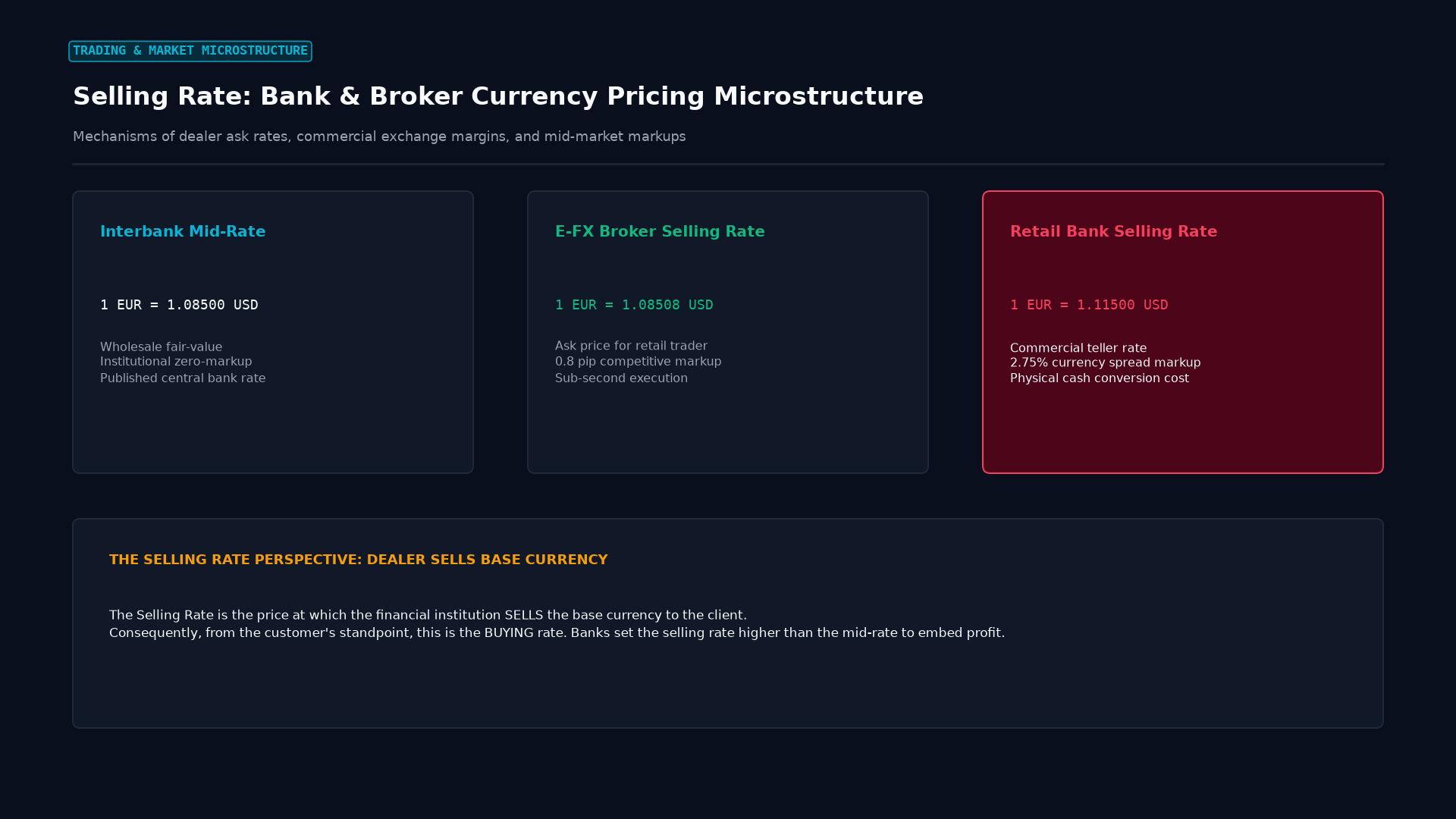 Figure: Dealer ask pricing: commercial exchange rate markup applied over wholesale interbank mid-rates when selling base currency to clients.
Direct vs. Indirect Quotation: Interpreting the Selling Rate
The interpretation of the selling rate depends on whether the currency is quoted directly or indirectly in the domestic market:
1. Direct Quotation (Foreign Currency Quoted in Terms of Domestic Currency)
- Format: 1 Unit of Foreign Currency = $X$ Units of Domestic Currency.
- In the United States, EUR/USD at 1.0852 means the bank’s selling rate is $1.0852. To buy €1.00, the customer must pay $1.0852.
- A higher selling rate means the foreign currency has appreciated, making it more expensive to acquire.
2. Indirect Quotation (Domestic Currency Quoted in Terms of Foreign Currency)
- Format: 1 Unit of Domestic Currency = $X$ Units of Foreign Currency.
- In the United Kingdom, GBP/USD at 1.3050 means £1.00 = $1.3050. The bank’s selling rate for British Pounds indicates how many US Dollars the bank demands to deliver £1.00.
Calculating Dealer Spread Margin Percentage
The percentage margin embedded in a dealer’s selling rate is calculated as:
$$\text{Dealer Spread Margin (%)} = \left( \frac{\text{Selling Rate} - \text{Buying Rate}}{\text{Selling Rate}} \right) \times 100$$
On an interbank EUR/USD quote of 1.0850 / 1.0852:
$$\text{Margin} = \left( \frac{1.0852 - 1.0850}{1.0852} \right) \times 100 = 0.00184% \quad (\text{Ultra-liquid})$$
In contrast, at a retail airport currency bureau quoting 1.0200 / 1.1400:
$$\text{Margin} = \left( \frac{1.1400 - 1.0200}{1.1400} \right) \times 100 = \mathbf{10.53%} \quad (\text{Heavy retail markup})$$
Selling Rate vs. Buying Rate vs. Mid-Market Rate
| Market Dimension | Buying Rate (Bid) | Mid-Market Rate | Selling Rate (Ask / Offer) |
|---|---|---|---|
| Market Definition | Rate dealer pays to purchase base currency | Exact mathematical midpoint $(\text{Bid} + \text{Ask}) / 2$ | Rate dealer charges to sell base currency |
| Client Perspective | Price client receives when selling | Benchmark theoretical fair value; unexecutable | Price client must pay when purchasing |
| Relative Value | Always the lower number in the quote | Neutral central reference point | Always the higher number in the quote |
| Application | Export revenue conversion, closing long trades | Financial reporting, mark-to-market accounting | Import payments, purchasing foreign currency, going long |
Retail Banking Markups vs. Interbank Tier-1 Execution
The selling rate displayed to an end customer varies drastically depending on the transaction tier and market venue:
                      GLOBAL FX SELLING RATE PYRAMID

 [ Tier-1 Interbank Market ]  EUR/USD Ask: 1.08502  ──► Raw wholesale spread (0.2 pips)
              │
              ▼
 [ Corporate Prime Desks ]    EUR/USD Ask: 1.08515  ──► Commercial spread (1.5 pips)
              │
              ▼
 [ Retail Commercial Banks ]  EUR/USD Ask: 1.11500  ──► International wire markup (~2.5% - 3%)
              │
              ▼
 [ Airport Currency Booths ]  EUR/USD Ask: 1.20500  ──► Physical cash markup (~10% - 15%)
Real-World Case Study: The Commercial Remittance Revolution and Mid-Market Pricing
Historically, legacy commercial banks held an absolute monopoly over corporate and consumer foreign exchange transfers. When a small business in the United States wanted to pay a €100,000 supplier invoice in Germany, the bank would execute the transaction using an inflated retail selling rate.
       LEGACY BANK WIRE VS. MODERN FINTECH DISRUPTION

 Invoice Amount: €100,000
 Prevailing Interbank Mid-Market Rate: 1.0850 ($108,500 true value)

 1. Commercial Bank Execution:
    - Quoted Selling Rate: 1.1175 (3.00% markup above mid-market)
    - Wire Transfer Administrative Fee: $45.00
    - Total Cost to Business: €100,000 * 1.1175 + $45 = $111,795.00
    - Hidden Dealer Margin Retained by Bank: $3,250.00

 2. Disrupted Fintech Execution (Wise / Revolut):
    - Executed Selling Rate: 1.0850 (Direct interbank mid-market rate)
    - Transparent Processing Fee: 0.35% ($379.75)
    - Total Cost to Business: $108,879.75
    - Net Savings Realized by Business: $2,915.25
This structural price opacity led to regulatory interventions worldwide, including the European Union’s Cross-Border Payments Regulation (CBPR2) and U.S. Consumer Financial Protection Bureau (CFPB) remittance rules, compelling institutions to disclose the exact markup embedded within their selling rates.
Tactical Negotiation: How Corporate Treasuries Optimize Selling Rates
Multinational corporations managing cross-border supply chains deploy specific protocols to minimize selling rate penalties:
- Multi-Bank FX Aggregation: Rather than relying on a single relationship bank, corporate treasuries route requests for quotes (RFQs) simultaneously to 3–5 liquidity providers via multi-dealer platforms (such as FXall or Bloomberg FIT), forcing dealers to compete on selling rates.
- Batching Conversions: Combining multiple small foreign currency obligations into a single large block allows companies to negotiate institutional selling rates rather than being subjected to tiered retail schedules.
- Synthetic Conversion via FX Swaps: In volatile markets, companies utilize FX forwards and swaps to lock in guaranteed future selling rates, hedging corporate budgets against currency depreciation.
Frequently Asked Questions
Why does a traveler always receive a worse selling rate at the airport?
Airport currency booths carry enormous overhead costs, including airport concession leases, vault security, physical cash shipping, insurance, and the risk of holding illiquid physical banknote inventories. They pass these operating burdens to captive consumer travelers by inflating their selling rates by 8% to 15% above the interbank rate.
If I want to buy a currency pair in trading software, do I buy at the buying rate or the selling rate?
You buy at the selling rate (Ask/Offer). The broker is selling the financial instrument to you at their selling rate. When you eventually close the trade by selling it back, the broker purchases it from you at their buying rate (Bid).
Is the selling rate fixed for the entire business day?
For retail over-the-counter transactions, physical exchange booths and some bank branches publish a static “card rate” once every morning. However, in modern electronic markets, retail brokerages, and wholesale banking, selling rates update continuously thousands of times per second based on interbank supply and demand.
Ready to trade forex?
Open a free demo account with a regulated broker. Practice with virtual funds before risking real money.