Sidelined
A market state where capital and traders deliberately remain in cash and refrain from executing trades due to extreme uncertainty, binary risk events, or a total concentration of market liquidity into a single dominant asset.
What Does “Sidelined” Mean?
In financial market terminology, the term sidelined carries two complementary meanings depending on whether it describes market participants or the financial assets themselves:
- Sidelined Traders and Capital: A condition where institutional fund managers, algorithmic desks, or retail speculators deliberately exit active exposure and park capital in cash or short-term Treasury bills. Market participants remain “on the sidelines” when binary geopolitical risks, impending central bank interest rate decisions, or extreme volatility make directional risk modeling unviable.
- Sidelined Currency Pairs or Assets: A structural market condition where an overwhelming surge of institutional interest and trading volume focuses exclusively on one specific currency pair (e.g., USD/JPY during a central bank intervention), draining liquidity away from other major and cross pairs. Consequently, secondary pairs become sidelined—trading in unusually thin, sluggish, or erratic conditions.
As Wall Street trading legend Jesse Livermore famously observed: “There is a time to go long, a time to go short, and a time to go fishing.” Sitting sidelined is an active, strategic choice that protects capital during market regimes where the probability of being whipsawed exceeds expected statistical returns.
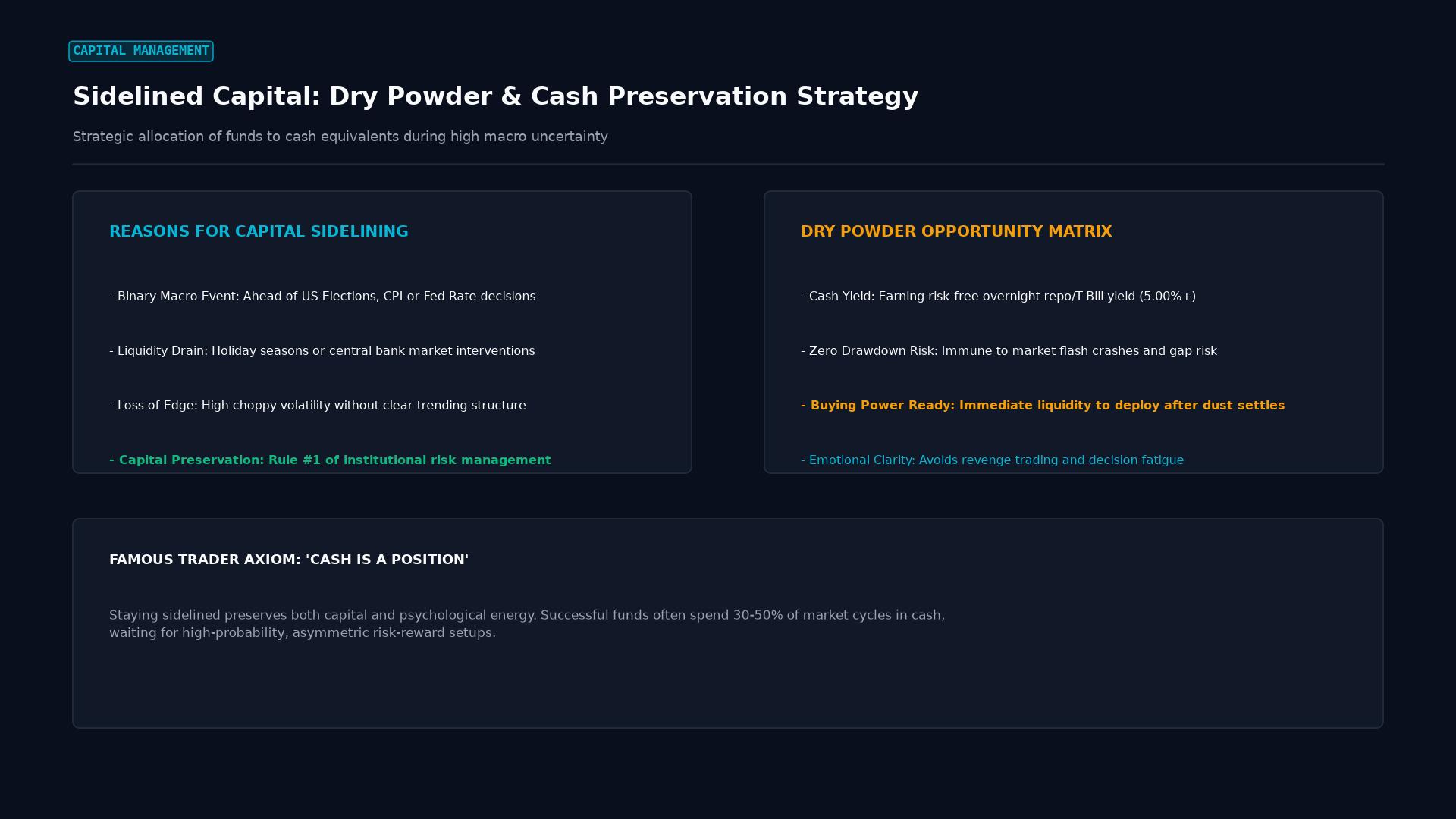 Figure: Institutional capital preservation: allocating capital to risk-free cash during binary macro shocks to maintain dry powder for asymmetric setups.
Sidelined Capital vs. Dry Powder vs. De-Risking
While these terms describe defensive stances, their operational objectives differ:
| Term | Primary Definition | Intent / Motivation | Typical Asset Allocation |
|---|---|---|---|
| Sidelined | Actively abstaining from market transactions due to uncertainty or lack of conviction | Capital preservation; avoiding choppy, high-risk conditions | 100% Cash, overnight repo, or ultra-short Treasury bills |
| Dry Powder | Unallocated cash reserves held specifically to exploit future opportunities | Opportunistic hunting; waiting for market crashes or deep discounts | Segregated liquidity reserves within a hedge fund or private equity firm |
| De-Risking | Systematically lowering gross and net portfolio exposure | Complying with regulatory risk budgets (e.g., Value-at-Risk limits) | Reducing leverage, buying options hedges, trimming beta |
When Currency Pairs Become Sidelined: The Liquidity Drain Phenomenon
In the foreign exchange market, liquidity is not static; it migrates dynamically toward volatility and yield. When a sovereign central bank conducts massive market interventions or a currency pair breaks through multi-decade extremes, the entire interbank order book shifts its quoting capacity:
        INTERBANK LIQUIDITY MIGRATION DURING CRISIS

 Normal Market Distribution:
 [ EUR/USD: 35% ]  [ USD/JPY: 20% ]  [ GBP/USD: 15% ]  [ Crosses/Exotics: 30% ]

 Crisis / Intervention Shock (e.g., BOJ Intervention on Yen):
 [ USD/JPY: 65% ]  ◄── Liquidity Providers flood into Yen to manage toxic order flow
 [ EUR/USD: 20% ]
 [ GBP/USD: 10% ]
 [ AUD/NZD, EUR/GBP, CAD/CHF: 5% ] ◄── SIDELINED: Spreads widen 4x; volume evaporates
When minor and cross pairs are sidelined:
- Spreads Expand: Because market makers concentrate quoting bandwidth on the primary mover, spreads on secondary crosses widen significantly.
- Erratic Price Action: Thin order books mean relatively small commercial client orders can cause disproportionately large price spikes (whipsaws).
- Correlation Decoupling: Standard statistical correlations break down as quote currencies are revalued solely through the lens of the dominant trending currency.
Real-World Institutional Case Study: Global FX Desks Sidelined Ahead of the 2016 Brexit Vote
In the weeks leading up to the June 23, 2016 United Kingdom European Union Membership Referendum (Brexit), global financial institutions adopted one of the most extreme sidelined postures in modern history:
       GBP/USD IMPLIED VOLATILITY VS. SPOT TRADING (JUNE 2016)

 1-Month GBP Volatility: Surged from 10% to over 32% (Historic Peak)
 Prime Broker Margin Requirements: Raised from 2% (1:50) to 20% (1:5)
Institutional Desk Activity: Over 60% of discretionary FX funds moved 100% to Cash- The Risk Evaluation: Because opinion polls were deadlocked within the margin of error, hedge fund algorithms and risk managers could not assign a statistically valid edge to either “Remain” or “Leave.”
- The Strategic Retreat: Rather than gambling on a 50/50 binary political outcome, major institutional macro funds moved completely to the sidelines, liquidating British Pound and Euro positions into U.S. Dollars and Swiss Francs.
- The Aftermath: When the “Leave” victory was confirmed in the early hours of June 24, GBP/USD suffered the largest single-day collapse in modern foreign exchange history, plunging over 1,800 pips from 1.5000 to 1.3228. Institutional traders who remained sidelined preserved millions in capital, while those who attempted to trade through the event suffered catastrophic slippage and margin liquidations.
The Strategic Power of Cash: Why Top Traders Sit Sidelined
Professional portfolio managers recognize that remaining sidelined delivers three major tactical advantages:
- Emotional Equilibrium: Sitting in cash eliminates psychological anxiety, allowing traders to observe market structure shifts with objective clarity.
- Zero Negative Carry: In volatile, non-trending markets, active traders bleed capital through constant stop-outs, bid-ask spread frictions, and overnight swap charges. Cash earns risk-free interest while incurring zero trading friction.
- Immediate Agility: When a massive market dislocation or structural trend finally clarifies, sidelined capital can be deployed aggressively at prime institutional levels, whereas trapped traders are paralyzed managing losing positions.
Frequently Asked Questions
Is remaining sidelined considered a sign of trader indecision or weakness?
No. In professional trading, choosing to remain sidelined is a sign of high discipline and risk maturity. Retail traders feel an impulsive need to trade every session (overtrading), whereas institutional operators only commit capital when the mathematical expectancy and market conditions strongly favor their strategy.
What causes sidelined capital to re-enter the market?
Sidelined capital re-enters when the source of uncertainty is definitively resolved. Typical re-entry triggers include the conclusion of major elections, the publication of long-awaited central bank policy statements, or a decisive technical breakout above a multi-month consolidation range confirmed by surging volume.
Can sitting sidelined hurt a long-term portfolio?
Yes, over extended multi-year periods. If an investor remains permanently sidelined in cash out of chronic fear, inflation steadily erodes purchasing power, and the investor suffers massive opportunity costs by missing secular bull markets and compounding returns. Sidelined positioning is a tactical, temporary stance—not a permanent investment strategy.
Ready to trade forex?
Open a free demo account with a regulated broker. Practice with virtual funds before risking real money.