Thin Market
A financial or foreign exchange trading environment characterized by low trading volume, sparse order book depth, and few active market participants, resulting in wide bid-ask spreads, severe execution slippage, and outsized price volatility.
What Is a Thin Market?
A thin market (commonly termed an illiquid market) is a financial environment where the number of active buyers and sellers is exceptionally low and the aggregate volume of resting limit orders in the central limit order book (Depth of Market) is sparse.
Because there is minimal liquidity resting on either side of the spread, a thin market lacks the structural resilience to absorb transaction flow. In a liquid, deep market, a $50 million market order is absorbed smoothly with fractional-pip impact; in a thin market, that exact same transaction can sweep through multiple empty order book tiers, causing a sudden, violent price dislocation or flash spike.
Thin markets are characterized by wide bid-ask spreads, erratic price action, and severe execution slippage, making them hazardous for retail traders and institutional desks alike.
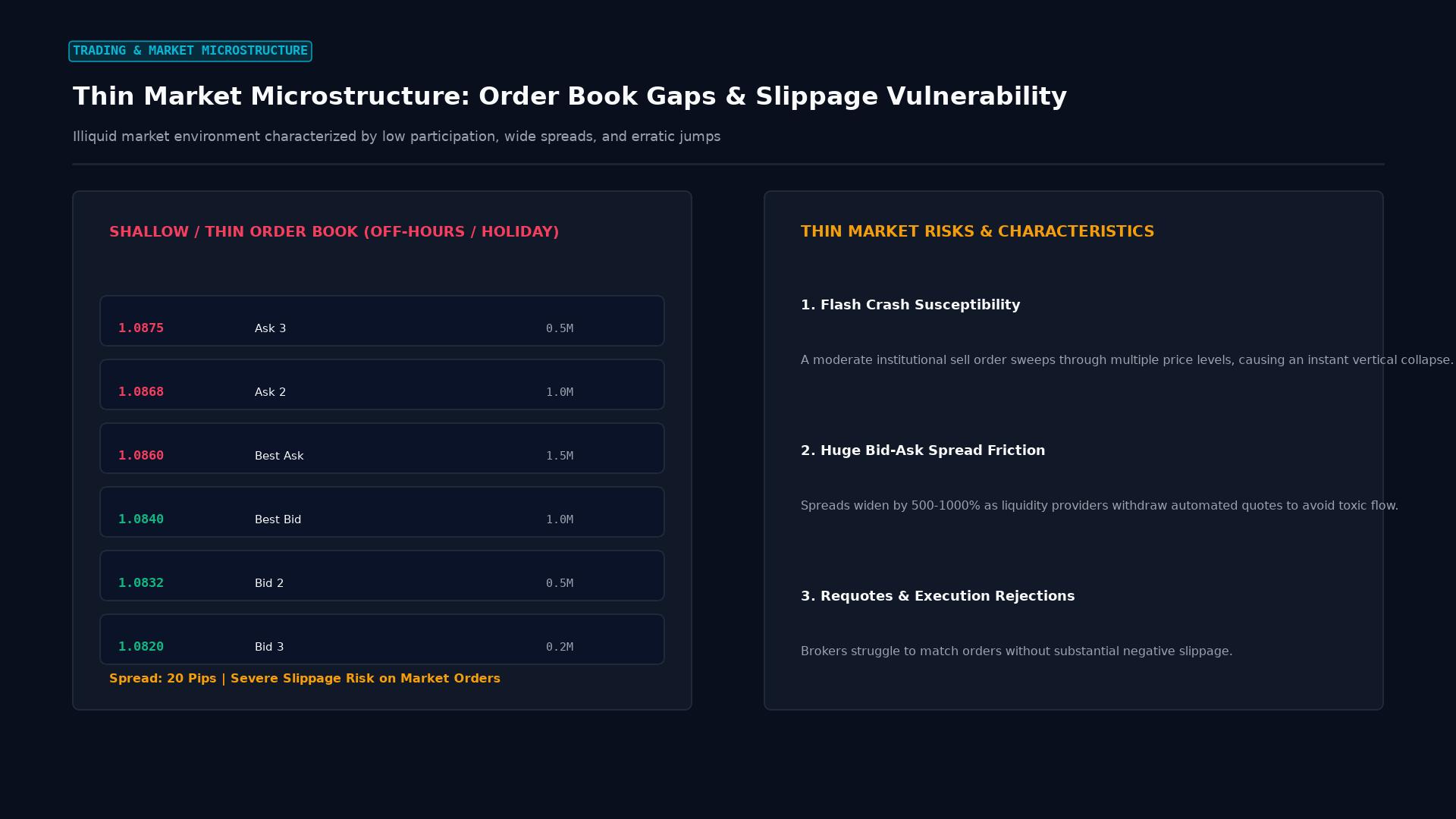 Figure: Illiquid market environment: shallow resting depth, multi-pip spreads, and extreme flash crash vulnerability upon institutional order sweeps.
When and Why Do Financial Markets Become Thin?
Market thinness is rarely a permanent condition in major assets; rather, it manifests during specific predictable timeframes and structural shocks:
1. The Daily Session “Twilight Zone” (5:00 PM – 6:00 PM EST)
In the 24-hour foreign exchange market, liquidity is not uniform. At 5:00 PM Eastern Standard Time, New York dealing desks close, and the daily bank settlement rollover occurs. For roughly one to two hours before the Tokyo and Sydney sessions gain momentum, interbank market makers pull quotes to reconcile ledgers, creating a notorious daily thin-market window where spreads expand dramatically.
2. Major Bank Holidays
During major global holidays—most notably the Christmas-to-New-Year week, Thanksgiving in the U.S., or “Golden Week” in Japan—institutional trading desks are lightly staffed or completely shut down. Volumes drop by 70% to 85%, leaving price action vulnerable to algorithmic sweeps.
3. Pre-News Liquidity Voids
In the two to three minutes immediately preceding tier-1 macroeconomic releases (such as the U.S. Non-Farm Payrolls, CPI, or central bank interest rate announcements), algorithmic market-making systems automatically withdraw resting limit orders to avoid being adversely selected by news traders, creating an instantaneous thin market.
4. Exotic and Minor Currency Crosses
Emerging market currencies (such as the South African Rand, Turkish Lira, or Hungarian Forint) operate in structurally thin regimes compared to G4 majors, naturally carrying wider spreads and higher gap risks.
Thin Market vs. Liquid Market vs. Distressed Market
| Dimension | Thin (Illiquid) Market | Liquid (Stable) Market | Distressed Market |
|---|---|---|---|
| Trading Volume | Substantially below historical average | Consistently elevated | High volume, but overwhelmingly one-sided |
| Depth of Market (DOM) | Extremely shallow; wide price gaps between tiers | Deep, dense tiers of resting limit orders | Complete evaporation of bids (or offers) |
| Bid-Ask Spreads | Wide (Can expand 5x to 10x normal levels) | Ultra-tight (0.1 to 0.4 pips in major FX) | Blown out; indicative pricing only |
| Execution Slippage | Severe on standard market orders | Minimal to zero on typical sizes | Catastrophic; multiple price tiers swept |
| Price Stability | Prone to erratic spikes and false breakouts | Smooth, continuous trending or ranging | Vertical freefall or explosive panic squeeze |
Real-World Institutional Case Study: The January 2019 Japanese “Flash Crash”
The lethal danger of thin markets was dramatically demonstrated in the early morning of January 3, 2019, during the Japanese “Golden Week” New Year holiday:
       AUD/JPY THIN-MARKET FLASH CRASH (JANUARY 3, 2019)

 78.50 ──┐ (09:30 Sydney Time: New York closed; Tokyo closed for holiday)
         │\
 76.00 ──┼─\  [ Retail Stop-Loss Cascade Triggered by Apple Revenue Warning ]
         │  \
 74.00 ──┼───\___ Institutional Market Makers OFFLINE; Order Books Empty
         │       \
 72.00 ──┼────────\___ Algorithmic Sell Orders Sweep Through Vacant Books
         │            \
 70.00 ──┼─────────────\___ FLASH CRASH BOTTOM: Prints ~70.50 (-8% in 7 minutes)
└───────────────────────────────────────────────────────────────────- The Environment: Tokyo banks were closed for a four-day national holiday, and New York desks had logged off for the evening. The market was operating in the ultimate thin liquidity window.
- The Catalyst: Apple Inc. issued a surprise downward revision to its quarterly revenue guidance due to slowing Chinese iPhone sales.
- The Cascade: Automated algorithmic sentiment scrapers detected the negative headline and initiated market sell orders in high-beta carry pairs (AUD/JPY and USD/JPY).
- The Collapse: Because Japanese bank market makers were offline, there were virtually no resting limit bids in the EBS matching engines. The selling cascaded through empty price tiers, collapsing AUD/JPY by nearly 8% (800 pips) in less than seven minutes before recovering. Retail margin accounts that held leveraged long carry positions were completely wiped out.
Tactical Rules for Navigating Thin Markets
Professional risk officers enforce strict operational rules during thin market conditions:
- Avoid Trading During the 5:00 PM EST Rollover: Retail traders should refrain from opening or closing positions between 4:55 PM and 5:30 PM EST. Spreads on minor pairs routinely expand from 1.5 pips to 15+ pips, creating immediate negative equity upon fill.
- Never Deploy Large Market Orders: In a thin market, aggressive market orders sweep through the sparse book. Always deploy Limit Orders to guarantee an exact execution ceiling.
- Widen Stop-Loss Buffers: Normal volatility boundaries fail in thin markets. If holding swing positions over holidays, widen stop-loss distances and cut position size proportionally to prevent random low-volume spikes from triggering premature exits.
Frequently Asked Questions
Why do brokers widen bid-ask spreads during a thin market?
Market makers and liquidity providers widen their spreads to protect themselves from inventory risk. In a thin market with few buyers, a dealer who buys currency from a customer cannot easily offload it to another counterparty. To compensate for the high risk of holding illiquid inventory that could drop in price, the dealer charges a significantly higher spread.
Can an individual trader manipulate a thin market?
Yes. In an extremely thin market (such as an exotic currency pair during off-hours or a micro-cap stock), a relatively modest trade of $1 million to $5 million can aggressively move the quoted price by several percent, creating false breakouts (“spoofing” or liquidity sweeps). This is why institutional algorithms frequently exploit thin holiday sessions to hunt clustered retail stops.
Does high volatility always mean a market is thin?
Not necessarily. A market can be highly volatile during the London-New York overlap following a Federal Reserve rate shock, processing record-breaking multi-billion-dollar trading volume. However, volatility in a thin market is characterized by sudden, jagged price jumps on anemic, low volume, reflecting a structural lack of counterparty liquidity rather than vigorous two-way participation.
Ready to trade forex?
Open a free demo account with a regulated broker. Practice with virtual funds before risking real money.