Society for Worldwide Interbank Financial Telecommunication (SWIFT)
A secure, standardized global financial messaging network that enables over 11,000 financial institutions across more than 200 countries to transmit instructions, payment orders, and foreign exchange confirmations.
What Is SWIFT?
The Society for Worldwide Interbank Financial Telecommunication (SWIFT) is a Belgian cooperative society established in 1973 to replace the vulnerable, error-prone Telex network. Headquartered in La Hulpe, Belgium, SWIFT operates the critical messaging backbone through which global financial institutions communicate cross-border payments, foreign exchange transactions, security trades, and treasury confirmations.
A critical structural distinction must be made: SWIFT does not hold money, manage accounts, or clear or settle funds.
Instead, SWIFT is an ultra-secure, encrypted messaging system. When an individual or corporation initiates an international bank transfer, SWIFT transmits the standardized payment order between the sending bank, correspondent banks, and receiving bank. The actual monetary settlement occurs separately through domestic central bank payment systems (such as Fedwire or TARGET2) and commercial bank correspondent nostro/vostro accounts.
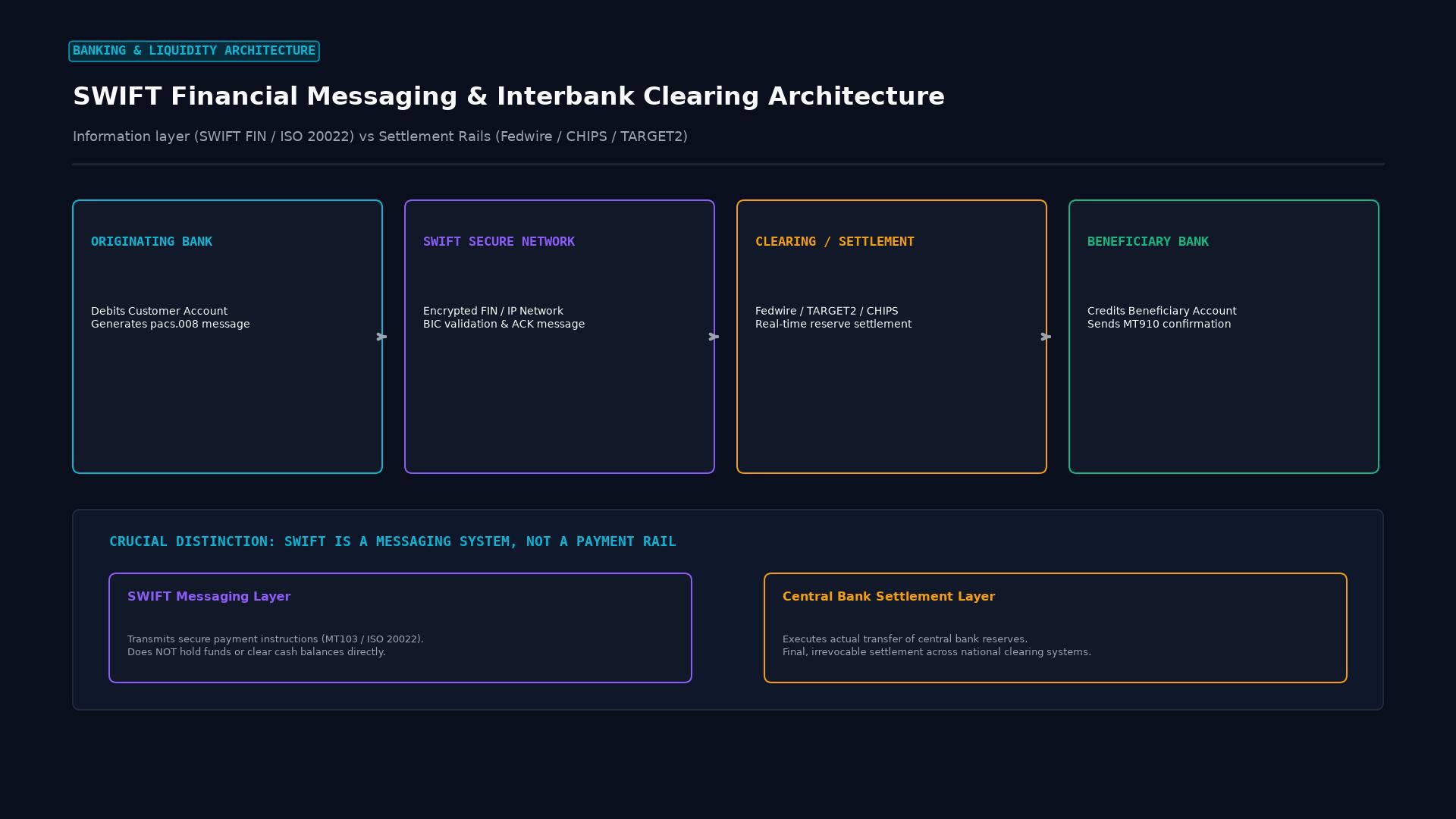 Figure: The architectural boundary between financial messaging (SWIFT FIN / ISO 20022 pacs.008) and central bank gross settlement rails (Fedwire, TARGET2, CHAPS).
The Anatomy of a SWIFT Code (BIC)
To route messages accurately without human intervention, every participating financial entity is assigned a standardized Business Identifier Code (BIC) under ISO 9362. A SWIFT code consists of 8 or 11 alphanumeric characters:
$$\mathbf{C}\mathbf{I}\mathbf{T}\mathbf{I} ; \mathbf{U}\mathbf{S} ; \mathbf{3}\mathbf{3} ; \mathbf{X}\mathbf{X}\mathbf{X}$$
   CITI          US              33            XXX
 ┌──────┐     ┌──────┐        ┌──────┐      ┌───────┐
 │ Bank │     │Country│       │Location│    │Branch │
 │ Code │     │ Code │        │ Code │      │ Code  │
 └──────┘     └──────┘        └──────┘      └───────┘
 4 Letters    2 Letters       2 Letters/    3 Characters
(Citibank) (United States) Digits (NY) (Primary Office)- Bank Code (4 characters): Unique identifier of the financial institution.
- Country Code (2 characters): ISO country standard (e.g., US, GB, DE, JP).
- Location Code (2 characters): City or regional hub designation.
- Branch Code (3 characters, optional): Identifies specific branches or departments (“XXX” denotes the institution’s primary head office).
Core Financial Message Types: MT vs. ISO 20022 MX Standards
For five decades, SWIFT operated on legacy Message Type (MT) categories:
| SWIFT MT Category | Description | Primary Financial Function |
|---|---|---|
| MT103 | Single Customer Credit Transfer | The universal standard for retail and corporate cross-border wires |
| MT202 / MT202 COV | General Financial Institution Transfer | Interbank liquidity transfers and cover payments |
| MT300 | Foreign Exchange Confirmation | Confirms agreed exchange rates, settlement dates, and currencies for FX spot/forward trades |
| MT700 | Documentary Credit | Issues commercial Letters of Credit for international trade |
The Modern Migration: ISO 20022 MX Standard
The global financial system is currently completing a comprehensive transition from legacy MT messages to the ISO 20022 standard (MX messages). Utilizing structured XML data architecture, ISO 20022 enables financial messages (such as pacs.008 replacing MT103) to carry significantly richer metadata, including full invoice breakdowns, enhanced anti-money laundering (AML) identification, and instant cross-border tracking via SWIFT gpi (Global Payments Innovation).
SWIFT vs. Clearing Houses vs. Settlement Rails
| Dimension | SWIFT | Real-Time Gross Settlement (e.g., Fedwire, TARGET2) | Continuous Linked Settlement (CLS) |
|---|---|---|---|
| Core Function | Financial telecommunications and instruction messaging | Irrevocable monetary fund transfer and final gross settlement | Simultaneous multi-currency FX settlement (PvP) |
| Holds Capital? | No (Zero balance sheets or cash accounts) | Yes (Holds commercial bank central bank reserve accounts) | Yes (Holds member settlement liquidity) |
| Settlement Finality | Messages are legal instructions, not final money | Immediate legal finality in central bank reserves | Eliminates principal Herstatt risk across 18 currencies |
| Ownership | Member-owned Belgian cooperative | National Central Banks (Federal Reserve, ECB) | Shareholder-owned consortium of global banks |
Real-World Institutional Case Study: Weaponization and the 2022 Russian Bank Sanctions
Because SWIFT links virtually every major banking institution on Earth, access to its network is essential for cross-border commerce. The systemic power of SWIFT was demonstrated in March 2022 following the escalation of the conflict in Ukraine:
       SWIFT EXCLUSION AND FINANCIAL DISLOCATION (MARCH 2022)

 The Western Coalition Sanction:
 The European Union, United States, United Kingdom, and Canada mandated
 that major Russian financial institutions (including VTB, Sberbank, Bank Rossiya)
 be completely disconnected from the SWIFT messaging network.

 Immediate Systemic Consequences:
 1. Cross-Border Paralysis: Russian commercial entities could no longer transmit
    or receive standardized MT103/MT202 messages to foreign suppliers.
 2. Foreign Exchange Impact: The Russian Ruble (USD/RUB) collapsed by over 50%
    within days, temporarily touching 140.00 before capital controls were imposed.
 3. Fragmentation Acceleration: The action catalyzed non-Western powers to accelerate
    alternative national messaging networks, including China's CIPS (Cross-Border
    Interbank Payment System) and Russia's SPFS.
The 2022 actions confirmed that while SWIFT is formally a private cooperative governed by Belgian law, its infrastructure serves as a strategic geopolitical choke point in the international financial architecture.
Frequently Asked Questions
What is the practical difference between a SWIFT code and an IBAN?
A SWIFT code (BIC) identifies the specific financial institution and branch executing the transfer, whereas an IBAN (International Bank Account Number) identifies the specific individual or corporate bank account holding the funds. In international wires, both are typically required: the SWIFT code directs the message to the right bank, and the IBAN deposits the money into the right account.
How long does a standard SWIFT wire transfer take to settle?
Historically, SWIFT transfers took 1 to 5 business days because messages had to pass through multiple intermediary correspondent banks. However, the introduction of SWIFT gpi has revolutionized transaction speeds: over 80% of gpi transactions now credit beneficiary accounts within hours, and over 50% arrive in under 30 minutes.
Can SWIFT freeze an individual’s money?
No. SWIFT cannot freeze money because it never holds or stores funds. However, financial institutions integrated into SWIFT utilize automated sanctions-screening filters. If a message contains the name of an individual, entity, or vessel on international sanctions lists (e.g., OFAC or EU lists), the banks themselves freeze the transaction based on the message content.
Ready to trade forex?
Open a free demo account with a regulated broker. Practice with virtual funds before risking real money.