Soft Market
A financial market environment characterized by an excess of supply over demand, where sellers outnumber buyers, leading to declining prices, widening buyer concessions, and subdued trading momentum.
What Is a Soft Market?
A soft market (often termed a “buyer’s market”) describes a condition across financial, commodity, or currency exchanges where the supply of an asset noticeably exceeds prevailing investor demand. In a soft market, sellers outnumber active buyers, stripping sellers of pricing power and forcing them to lower their asking prices to attract bids.
While frequently associated with declining asset prices, a soft market is not necessarily defined by violent panic selling or crash conditions. Rather, it represents a state of persistent, grinding weakness where buying interest is sluggish, liquidity depth is skewed, and institutional participants are reluctant to commit fresh capital.
Across different financial domains, the concept of market softness manifests in distinct ways:
- Foreign Exchange: A specific currency is labeled “soft” when persistent trade deficits, capital flight, or ultra-dovish monetary policy create sustained downward pressure against major trading partners.
- Equities and Debt: Issuers struggle to float new initial public offerings (IPOs) or bond issues without offering substantial discounts.
- Insurance and Reinsurance: Premium rates fall, underwriting guidelines loosen, and insurers aggressively compete for client coverage.
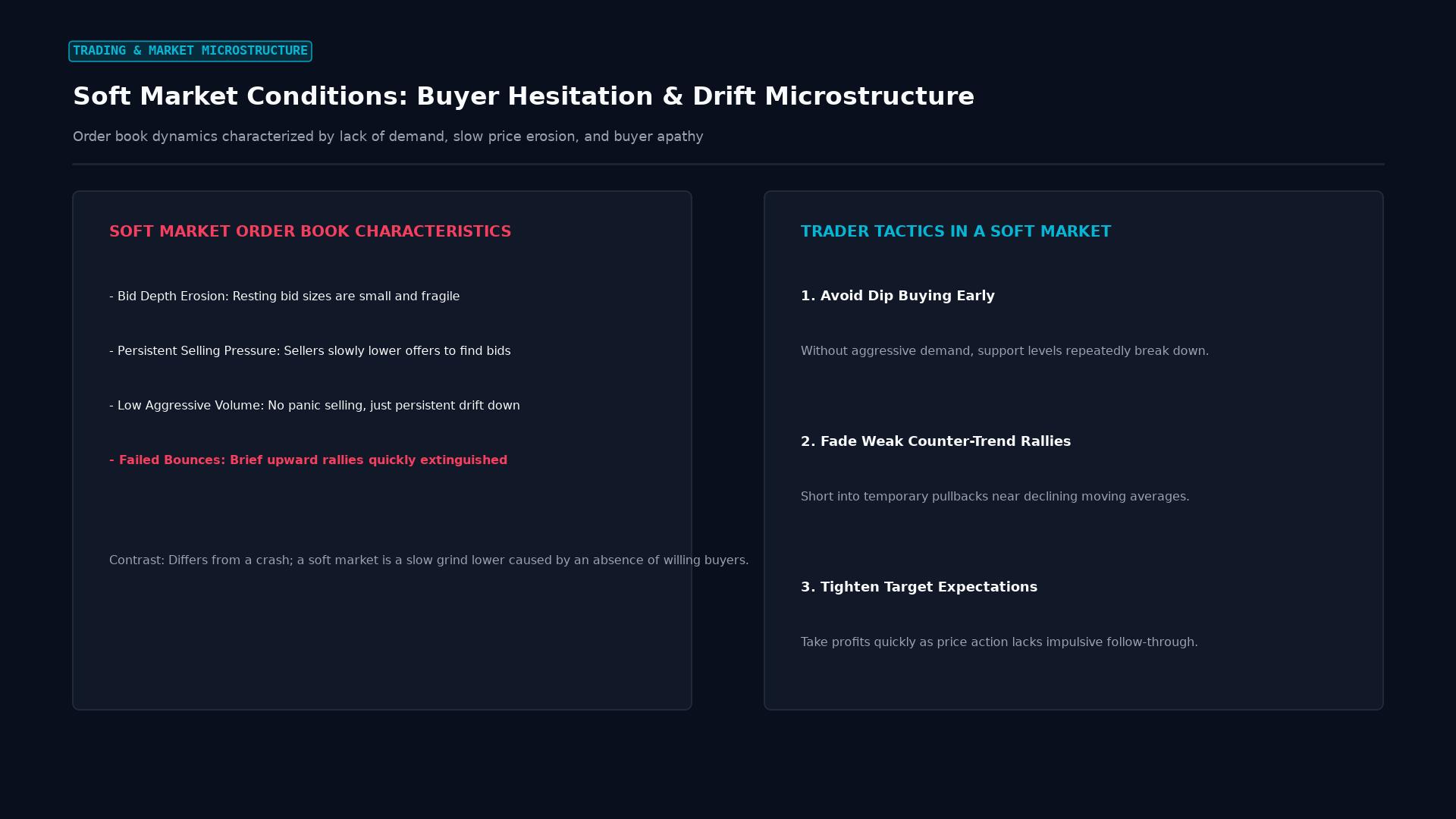 Figure: Order book dynamics of a soft market: bid depth erosion, persistent downward price drift, low volatility, and repeated bounce failures.
Soft Market vs. Hard Market vs. Bear Market
To accurately assess market regimes, analysts distinguish between softness, tightness (hardness), and outright secular bear trends:
| Dimension | Soft Market (Buyer’s Market) | Hard Market (Seller’s Market) | Bear Market |
|---|---|---|---|
| Supply vs. Demand | Supply exceeds demand (Surplus) | Demand exceeds supply (Deficit) | Structural liquidation and capital destruction |
| Pricing Power | Resides firmly with Buyers | Resides firmly with Sellers | Neutral; market governed by risk aversion |
| Price Behavior | Drifting downward; sluggish rallies | Surging upward; steep premiums | Downward momentum $>20%$ from peak |
| Volatility Profile | Low to moderate; lack of aggressive bidding | High to explosive; panic buying | Elevated volatility; sharp counter-trend squeezes |
| Institutional Activity | Distribution or wait-and-see posture | Aggressive accumulation | Systematic deleveraging and margin liquidations |
Order Flow Dynamics in a Soft Currency Market
In foreign exchange trading, identifying a soft market regime requires analyzing the interaction between market orders and the central limit order book:
- Failure of Breakout Rallies: In a soft market, upside momentum bursts lack institutional follow-through. When price advances into overhead liquidity pools, large institutional sellers immediately step in to dump inventory, capping rallies and creating long upper candlestick wicks.
- Effort vs. Result Divergence (Volume Spread Analysis): High trading volume on an up-candle that yields only a fractional price advance signals that heavy institutional supply is absorbing retail buying (absorption), confirming the continuation of the soft market.
- Passive Bid Sweeps: Sellers are impatient and execute aggressive market sell orders, rapidly chewing through thin resting limit bids and establishing a persistent sequence of lower swing highs and lower swing lows.
Real-World Institutional Case Study: The 2014–2016 Global Crude Oil Soft Market
Between mid-2014 and early 2016, global energy and currency markets experienced one of the most severe soft market transitions in modern history:
       BRENT CRUDE OIL SOFT MARKET COLLAPSE (2014–2016)

 $115 ──┐ (June 2014 Peak - Balanced Market)
        │\
  $90 ──┼─\  [ US Shale Boom Floods Global Supply ]
        │  \
  $70 ──┼───\___ [ OPEC Refuses Production Cuts in Nov 2014 ]
        │       \
  $50 ──┼────────\___ Persistent Inventory Overhang: Buyers Vanish
        │            \
  $28 ──┼─────────────\___ Soft Market Trough (January 2016)
└─────────────────────────────────────────────────────- The Supply Glut: Technological innovations in horizontal drilling and hydraulic fracturing unlocked massive U.S. shale oil production, adding over 4 million barrels per day to global supply.
- The Structural Shift: In November 2014, Saudi Arabia and OPEC abandoned their historical role as swing producers, opting to maintain full production to defend market share.
- The Outcome: With storage hubs worldwide near maximum capacity, crude oil transformed into an extreme soft market. Prices plummeted from $115 to below $28 per barrel.
- Forex Transmission: Petrocurrencies (currencies whose economies depend on oil export revenues) entered devastating soft regimes. The Canadian Dollar (USD/CAD surged from 1.06 to 1.46), the Norwegian Krone, and the Russian Ruble suffered massive multi-year depreciations as export receipts collapsed.
Tactical Trading Strategies in a Soft Market
Navigating a soft market requires abandoning standard dip-buying rules and adopting disciplined trend-following defenses:
- Fade the Rallies (Sell the Rip): Rather than attempting to predict price bottoms, professional traders wait for weak, low-volume corrective bounces into moving average resistance (e.g., the 20-day or 50-day EMA) to initiate short positions.
- Tighten Profit Targets: Because soft markets often grind lower without vertical velocity, holding out for massive parabolic swings can result in open profits eroding during choppy consolidations. Scale out at prior swing lows.
- Avoid Counter-Trend Bottom Fishing: Novice traders frequently incur severe losses by attempting to buy “cheap” assets in a soft market. An asset that drops 50% can easily drop another 50% if the underlying structural supply imbalance remains unaddressed.
Frequently Asked Questions
What macroeconomic factors cause a currency to enter a soft market?
A currency enters a soft market primarily due to widening trade and current account deficits (imports exceeding exports), aggressive central bank monetary easing (lowering interest rates or expanding quantitative easing), economic stagnation, and political instability that drives foreign institutional capital away.
How does a soft market transition back into a hard market?
A soft market transitions into a hard market through supply destruction or a sudden demand shock. In commodities, low prices force high-cost producers into bankruptcy, curtailing supply. In currencies, central bank interest rate hikes or sovereign currency interventions absorb excess domestic liquidity, restoring balance to the market.
Is trading volume high or low in a typical soft market?
Trading volume in a soft market is typically below average. Because institutional buyers remain sidelined and retail sentiment is subdued, transactions are dominated by passive liquidation and low-momentum algorithmic drifting rather than vigorous two-way bidding.
Ready to trade forex?
Open a free demo account with a regulated broker. Practice with virtual funds before risking real money.