Bear Market
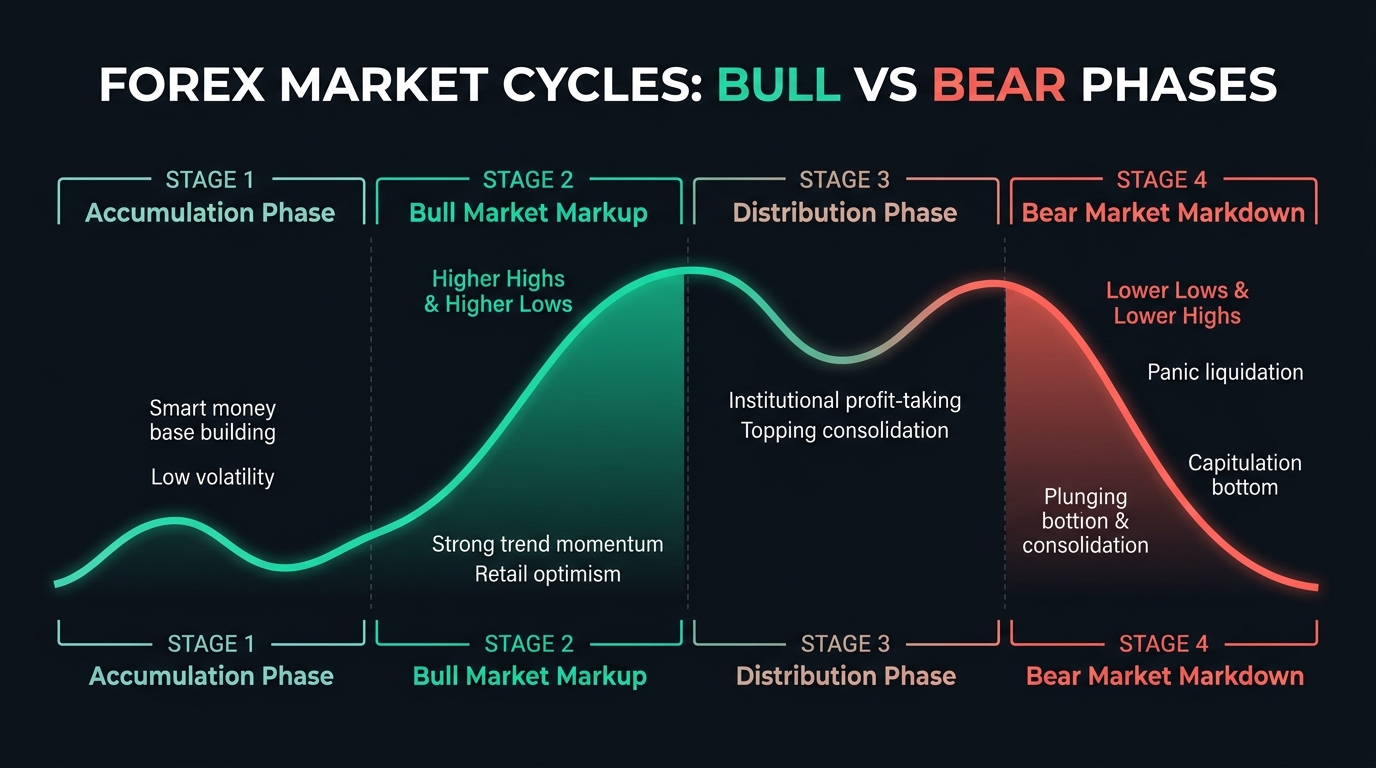
A bear market is a sustained period of declining prices in a financial market or a specific currency pair, typically defined as a decline of 20% or more from recent highs. In forex, the term is applied to specific currency pairs — a bearish USD/JPY market means the dollar has been consistently weakening against the yen over weeks or months, characterized by a pattern of lower highs and lower lows.
What Defines a Forex Bear Market
Unlike equity bear markets (where the 20% decline definition is more universally applied), forex bear markets are pair-specific and more loosely defined. A “bear market” in EUR/USD means the pair is in a sustained downtrend — the euro is consistently weakening against the dollar — but there’s no fixed percentage threshold.
The structural definition is more useful: a bear market in forex consists of a sustained pattern of lower highs and lower lows on the price chart. Each rally is less than the previous rally; each pullback breaks below the previous low. This structure, visible on daily or weekly charts, is the defining characteristic.
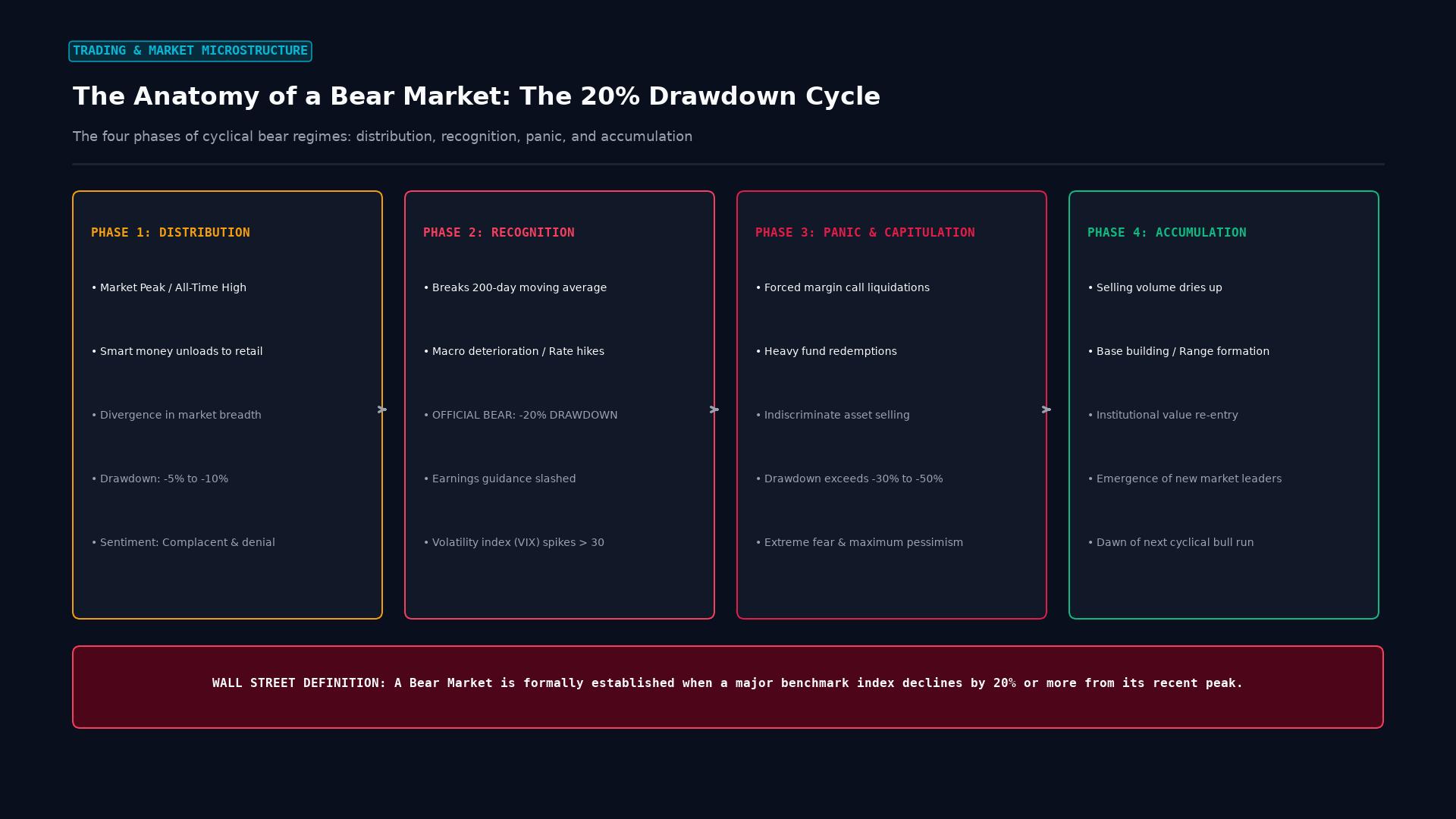 Figure: The four structural phases of cyclical bear markets: distribution, recognition (-20% drawdown breach), panic capitulation, and final accumulation base building.
Drivers of Forex Bear Markets
Every sustained bear market in a currency pair has identifiable fundamental catalysts:
Interest rate divergence: The most powerful driver. When one central bank is raising rates while another is holding or cutting, capital flows toward the higher-yield currency — creating a sustained bear market in the lower-yield currency. The euro’s bear market against the dollar in 2021-2022 was primarily driven by the Fed hiking aggressively while the ECB lagged significantly.
Economic deterioration: Rising unemployment, contracting GDP, declining PMI surveys, and weakening consumer confidence all signal an economy that cannot support current interest rate levels — creating expectations for cuts that weaken the currency.
Political and geopolitical risk: Elections with uncertain outcomes, fiscal crises, geopolitical conflicts, and sanctions can trigger sustained currency bear markets. The Russian ruble’s collapse following the 2022 invasion of Ukraine and subsequent sanctions is an extreme example.
Commodity price declines: For commodity-linked currencies (AUD for iron ore and coal; CAD for oil; NOK for oil), sustained commodity price declines create fundamental headwinds — export revenues fall, growth slows, and rate cut expectations increase.
Trading Bear Markets: Short-Selling Strategies
The bear market trader’s priority: sell into rallies rather than chase price lower.
The technical approach:
- Confirm the downtrend structure: lower highs, lower lows on daily chart
- Wait for a relief rally — price bouncing against the downtrend
- Identify resistance: previous swing low (now resistance after being broken), declining trend line, falling 20 EMA
- Enter short when the rally stalls and shows a bearish reversal signal (shooting star, bearish engulfing)
- Stop above the recent swing high; target the next support level below
This approach — selling strength in a downtrend — provides better entries than chasing price at new lows.
Bear Market Sentiment and COT Data
The Commitment of Traders (COT) report, published weekly by the CFTC, shows futures market positioning. During a sustained bear market in a currency:
- Large speculators typically hold growing net-short positions
- When net short positioning reaches historic extremes, contrarian reversal risk increases
- A reduction in net shorts (short-covering) while price is still declining is an early warning sign of a potential bear market bottom
The Bear Market Bottom
Identifying the end of a bear market is notoriously difficult. Useful signals:
- RSI divergence: Price makes a new low but RSI makes a higher low — momentum is improving even as price drops
- Declining volume on new lows: Sellers are running out of conviction
- Failure to break below prior lows: The downtrend structure breaks — a lower low fails to materialize
- Central bank pivot: The hawkish currency switches tone, removing the primary fundamental driver
No single signal is sufficient. A combination of technical exhaustion, fundamental catalyst shift, and positioning data provides the highest-confidence reversal signal.
Key Takeaways
- Bear market: sustained pattern of lower highs and lower lows — no fixed percentage definition in forex
- Primary drivers: interest rate divergence, economic deterioration, political risk, commodity declines
- Trading strategy: sell into rallies at resistance — better than chasing new lows
- COT extreme short positioning signals increased reversal risk (contrarian warning)
- Bottom signals: RSI divergence, declining volume on new lows, failed break below prior lows, fundamental catalyst shift
FAQ
How long do forex bear markets typically last? It varies enormously. The dollar bear market of 2001-2008 lasted seven years. The euro’s bear market against the dollar in 2021-2022 lasted about 18 months. Short-term “bear markets” on lower timeframes (weeks of sustained weakness) can last days to weeks. The duration depends primarily on how persistent the fundamental drivers (interest rate differentials, growth divergence) remain.
Should I only take short trades during a bear market? The highest-probability trades in a bear market are short — selling into rallies. But significant counter-trend bounces (20-100+ pips in major pairs) occur regularly within any downtrend and can be traded on lower timeframes. The key: recognize whether you’re trading the primary trend or a counter-trend bounce, and size accordingly.
Ready to trade forex?
Open a free demo account with a regulated broker. Practice with virtual funds before risking real money.