SOS
SOS (Somali Shilling) is the official currency of the Federal Republic of Somalia, subdivided into 100 senti and regulated by the Central Bank of Somalia (CBS).
What is the Somali Shilling (SOS)?
The Somali Shilling (ISO code: SOS, Somali: shilin soomaali, symbol: Sh.So.) is the de jure sovereign currency of the Federal Republic of Somalia. Historically subdivided into 100 senti (cents), the currency is legally regulated by the Central Bank of Somalia (CBS) (Bankiga Dhexe ee Soomaaliya).
In global monetary economics, the Somali Shilling occupies a unique place: it survived for more than three decades without a functional central government or official central bank currency issuance.
Following the collapse of the central state in 1991, the Central Bank of Somalia ceased operations and did not print a single legal banknote for over thirty years.
Despite the complete absence of institutional backing, legal tender enforcement, or foreign exchange reserves, pre-1991 1,000-shilling paper notes, alongside billions of unauthorized notes printed by regional factions and commercial cartels, continued to circulate across clan lines as a market-driven medium of exchange.
In modern commerce, the Somali economy operates under extensive de facto dollarization and has become one of the most cashless societies in the world, dominated by US-dollar-denominated mobile money networks.
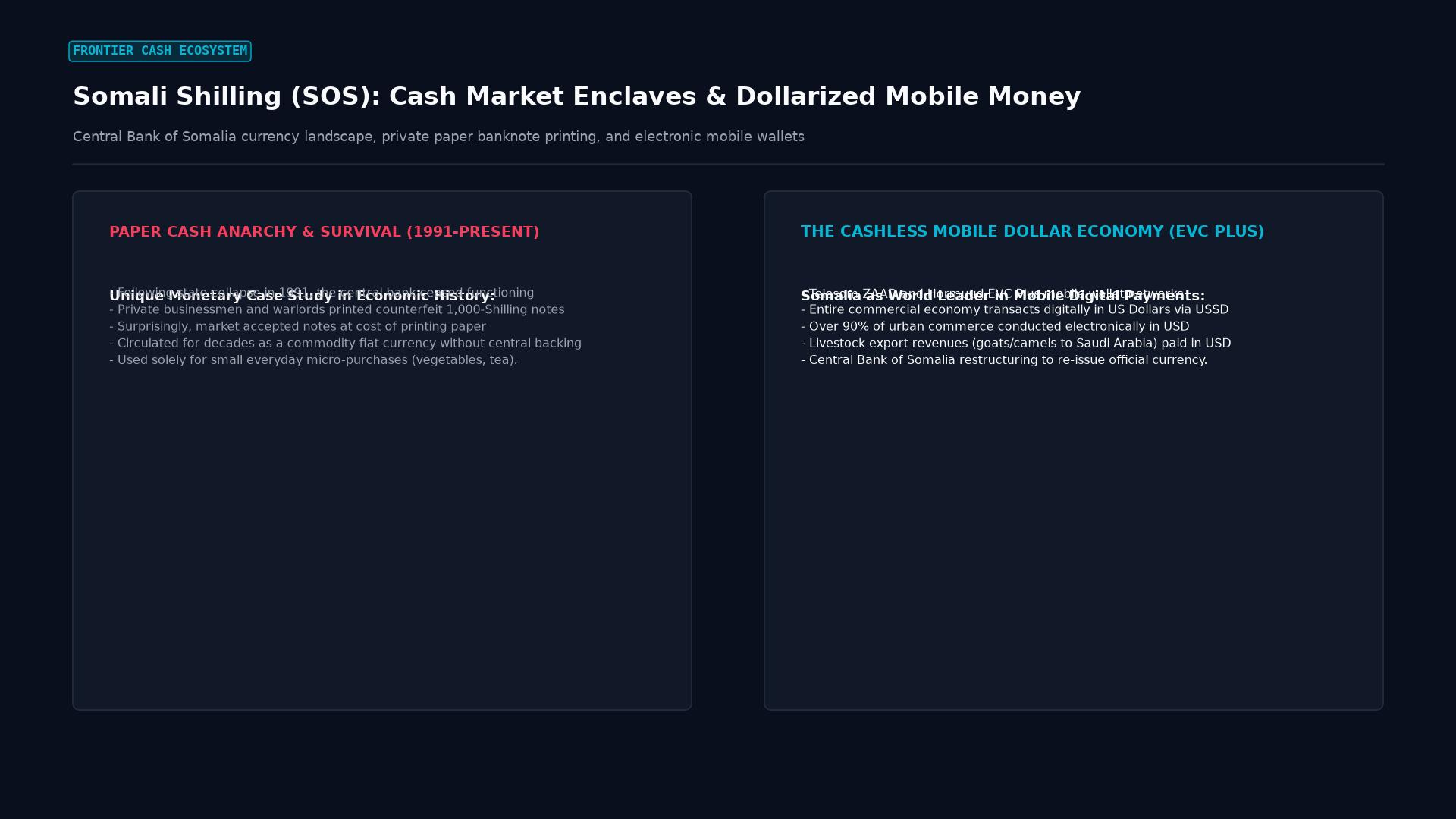 Figure: Central Bank of Somalia currency landscape, private paper banknote printing, and electronic mobile wallets
Historical Context: From Post-Colonial Unification to State Collapse
The monetary evolution of Somalia reflects the unification of two distinct colonial administrations followed by three decades of civil conflict and institutional rebuilding.
Unification and Creation of the Shilling (1960 to 1962)
In July 1960, the British Somaliland protectorate and the Italian-administered Trust Territory of Somaliland united to form the independent Somali Republic:
- The northern British region used the East African Shilling, while the southern Italian region used the Somalo (administered by the Cassa per la Circolazione Monetaria della Somalia).
- On July 1, 1960, the National Bank of Somalia was established. In December 1962, the government enacted currency unification, issuing the Somali Shilling (SOS) at par with the East African Shilling and at an exchange rate of $1\text{ Somalo} = 1\text{ Somali Shilling}$.
1950-1960: Dual Colonial Regimes
British Somaliland (East African Shilling) & Italian Somaliland (Somalo)
                      │
                      ▼
July 1960: Unification and Creation of the Central Bank
National Bank of Somalia founded to unify monetary systems
                      │
                      ▼
1962-1980s: Sovereign Somali Shilling Era
Socialist nationalization under Siad Barre; state-planned credit;
1989 Introduction of 1,000 Shilling Banknote (De La Rue)
                      │
                      ▼
January 1991: Collapse of the Central State
Siad Barre ousted; civil war begins;
Central Bank of Somalia looted and ceases operations
                      │
                      ▼
1991-2015: The "Stateless Currency" Phenomenon
Warlords and business cartels print unauthorized 1,000 Sh.So. notes;
Paper notes trade at marginal printing cost against the US Dollar
                      │
                      ▼
2010s-Present: Mobile Money Revolution & Institutional Rebirth
Widespread adoption of US Dollar mobile wallets (EVC Plus);
CBS restored under IMF HIPC Initiative debt relief program
The Stateless Currency Phenomenon (1991 to 2015)
The survival of the Somali Shilling after 1991 is considered by monetary economists (including Milton Friedman and Peter Leeson) as a historic real-world case study in spontaneous monetary order and market-clearing fiat.
The Unauthorized Banknotes
When the government collapsed in January 1991, commercial banks shuttered and official reserve backing disappeared.
Between 1992 and 2001, various warlords, interim regional administrations (such as in Puntland), and business consortiums contracted foreign security printers (in Canada, the United Kingdom, and Indonesia) to print billions of counterfeit and unauthorized 1,000-shilling banknotes:
- The “North” Notes (N-notes): Ordered by interim administration officials.
- The “Balweyn” Notes (B-notes): Ordered by southern warlords.
- These notes replicated the designs of the original 1989 De La Rue 1,000-shilling note.
       Warlords & Merchants Contract Foreign Commercial Printers
                                │
                                ▼
       Cargo Aircraft Deliver Billions of Unauthorized 1,000 Sh.So. Notes
                                │
                                ▼
       Traders Inject Notes into Mogadishu & Regional Livestock Markets
                                │
                                ▼
       Market Participants Cannot Distinguish Real from Fake
       Both Notes Circulate Intertwined at Equal Face Value
                                │
                                ▼
       Excess Printing Drives Exchange Rate Down to Marginal Printing Cost
       (Stabilizes at ~25,000 to 30,000 SOS per 1 USD)
Market Clearing at Marginal Cost
In traditional fiat currency systems, over-printing results in hyperinflation and currency death. In Somalia, an extraordinary economic ceiling emerged:
- When printing cartels imported too many notes, the exchange rate against the US dollar depreciated.
- The exchange rate fell until the purchasing power of a 1,000-shilling note roughly matched the marginal cost of printing, shipping, and handling paper money (approximately 2.5 to 4 US cents per note).
- If the exchange rate fell further, printing new notes became unprofitable for warlords, halting unauthorized printing.
- Because the market needed small-denomination cash to buy camel milk, vegetables, and tea, the 1,000-shilling note stabilized as a form of commodity money, trading in wholesale markets at roughly 25,000 to 30,000 SOS per 1 USD.
The Somaliland Divergence: The Somaliland Shilling (SLSH)
In May 1991, the northwestern territory declared independence as the Republic of Somaliland (internationally unrecognized).
To assert sovereign autonomy and rid its economy of hyperinflated Mogadishu paper, the regional government established the Bank of Somaliland (Baanka Somaliland) in 1994 and issued its own independent currency: the Somaliland Shilling (SLSH).
+------------------------------------------------------------------------------------+
|                         SOMALIA VS. SOMALILAND CURRENCY DUALITY                    |
+---------------------+-------------------------------+------------------------------+
| ATTRIBUTE           | SOMALIA (FEDERAL SOUTHERN)    | SOMALILAND (NORTHWESTERN)    |
+---------------------+-------------------------------+------------------------------+
| Official Currency   | Somali Shilling (SOS)         | Somaliland Shilling (SLSH)   |
| Administrative Body | Central Bank of Somalia (CBS) | Bank of Somaliland (Hargeisa)|
| Dominant Denominat. | 1,000 Sh.So. (Paper)          | 100, 500, 1000, 5000 SLSH    |
| Circulation Area    | Mogadishu, Puntland, Jubaland | Hargeisa, Berbera, Burao     |
| Acceptance of SOS   | Universal (Small retail cash) | Strictly prohibited in north |
+---------------------+-------------------------------+------------------------------+
In Somaliland, the Somali Shilling was withdrawn and demonetized. Today, transactions in Hargeisa are conducted in Somaliland Shillings, US Dollars, and mobile money systems (such as Telesom’s Zaad service).
The Mobile Money Revolution and De Facto Dollarization
By the late 2000s, physical Somali Shilling notes had deteriorated: surviving 1,000-shilling notes were worn, torn, and taped together, and counting large paper bricks for ordinary retail purchases became inefficient.
Rather than waiting for state reconstruction, Somalia became a pioneer in digital finance: the country transitioned directly into a mobile money society.
+------------------------------------------------------------------------------------+
|                         SOMALIA MOBILE WALLET ECOSYSTEM                            |
+-------------------+----------------------------------------------------------------+
| PLATFORM          | OPERATOR & FINANCIAL MECHANICS                                 |
+-------------------+----------------------------------------------------------------+
| EVC Plus          | Hormuud Telecom: Dominates southern and central Somalia. Free  |
|                   | USSD mobile transfers denominated in US dollars ($0.01 to $300)|
+-------------------+----------------------------------------------------------------+
| Zaad Service      | Telesom: Primary mobile payment platform across Somaliland,    |
|                   | integrated into local commerce, payrolls, and retail billing.  |
+-------------------+----------------------------------------------------------------+
| Sahal             | Golis Telecom: Operates across the northeastern Puntland State.|
+-------------------+----------------------------------------------------------------+
How the Dual-Currency Mobile System Operates
Today, more than 80% of urban Somalis use mobile money daily:
- US Dollar Denomination: Mobile money accounts (such as EVC Plus) are denominated in US dollars. A buyer purchasing groceries for $2.45 sends the payment instantly via a phone keypad (USSD code) to the merchant’s mobile ID.
- Physical Cash Marginalization: The physical Somali Shilling is used almost exclusively for micro-transactions below $1.00 USD in rural open-air markets, or in transactions involving elderly and rural pastoralists who lack cellular devices.
- Extreme Efficiency: The absence of transaction fees on basic peer-to-peer transfers has made digital money more ubiquitous in Somalia than in many advanced Western economies.
Macroeconomic Drivers: Diaspora Remittances (Hawala) and Livestock
Somalia’s external financial balance is supported by two massive cash inflow engines:
       Global Somali Diaspora (US, UK, UAE, Sweden, Kenya)
                               │
                               ▼
       Remittances via Hawala System (Dahabshiil, Taaj, Amal)
                               │
                               ▼
       $1.5 Billion to $2.0 Billion USD Annual Cash Inflows
       (Represents ~30% to 35% of National GDP)
                               │
                               ▼
       Directly Funds Household Consumption & Port Imports
1. The Hawala Financial Network
Because formal global banks severed correspondent banking ties with Somalia due to anti-money laundering (AML) and anti-terrorist financing (CFT) concerns, the nation relies on Hawala networks (licensed money transfer operators like Dahabshiil).
The global diaspora transmits between $1.5 billion and $2.0 billion USD annually into Somalia, far outstripping foreign humanitarian aid and providing the hard currency liquidity that stabilizes the country’s dollarized economy.
2. Livestock Exports
Somalia’s primary physical export is livestock: live sheep, goats, camels, and cattle shipped across the Gulf of Aden to Saudi Arabia, Oman, and the UAE, peaking during the annual Islamic Hajj pilgrimage.
Live animal exports generate foreign exchange earnings that fund essential food imports, such as wheat, sugar, pasta, and fuel.
Central Bank Modernization and Currency Reform
Following the formal recognition of the Federal Government of Somalia, the Central Bank of Somalia (CBS) was reconstituted in Mogadishu.
+------------------------------------------------------------------------------------+
|                         CBS REBUILDING ROADMAP (2020-PRESENT)                      |
+-------------------+----------------------------------------------------------------+
| MILESTONE         | REFORM MEASURE & STRATEGIC OUTCOME                             |
+-------------------+----------------------------------------------------------------+
| IMF HIPC Debt     | Completed in December 2023: Wiped out over $4.5B in external   |
| Relief Completion | bilateral and multilateral sovereign debt, restoring relations.|
+-------------------+----------------------------------------------------------------+
| National Payment  | Launched in 2021: Provides real-time automated clearing between |
| System (NPS)      | domestic commercial banks for both USD and local currency.     |
+-------------------+----------------------------------------------------------------+
| National Currency | Supported by the IMF and World Bank: Project to design, print, |
| Exchange Project  | and issue official new legal tender banknotes to replace       |
|                   | surviving counterfeit paper and restore monetary sovereignty.  |
+-------------------+----------------------------------------------------------------+
Under its currency reform roadmap, the CBS plans to issue newly designed, official legal tender banknotes in small denominations. The reform aims to provide low-income citizens with reliable physical cash for daily purchases while curbing illicit counterfeit printing.
Key Takeaways
- Official Currency of Somalia: The Somali Shilling (SOS, symbol: Sh.So.) is overseen by the reconstituted Central Bank of Somalia (CBS).
- Stateless Survival: Following the 1991 collapse of the central government, the currency continued circulating without an operating central bank, with unauthorized and counterfeit notes trading at their marginal cost of printing.
- De Facto Dollarization: The United States Dollar functions as the primary unit of account, store of value, and medium of commercial pricing across Somalia.
- Mobile Money Pioneer: Over 80% of domestic commerce is settled electronically via cellular USSD mobile money platforms (such as Hormuud’s EVC Plus), bypassing physical cash.
- Autonomous Somaliland Currency: The self-declared Republic of Somaliland established its own currency, the Somaliland Shilling (SLSH), banning the Somali Shilling in the northwest.
- Remittance Lifeline: Hawala money transfer operators (such as Dahabshiil) transfer up to $2.0 billion annually from the diaspora, underpinning the national balance of payments.
Frequently Asked Questions (FAQ)
How did the Somali Shilling retain value for thirty years without a government or central bank?
The Somali Shilling retained value because market participants needed a commonly accepted medium of exchange for small daily transactions. When warlords and private business cartels printed unauthorized 1,000-shilling banknotes, the supply expanded until the value of a note equaled the physical cost of importing paper, ink, and security printing. At that price floor (roughly 2.5 to 4 US cents per note, or ~25,000 to 30,000 shillings per dollar), the currency functioned as a stable commodity money that merchants and consumers across clan divisions continued to honor.
Can travelers use credit cards or international ATMs in Somalia?
International credit cards (such as Visa and Mastercard) have limited acceptance in Somalia, primarily restricted to upscale international hotels, airline ticket offices, and select commercial bank branches in Mogadishu and Hargeisa. The domestic economy relies on mobile money and US dollar cash. Travelers typically bring pristine, unblemished US dollar banknotes (preferably newly issued series) and exchange them locally or deposit them into a local mobile money wallet (like EVC Plus) for everyday payments.
What is the Somaliland Shilling, and how is it different from the Somali Shilling?
The Somaliland Shilling (SLSH) is the separate currency issued by the self-declared Republic of Somaliland, which broke away from Somalia in 1991. Introduced in 1994 by the Bank of Somaliland in Hargeisa, the Somaliland Shilling completely replaced the Somali Shilling across northwestern cities (such as Hargeisa, Berbera, and Burao). It is issued in banknotes of 100, 500, 1,000, and 5,000 shillings and operates alongside the US dollar and mobile digital payment services.
Ready to trade forex?
Open a free demo account with a regulated broker. Practice with virtual funds before risking real money.