Closed Position
A closed position refers to a completed financial trade where an investor or trader has executed an equal and opposite transaction, completely eliminating market exposure in an asset. Closing a trade crystallizes floating unrealized profit or loss into permanent, realized cash in the account balance.
What Is a Closed Position?
In financial trading, every trade exists in one of two states: open or closed. A closed position represents the final, completed stage of a trading transaction where an investor has exited the market and holds zero remaining financial exposure, risk, or ownership in that specific instrument.
To close an active open position, a trader must execute an offsetting trade of identical contract volume in the exact opposite direction:
- If a trader originally opened a Long (Buy) position of 1 Standard Lot in GBP/USD, they close the position by selling 1 Standard Lot of GBP/USD.
- If a trader originally opened a Short (Sell) position of 1 Standard Lot in USD/JPY, they close the position by buying back 1 Standard Lot of USD/JPY.
Once the closing order fills, the trade terminates. The broker’s trading engine unfreezes the margin previously locked to maintain the trade, and the floating unrealized profit or loss (P&L) is permanently crystallized into the account’s realized cash balance.
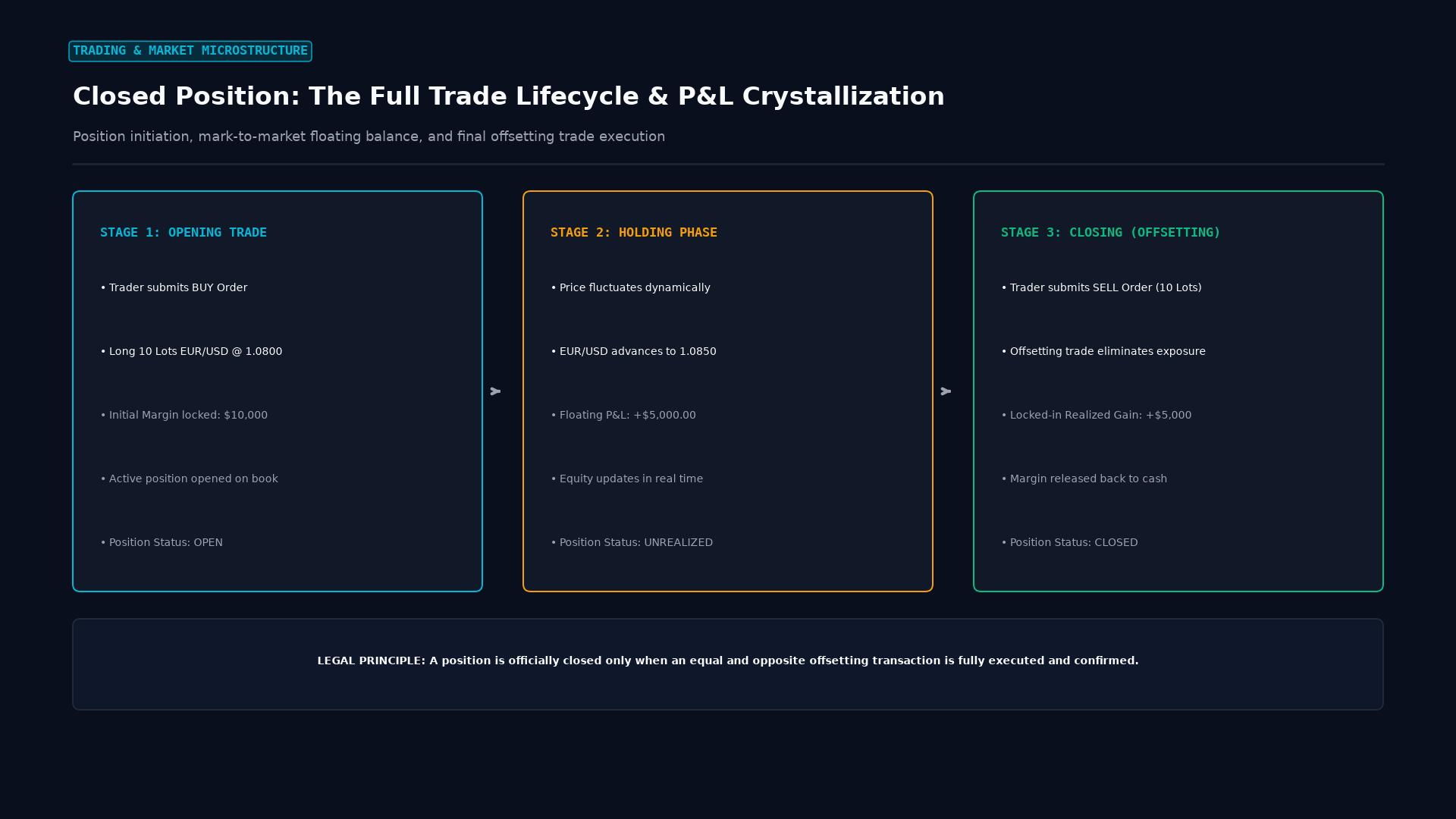 Figure: The three stages of trade positioning: initial opening order, floating mark-to-market holding period, and final offsetting execution that crystalizes realized P&L and releases margin.
The Three Stages of a Trade’s Life Cycle
Understanding the distinction between an open position and a closed position requires examining the three stages of trade execution:
1. Position Entry (Opening the Trade)
The trader submits an order (either via a live market order or a pending limit/stop order). The moment the order executes against an available bid or ask quote:
- The trade enters the market.
- The broker deducts Used Margin from the account’s collateral pool to secure the trade.
- The Account Balance remains completely unchanged, but the position begins floating in real time.
2. The Open Position (Floating P&L)
While the position is live, its market value fluctuates with every interbank price tick.
- The trader experiences unrealized profit or loss (frequently termed “paper profit” or “floating P&L”).
- The account’s Equity ($\text{Balance} \pm \text{Floating P&L}$) and Free Margin adjust dynamically.
- However, paper gains can vanish in a split second if market sentiment shifts; unrealized profit does not belong to the trader until the position is officially closed.
3. The Closed Position (Realized P&L)
When the closing order executes:
- Market exposure drops to zero.
- The locked margin is instantly released back into Free Margin.
- The net profit or loss—adjusted for broker execution commissions and accumulated overnight rollover swap charges—is permanently credited to or deducted from the Cash Balance.
Standard Methods for Closing a Position
Traders close market positions through several distinct execution mechanisms:
1. Manual Market Close
The trader clicks the “Close” button directly within their trading terminal (such as MetaTrader, cTrader, or TradingView). The platform immediately fires a market order in the opposing direction, matching against the current top of the broker’s order book.
2. Take-Profit Order (TP)
A pre-set limit order positioned at a favorable target price ahead of time. When the market advances and reaches the take-profit coordinate, the closing order automatically executes, locking in planned gains without requiring the trader to be seated at their computer.
3. Stop-Loss Order (SL)
A pre-set defensive stop order placed at an acceptable maximum pain threshold. If the market moves adversely and strikes the stop-loss level, the order triggers instantly, closing the position to prevent catastrophic capital depletion.
4. Trailing Stop
An automated dynamic order that follows a profitable trade upward at a specified pip distance. If the market continues trending favorably, the trailing stop ratchets higher; if the market reverses, the trailing stop remains stationary and closes the position when touched, preserving accumulated gains.
5. Partial Close (Scaling Out)
Professional risk management frequently involves closing a position in stages rather than all at once. For example, a trader who opens a 2-lot position might close 1 lot upon reaching a 50-pip technical target to lock in profit, while leaving the remaining 1 lot open with a stop-loss adjusted to breakeven to capture potential long-term trend continuation.
6. Automated Broker Liquidation (Stop-Out)
If a trader fails to manage risk and floating losses deplete account equity below the broker’s minimum margin threshold (e.g., 50% Margin Level), the broker’s risk management engine forcefully closes the trader’s open positions at prevailing market prices to prevent a negative account balance.
Practical Account Example: Open vs. Closed Position
Consider a trader with an account balance of $5,000.00 trading EUR/USD:
- Entry: The trader opens a Long position of 1 Standard Lot (100,000 EUR) at 1.0800.
- Margin required (at 1:100 leverage): $1,080.00
- Cash Balance: $5,000.00 (unchanged)
- Equity: $5,000.00
- During the Trade (Open State):
- EUR/USD rallies 80 pips to 1.0880.
- Floating Unrealized Profit: $10.00/\text{pip} \times 80\text{ pips} = +$800.00$
- Cash Balance: still $5,000.00
- Equity: $$5,000.00 + $800.00 = $5,800.00$
- If EUR/USD suddenly crashes back to 1.0800, that $800 gain completely disappears.
- Closing the Trade (Closed State):
- The trader decides to exit and clicks “Close Position.”
- The broker executes an offsetting market sell order of 100,000 EUR at the bid price of 1.0880.
- The $1,080.00 used margin is unlocked.
- The +$800.00 profit is permanently realized (deducting a $6.00 round-turn commission, yielding net +$794.00).
- New Cash Balance: $$5,000.00 + $794.00 = $5,794.00$
- New Equity: $5,794.00 (now 100% in cash, with zero market exposure).
Key Takeaways
- A closed position is a completed transaction with zero remaining market risk, achieved by executing an equal and opposite trade.
- Buying is closed by selling; selling is closed by buying back.
- Closing a trade converts floating unrealized profit/loss into permanent cash balance adjustments.
- Positions can be closed manually, via automated Take-Profit or Stop-Loss orders, or through broker stop-out liquidations.
- Partial closing allows traders to bank profits while keeping a runner active for extended trend gains.
FAQ
Can I close only part of my trade? Yes. Modern trading platforms support partial closes. If you hold a 1.00 lot position, you can manually enter 0.50 lots in the volume box when clicking “Close,” leaving the remaining 0.50 lots active in the market.
What is the difference between realized and unrealized profit? Unrealized profit (floating P&L) is paper profit from an active open position that changes continuously with market movements. Realized profit is permanent cash added to your balance once the position is officially closed.
Does closing a trade incur extra fees? If your broker operates an ECN model with per-side commissions, you will pay the second half of your commission upon closing. Additionally, you always cross the bid-ask spread: long positions close at the bid, and short positions close at the ask.
Ready to trade forex?
Open a free demo account with a regulated broker. Practice with virtual funds before risking real money.