Sub-account
A secondary, segregated trading or banking account nested underneath an umbrella master account, utilized to partition capital, isolate distinct algorithmic or discretionary strategies, or allocate trades across managed client portfolios.
What Is a Sub-Account?
A sub-account is an auxiliary account created under the administrative umbrella of a primary master account at a financial brokerage, commercial bank, or investment platform. While legal ownership, identity verification (KYC), and tax reporting remain centralized under the master account, each sub-account functions as an independent, self-contained financial ledger.
In institutional asset management and modern retail trading, sub-accounts serve as essential operational firewalls. By dividing capital across multiple sub-accounts, portfolio managers and individual traders can run distinct trading strategies with separate equity balances, margin calculations, and performance metrics, ensuring that a drawdown or margin liquidation in one high-risk strategy does not contaminate or jeopardize the capital allocated to other portfolios.
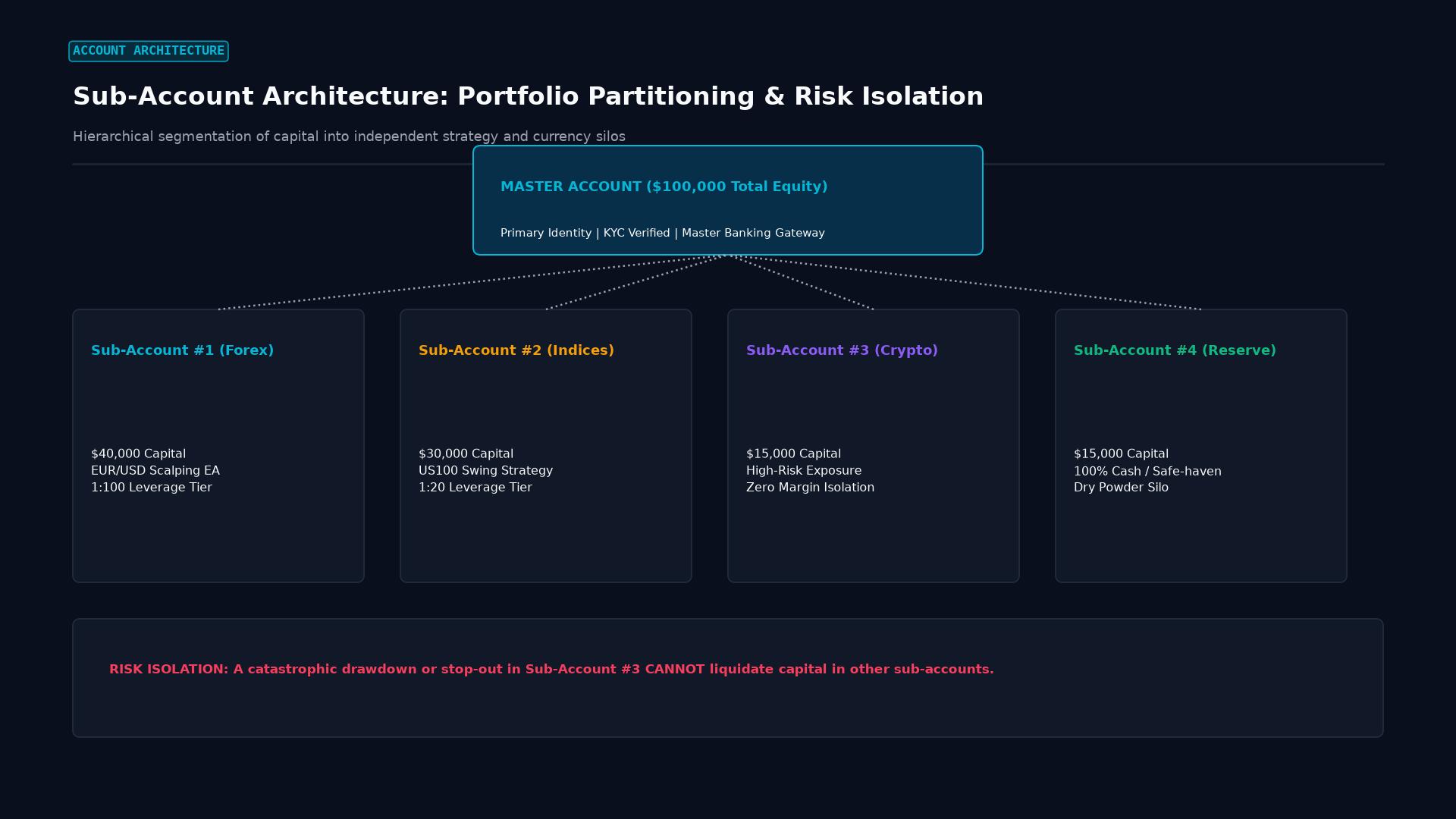 Figure: Hierarchical account design: master capital pool partitioned into isolated strategy silos to prevent cross-account margin contagion.
Primary Use Cases for Sub-Accounts
Both retail participants and institutional firms deploy sub-account architecture across four core operational workflows:
1. Strategy and Risk Isolation (Firewalling)
Running multiple strategies within a single pooled account creates severe systemic risk. If a high-frequency grid-trading algorithm experiences a malfunction and accumulates catastrophic unrealized losses, the broker’s risk engine will automatically liquidate all positions across the account—including unrelated, profitable long-term swing trades. Segregating strategies into dedicated sub-accounts guarantees that margin calls are strictly isolated to the failing sub-account.
2. Multi-Currency Ledger Management
Global traders frequently open sub-accounts denominated in different base currencies (e.g., Sub-Account 1 in USD, Sub-Account 2 in EUR, Sub-Account 3 in GBP). This structure allows a trader to trade European assets directly from a Euro ledger, eliminating the repetitive foreign exchange conversion fees and spread drag incurred when funding trades from a foreign-currency master account.
3. Professional Money Management (PAMM & MAM Systems)
Registered investment advisers and asset managers utilize Percentage Allocation Management Module (PAMM) or Multi-Account Manager (MAM) software. The fund manager executes a single master block trade (e.g., 50 lots), and the institutional broker’s server automatically distributes proportional allocations into hundreds of individual investor sub-accounts based on their respective equity balances.
4. API and Algorithmic Permissioning
In proprietary trading firms and quantitative hedge funds, risk officers issue restricted API keys to external quantitative developers. The API key is permissioned to trade only within a specific sub-account with strictly capped capital, preventing rogue algorithms from accessing the firm’s core reserves.
Sub-Account vs. Master Account vs. Omnibus Account
| Account Model | Structural Definition | Legal Ownership | Margin Isolation | Typical Users |
|---|---|---|---|---|
| Sub-Account | Dependent secondary account partitioned under a master ledger | Owned by master account holder or managed client | Yes (Margin calculated independently) | Active traders, managed fund clients, algorithmic desks |
| Master Account | The primary umbrella account holding the legal relationship with the broker | Primary individual, corporate entity, or fund | Centralized funding repository | Account owners, institutional fund managers |
| Omnibus Account | A single consolidated account holding pooled funds of multiple undisclosed clients | Registered to a broker or clearing firm | No (Margin pooled multilaterally) | Introducing brokers (IBs), correspondent banks |
Real-World Institutional Case Study: PAMM Allocation in Commodity Trading Advisories (CTAs)
In institutional foreign exchange asset management, professional fund managers leverage sub-account allocation engines to manage hundreds of external client accounts simultaneously:
       PAMM SUB-ACCOUNT TRADE ALLOCATION FLOW

 Fund Manager executes 10.00 Standard Lots EUR/USD on Master Console.
 ─────────────────────────────────────────────────────────────────────────────
 Total Pooled Equity: $1,000,000 across 3 Sub-Accounts

 Sub-Account 1 (Corporate Client):
 - Equity: $500,000 (50% of Pool)  ──► Automatically allocated 5.00 Lots

 Sub-Account 2 (Family Office):
 - Equity: $300,000 (30% of Pool)  ──► Automatically allocated 3.00 Lots

 Sub-Account 3 (High-Net-Worth Individual):
 - Equity: $200,000 (20% of Pool)  ──► Automatically allocated 2.00 Lots
 ─────────────────────────────────────────────────────────────────────────────
 Outcome: Instantaneous, zero-latency execution across all sub-accounts with
          identical fill prices and automated performance-fee watermarking.
By leveraging sub-account allocation, the asset manager eliminates the regulatory and operational nightmare of manually placing dozens of separate trades into individual client accounts.
Operational Mechanics: Internal Capital Transfers
In modern electronic brokerage platforms (such as Interactive Brokers or Tier-1 multi-asset brokerages), managing capital between sub-accounts provides distinct operational advantages:
- Instantaneous Internal Sweeps: Transferring capital between sub-accounts occurs instantly via internal software database adjustments, bypassing external banking networks (SWIFT, Fedwire, SEPA) and incurring zero transaction fees.
- Dynamic Capital Rebalancing: If a quantitative momentum sub-account experiences a profitable surge, the trader can immediately sweep realized profits into a conservative cash-reserve sub-account to lock in gains.
- Independent Performance Attribution: Detailed monthly performance reporting, Sharpe ratios, maximum drawdowns, and trade expectancy are calculated separately for each sub-account, enabling rigorous quantitative performance attribution.
Frequently Asked Questions
Does each sub-account have a separate login?
Most modern brokerages allow the master account owner to configure custom access rules. The master owner can access all sub-accounts through a single unified dashboard, while external traders, junior portfolio managers, or managed clients can be granted restricted credentials that permit them to view or trade only their designated sub-account.
Are sub-accounts protected separately by regulatory insolvency insurance (e.g., SIPC)?
Generally, no. Under regulatory bodies like the U.S. SIPC or the UK FSCS, coverage limits apply per legal customer, not per sub-account. If an individual holds three sub-accounts under one master registration, the $500,000 SIPC protection limit applies to the combined aggregate equity of all accounts, not $500,000 per sub-account.
Can a margin call on one sub-account cause the broker to seize funds from another sub-account?
Under standard isolated margin rules, a margin call or stop-out event in one sub-account will liquidate positions only within that specific sub-account. However, the legal terms of the master brokerage agreement typically grant the broker a general lien: if a catastrophic deficit occurs in one sub-account (negative equity), the brokerage retains the contractual right to sweep funds from other sub-accounts under the same master umbrella to cover the debt.
Ready to trade forex?
Open a free demo account with a regulated broker. Practice with virtual funds before risking real money.