Omnibus Account
An omnibus account is an umbrella custodial and clearing account established by a broker, futures commission merchant, or financial intermediary with an upstream clearinghouse or custodian, pooling the transactions and collateral of multiple individual clients under the intermediary's single legal name while maintaining detailed sub-ledgers internally.
What Is an Omnibus Account?
In securities clearing, futures settlement, and international foreign exchange, an omnibus account is a master trading and custody account opened by a financial intermediary (such as an executing broker, introducing broker, or asset management platform) with a clearing broker, Futures Commission Merchant (FCM), or central clearinghouse.
Under the omnibus structure:
- Upstream Visibility: The upstream clearing firm sees only the single omnibus account registered in the intermediary’s corporate name. The clearing broker does not know the individual identities, positions, or trade histories of the intermediary’s underlying clients.
- Downstream Accounting: The originating intermediary maintains private internal bookkeeping records (sub-ledgers) that track each individual client’s cash balance, open positions, floating P&L, and margin requirements.
- Margin and Settlement Netting: Transactions executed by different clients inside the omnibus account are frequently netted together before being transmitted upstream, significantly reducing external margin requirements, clearing fees, and settlement bandwidth.
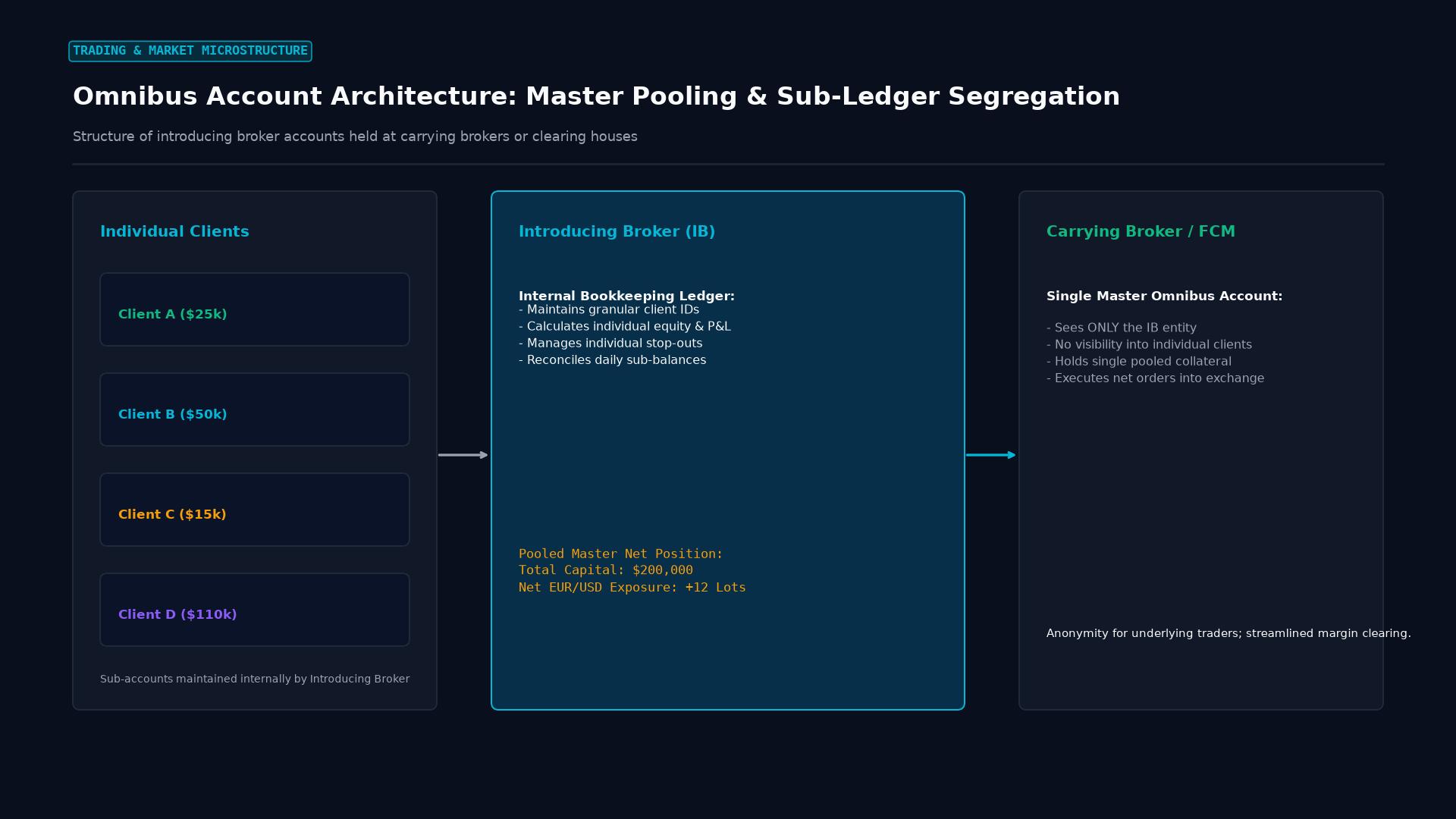 Figure: Master-sub account structure: introducing broker maintaining segregated sub-client accounts while clearing via a single pooled master account.
Omnibus Accounts vs. Fully Disclosed Accounts
When a brokerage or money manager establishes a clearing arrangement, they choose between an omnibus structure and a fully disclosed account model:
| Operational Feature | Omnibus Account | Fully Disclosed Account |
|---|---|---|
| Client Confidentiality | Client identities remain completely hidden from the clearing firm. | Clearing firm receives full KYC/AML data for each individual end-client. |
| Internal Bookkeeping | The introducing broker handles all trade allocation, statements, and margin monitoring. | Clearing firm produces individual statements and manages account-level margin calls. |
| Clearing Costs | Significantly lower clearing and transaction ticket fees due to netted order routing. | Higher per-ticket clearing fees; each client trade is cleared individually. |
| Commingling Risk | High; client funds are pooled in a single master balance at the clearing level. | Low; each client holds a discrete segregated sub-account at the clearinghouse. |
| Shortfall Contagion (Fellow-Customer Risk) | If one client defaults severely, the pooled omnibus collateral can be impacted. | Client assets are legally isolated from the defaults of other broker clients. |
Regulatory Framework and Segregation Rules
Because omnibus accounts pool client collateral, regulatory authorities impose strict structural mandates to protect customer assets from broker mismanagement or insolvency:
1. US CFTC Regulation 1.20 and 1.22
Under the Commodity Futures Trading Commission (CFTC), US FCMs operating customer omnibus accounts must segregate customer funds from the firm’s proprietary operational capital. Furthermore, under Regulation 1.22, an FCM cannot use the margin deposits of non-defaulting customer A to cover the trading losses or margin deficit of defaulting customer B inside the omnibus pool (“residual interest” requirement).
2. Legal Segregation with Operational Commingling (LSOC)
In cleared swaps markets, the Dodd-Frank Act implemented LSOC rules. LSOC permits clearing members to commingle swap collateral operationally within an omnibus account at the central clearing counterparty (CCP), but mandates that if a clearing member defaults, the CCP cannot access the collateral of non-defaulting swap customers to satisfy the shortfall of defaulting clients.
3. MiFID II and Client Asset Sourcebook (CASS)
In the United Kingdom, the Financial Conduct Authority (FCA) enforces strict rules under CASS 7. Brokers using omnibus accounts must perform daily internal and external client money reconciliations to ensure that aggregate client ledger balances exactly match total segregated funds deposited across institutional banking partners.
Real-World Case Study: The 2011 MF Global Collapse
The structural vulnerability of customer omnibus accounts was starkly demonstrated during the October 2011 bankruptcy of primary dealer MF Global, led by former New Jersey Governor Jon Corzine.
- Proprietary Bets: MF Global made a massive $6.3 billion leveraged proprietary bet on European sovereign debt (bonds issued by Italy, Spain, and Portugal).
- Liquidity Squeeze: As the European sovereign debt crisis escalated, rating agency downgrades triggered severe margin calls from clearinghouses against MF Global’s proprietary trading accounts.
- The Breach: In the chaotic final days before filing Chapter 11 bankruptcy, MF Global management transferred hundreds of millions of dollars out of customer omnibus segregated accounts to satisfy proprietary margin calls and bank overdrafts.
- The Shortfall: When administrators entered the firm, over $1.6 billion in customer omnibus funds was missing.
- Resolution: Although the Trustee in bankruptcy (James Giddens) eventually recovered 100% of customer funds over the subsequent five years through asset liquidations, the collapse forced global regulators to overhaul omnibus reporting rules, requiring daily electronic verification of segregated balances.
Frequently Asked Questions
Can an introducing broker trade forex through an omnibus account?
Yes. Introducing brokers (IBs) and white-label brokers routinely use omnibus accounts with Tier-1 prime brokers or liquidity providers. The IB aggregates retail customer orders on its own trading server (e.g., MetaTrader), while clearing only the net foreign exchange risk through its omnibus line with the institutional liquidity provider.
What is “Fellow-Customer Risk”?
Fellow-customer risk is the danger that a catastrophic loss suffered by one trader in a pooled omnibus account exceeds that trader’s account balance, creating a deficit that the broker fails to cover immediately. In the event of broker bankruptcy, non-defaulting customers may face pro-rata haircuts on their deposited funds until the shortfall is resolved.
How does margin calculation differ between gross and net omnibus accounts?
- In a Gross Omnibus Account, the clearinghouse calculates initial margin based on the sum of all individual client positions without offsetting (e.g., 100 longs + 80 shorts = 180 lots of margin).
- In a Net Omnibus Account, the clearinghouse requires margin only on the net open position (e.g., 100 longs - 80 shorts = 20 lots of net margin), substantially reducing capital tie-up.
Ready to trade forex?
Open a free demo account with a regulated broker. Practice with virtual funds before risking real money.