Swissy
Traders' market slang for the Swiss Franc (ISO currency code: CHF), or specifically for the USD/CHF currency pair, globally renowned as the world's premier safe-haven currency.
What Is “Swissy”?
In institutional foreign exchange dealing rooms, “Swissy” is the universal shorthand nickname for the Swiss Franc (currency code: CHF, symbol: Fr. or SFr.). On many spot desks, the term is also used specifically to designate the USD/CHF currency pair.
The currency code CHF reflects Switzerland’s formal Latin name: Confoederatio Helvetica (CH), combined with F for Franc.
Among the global financial community, Swissy occupies a legendary status: it is universally recognized as the ultimate sovereign safe-haven currency. Whenever international geopolitical tensions flare, global banking panics erupt, or severe inflationary shocks threaten fiat currencies, institutional capital floods across the Swiss border, driving aggressive appreciation in Swissy.
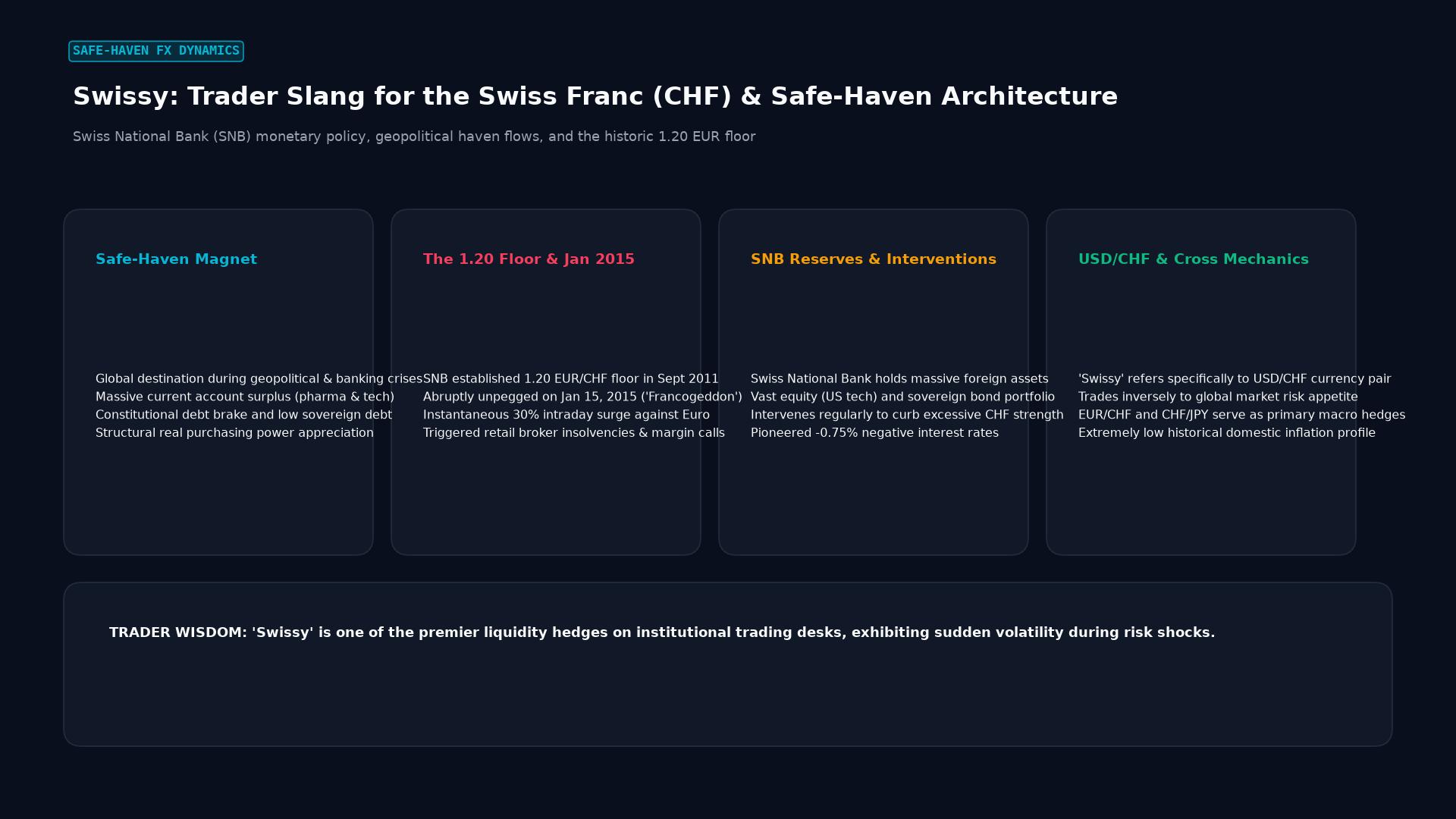 Figure: Swiss National Bank (SNB) monetary policy, geopolitical haven flows, and the historic 1.20 EUR floor
Macroeconomic Profile: Why Swissy Is the World’s Premier Safe Haven
The extraordinary strength and resilience of the Swiss Franc are grounded in four macroeconomic pillars:
- Constitutional Armed Neutrality: Switzerland has maintained an unbroken stance of international military neutrality since the Treaty of Paris in 1815. It is not a member of the European Union or NATO, rendering its domestic economy structurally insulated from foreign sovereign entanglements.
- Structural Current Account Surpluses: Switzerland consistently generates massive trade and current account surpluses (regularly exceeding 7% to 10% of GDP). Its export economy does not compete on cheap commodity prices, but rather on non-price-elastic, high-margin specialized goods (pharmaceutical giants Novartis and Roche, precision industrial robotics, and luxury horology).
- The Constitutional “Debt Brake” (Schuldenbremse): Enacted by national referendum in 2001, the Swiss constitution legally mandates that the federal budget must be balanced across the economic cycle. Consequently, Switzerland’s debt-to-GDP ratio hovers around an enviable 27% to 40%, a fraction of the debt burdens carried by the United States (>120%), Japan (>260%), or the Eurozone.
- World-Leading Foreign Reserve Vault: To combat excessive Swissy strength, the Swiss National Bank (SNB) accumulated an enormous sovereign investment portfolio exceeding $1 trillion, holding vast reserves of physical gold, foreign government bonds, and global blue-chip equities.
The Swiss National Bank (SNB) Dilemma: Fighting Chronic Strength
While global investors love Swissy, the Swiss National Bank considers an excessively strong currency to be an existential domestic threat:
- A soaring Swiss Franc makes Swiss exports prohibitively expensive for European and American buyers.
- It triggers severe domestic deflation, as cheap imported foreign goods continuously push Swiss consumer price inflation below zero.
To combat this appreciation, the SNB has deployed some of the most aggressive and unorthodox monetary experiments in modern history, including:
- Negative Benchmark Interest Rates: Sinking its policy rate to -0.75% between 2015 and 2022, effectively penalizing foreign institutional banks for parking capital in Swiss Francs.
- Direct Currency Interventions: Selling hundreds of billions in newly minted Swiss Francs to purchase U.S. Dollars and Euros in the interbank market.
Real-World Institutional Case Study: “Frankenshock” and the 1.2000 EUR/CHF De-Pegging
The most dramatic currency event of the 21st century occurred on Thursday, January 15, 2015, an event known globally as the “Frankenshock”:
       EUR/CHF "FRANKENSHOCK" COLLAPSE - JANUARY 15, 2015

 1.2000 ──┐ [ Multi-Year SNB Defense Floor: Interbank bids artificially pegged ]
          │\
 1.1500 ──┼─\  10:30 CET: SNB unexpectedly announces abandonment of the floor
          │  \
 1.0500 ──┼───\___ Institutional and Retail Bids EVAPORATE from EBS & Reuters
          │       \
 0.9500 ──┼────────\___
          │            \
 0.8500 ──┼─────────────\___ FLASH BOTTOM: EUR/CHF plunges ~30% in minutes
└──────────────────────────────────────────────────────────────- The Artificial Floor: In September 2011, during the Eurozone debt crisis, the SNB instituted an emergency minimum exchange rate floor of 1.2000 on EUR/CHF, vowing to buy unlimited Euros to defend the barrier.
- The Accumulation Trap: By early 2015, with the European Central Bank preparing to launch massive quantitative easing (QE), defending the 1.20 peg became impossible without hyperinflating the SNB’s balance sheet.
- The Shockwave: On January 15, at precisely 10:30 AM Zurich time, the SNB abruptly abandoned the 1.2000 floor with zero prior warning.
- The Devastation: Within seconds, the bid book vanished. EUR/CHF collapsed by nearly 30%, briefly trading below 0.8500. Major institutional hedge funds (such as Everest Capital) were wiped out, and prominent retail brokerages (including Alpari UK) entered insolvency within 24 hours due to massive negative client balances.
Swissy vs. Other Global Safe Havens
| Asset | Safe-Haven Mechanism | Yield / Carry Profile | Vulnerabilities |
|---|---|---|---|
| Swiss Franc (Swissy) | Current account surplus, political neutrality, fiscal conservatism | Low to Negative (Chronic carry funding currency) | Aggressive SNB currency market intervention risk |
| Japanese Yen (JPY) | Net foreign asset creditor nation, domestic investor repatriation | Ultra-low (Historic carry funding vehicle) | Extreme public debt-to-GDP, energy import dependence |
| U.S. Dollar (USD) | Global reserve hegemon, unmatched treasury bond liquidity | Moderate to High (Benchmark yield advantage) | Expanding fiscal deficits, debt-ceiling political standoffs |
| Gold (XAU) | Physical hard asset with zero counterparty credit risk | Zero yield (Carries storage and insurance costs) | High opportunity cost during rapid real rate hike cycles |
Frequently Asked Questions
Why is USD/CHF referred to as a “counter-currency” pair?
USD/CHF historically exhibited an intense inverse correlation with EUR/USD (frequently reaching -0.90 to -0.95 correlation). Because Switzerland is located in the heart of Europe and maintains deep economic ties with the Eurozone, a rising EUR/USD almost perfectly mirrors a falling USD/CHF, making USD/CHF a classic cross-check for broader European dollar flows.
How does the SNB conduct verbal intervention on Swissy?
In its quarterly monetary policy assessments, the SNB frequently includes explicit forward-guidance phrasing, stating that “the Swiss Franc remains highly valued” and declaring that the central bank “remains willing to be active in the foreign exchange market as necessary.” These verbal interventions signal to algorithmic desks that the SNB is actively monitoring exchange rate levels.
What is the “Safe-Haven Unwind” trade?
When global geopolitical panics subside and market confidence returns (“risk-on”), capital rapidly exits the Swiss Franc to seek higher yields in growth-oriented, high-yielding currencies (such as the Australian Dollar, British Pound, or emerging market currencies). This safe-haven unwind frequently produces sharp multi-week rallies in pairs like GBP/CHF and AUD/CHF.
Ready to trade forex?
Open a free demo account with a regulated broker. Practice with virtual funds before risking real money.