SYP
SYP (Syrian Pound) is the official currency of the Syrian Arab Republic, subdivided into 100 qirsh (piastres) and regulated by the Central Bank of Syria (CBS).
What is the Syrian Pound (SYP)?
The Syrian Pound (ISO code: SYP, Arabic: الليرة السورية, symbol: LS or £S) is the official legal tender of the Syrian Arab Republic. Administered, issued, and regulated by the Central Bank of Syria (CBS) (Masrif Suriyah al-Markazi), the currency is nominally subdivided into 100 qirsh (piastres). Due to the catastrophic depreciation of the currency during more than a decade of civil war, piastre coins and low-denomination banknotes have been abandoned, and transactions are conducted in large whole pound denominations.
Prior to 2011, the Syrian Pound was a relatively stable regional currency, trading for years in a narrow range around 47 SYP per 1 US Dollar, supported by sovereign oil exports, agricultural self-sufficiency, and conservative foreign debt policies.
Following the outbreak of the Syrian civil conflict in 2011, the currency suffered a systemic collapse. Comprehensive international economic sanctions (most notably the US Caesar Syria Civilian Protection Act of 2019), physical infrastructure destruction, the loss of state control over northeastern oil fields, and banking failures in neighboring Lebanon caused the Syrian Pound to lose more than 99% of its pre-war value.
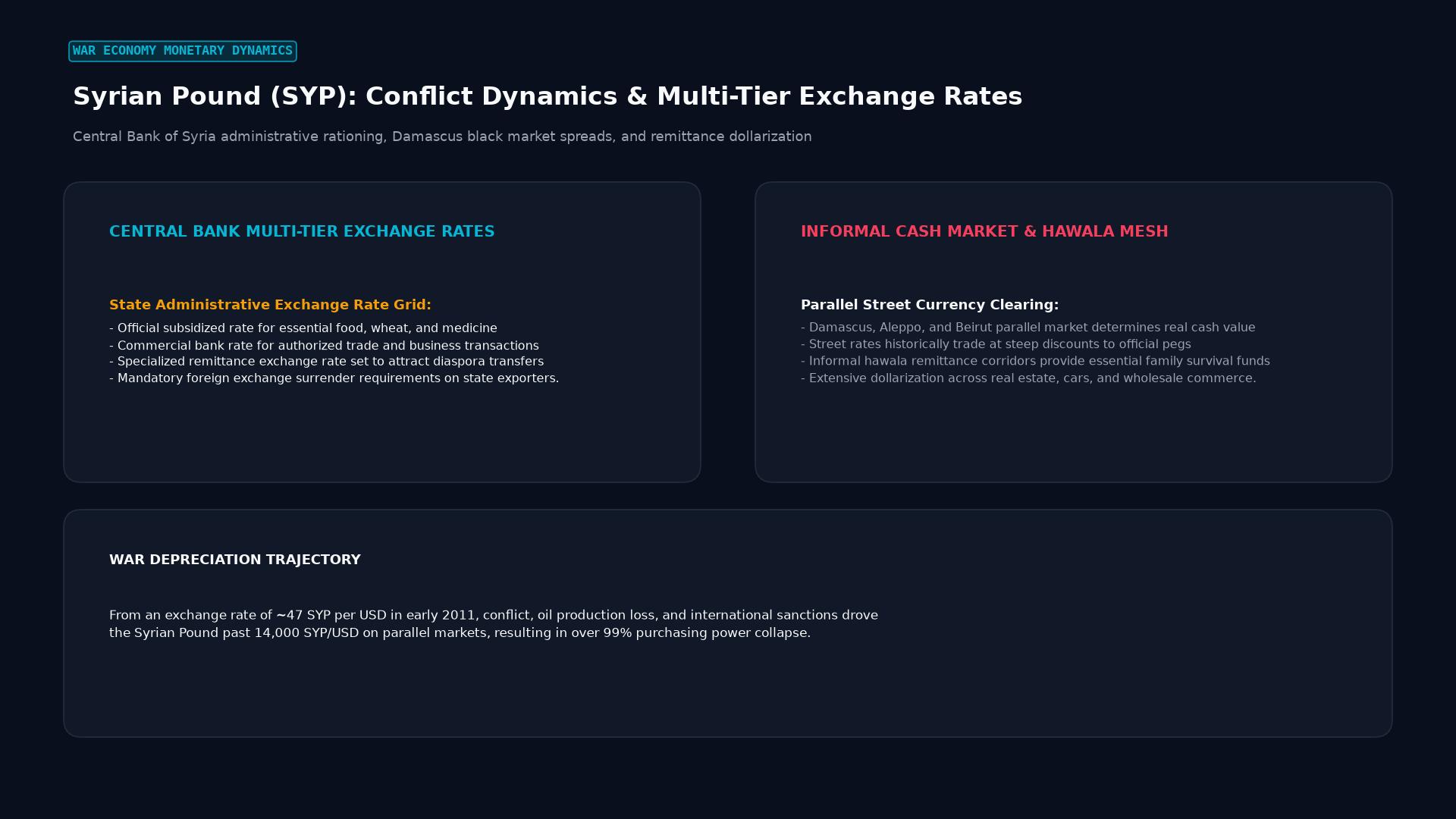 Figure: Central Bank of Syria administrative rationing, Damascus black market spreads, and remittance dollarization
Historical Context: From the French Mandate to Central Bank Autonomy
The modern monetary history of Syria evolved through colonial French administration, monetary union with Lebanon, and post-colonial socialist nationalization.
The French Mandate and the Banque de Syrie (1919 to 1949)
Following the collapse of the Ottoman Empire after World War I and the establishment of the French Mandate over Syria and Lebanon, French authorities introduced a unified monetary system:
- In 1919, the Banque de Syrie (later the Banque de Syrie et du Liban) was granted a private concession to issue banknotes pegged to the French Franc at a rate of 1 Syrian Pound = 20 French Francs.
- In 1949, following independence and monetary disagreements with France and Lebanon, Syria formally severed its currency link to the French franc and dissolved the monetary union with Lebanon, establishing an independent national currency.
1919-1949: French Mandate & Monetary Union with Lebanon
Banque de Syrie issues common banknotes pegged to the French Franc
                      │
                      ▼
1949: Monetary Independence
Severance of French Franc link; dissolution of common Lebanese currency
                      │
                      ▼
March 1953: Creation of the Central Bank of Syria (CBS)
Law No. 87 establishes state central bank and monetary board
                      │
                      ▼
1960s-1990s: Ba'athist State Planning & Peg to US Dollar
State monopoly over banking; multi-tier administrative exchange rates;
Strict foreign exchange controls; long-term peg near ~47-50 SYP/USD
                      │
                      ▼
2011: Outbreak of the Syrian Civil War
Sanctions, loss of oil fields, and destruction of GDP
                      │
                      ▼
2019-Present: Caesar Act & Lebanese Banking Crisis
Depreciation accelerates; black market rate drops past 14,000 SYP/USD;
Multi-tier official devaluations by CBS to track parallel street rates
The Establishment of the Central Bank of Syria (1953)
On March 28, 1953, Legislative Decree No. 87 established the Central Bank of Syria (CBS). The central bank opened its doors in August 1956, assuming sole legal authority to issue sovereign banknotes, manage official gold and foreign exchange reserves, and act as fiscal agent for the Ministry of Finance.
For the next half-century, the Syrian government pursued socialist-style state control over the financial sector, maintaining strict administrative exchange controls and a state banking monopoly until private commercial banks were cautiously re-authorized in the early 2000s.
Macroeconomic Collapse: The Civil War and External Sanctions
The collapse of the Syrian Pound from a stable 47 per USD to over 13,000–15,000 per USD was driven by structural economic shocks:
       Outbreak of War & Destruction of Industrial Base (Aleppo, Homs)
                                │
                                ▼
       Loss of Sovereign Control over Eastern Oil Fields (Deir ez-Zor)
       (Syria shifts from oil-exporting nation to fuel-dependent importer)
                                │
                                ▼
       Imposition of US & EU International Sanctions (Caesar Act 2019)
       (Cut off from SWIFT, Western clearing, and foreign investment)
                                │
                                ▼
       The 2019 Lebanese Banking Crisis (Freezing Billions in Syrian Deposits)
                                │
                                ▼
       Central Bank Foreign Exchange Reserves Depleted to Near-Zero
       Uncontrolled Money Printing Drives Severe Currency Depreciation
1. The Loss of Hydrocarbon Export Revenues
Prior to 2011, crude oil was Syria’s primary source of foreign exchange and government revenue, generating over 25% of state budget income and supplying European refiners with over 380,000 barrels per day.
- Early in the conflict, the government lost physical control over major oil-producing basins in the eastern Euphrates region (Deir ez-Zor and Hasakah).
- Syria shifted from an energy exporter into a net importer of crude oil and refined diesel, requiring hundreds of millions of dollars in maritime fuel shipments (primarily supplied by Iran under sovereign credit lines).
2. The Caesar Syria Civilian Protection Act of 2019
Enacted by the United States Congress in December 2019 and entering into force in June 2020, the Caesar Act imposed secondary sanctions on foreign companies, banks, or individuals:
- Any foreign entity providing commercial, construction, engineering, or aviation financing to the Syrian government or its state-owned enterprises faced asset freezes and exclusion from the US financial system.
- The Caesar Act deterred prospective Gulf Arab and international investors from participating in post-war reconstruction, cutting off foreign direct investment flows.
3. The Lebanese Banking Crisis Spillover (2019)
Historically, the commercial banking sector in Beirut, Lebanon, functioned as Syria’s financial window to the outside world. Syrian business owners, traders, and wealthy families held an estimated $20 billion to $30 billion USD in deposits in Lebanese commercial banks to finance import trade and protect savings from domestic controls.
When the Lebanese banking system collapsed in October 2019, Lebanese banks imposed capital controls, freezing dollar accounts.
Syrian importers were cut off from their liquidity overnight, forcing them to compete for physical US dollars in the Damascus black market and triggering a sharp collapse of the Syrian Pound.
The Multi-Tier Exchange Rate Architecture
To manage scarce foreign exchange reserves, the Central Bank of Syria operated a multi-tiered exchange rate system, publishing separate official rates for different sectors of the economy:
+------------------------------------------------------------------------------------+
|                         CBS MULTI-TIER EXCHANGE RATE SYSTEM                        |
+-------------------+----------------------------------------------------------------+
| EXCHANGE TIER     | ECONOMIC APPLICATION & LEGAL SCOPE                             |
+-------------------+----------------------------------------------------------------+
| Official Central  | Used for government state budgeting, customs valuation, and    |
| Bank Rate         | state-to-state sovereign debt accounting.                      |
+-------------------+----------------------------------------------------------------+
| Remittances and   | Periodic bulletin rate set for diaspora remittances sent via   |
| FX Operations Rate| licensed money transfer agencies, designed to track the street.|
+-------------------+----------------------------------------------------------------+
| Commercial Bank   | Rate authorized for licensed private commercial banks to fund  |
| Financing Rate    | authorized industrial and agricultural import letters of credit|
+-------------------+----------------------------------------------------------------+
| Parallel Street   | The unregulated open-market cash rate ("Black Market"), which  |
| Rate (Black Mkt)  | sets real-world pricing for food, imported electronics, & cars.|
+-------------------+----------------------------------------------------------------+
Periodically, when the spread between the official remittance rate and the black market rate widened, overseas workers stopped using official channels and routed their funds through informal networks.
In response, the CBS executed series of discrete devaluations, raising its official remittance rate to narrow the gap and recapture hard currency flows into the banking system.
Foreign Exchange Controls and Penalties (Decrees 3 and 4)
In January 2020, the Syrian presidency issued Legislative Decrees No. 3 and No. 4, introducing severe criminal penalties to suppress domestic dollarization and stop currency depreciation:
+------------------------------------------------------------------------------------+
|                         SYRIAN FX REGULATORY CRACKDOWN                             |
+-------------------+----------------------------------------------------------------+
| PROHIBITED ACTION | Criminalized the use of any foreign currency (USD, EUR, TRY)  |
|                   | for domestic commercial payments, real estate leases, or retail|
|                   | pricing within the Syrian Arab Republic.                       |
+-------------------+----------------------------------------------------------------+
| STATUTORY PENALTY | Mandatory prison sentences of 3 to 7 years of hard labor,      |
|                   | combined with heavy fines and the confiscation of all seized   |
|                   | foreign currency cash balances.                                |
+-------------------+----------------------------------------------------------------+
| REPORTING CRIME   | Prohibited the publishing of non-official, parallel black-     |
|                   | market exchange rate quotes on websites or social media apps.  |
+-------------------+----------------------------------------------------------------+
While these decrees suppressed public street transactions in major cities, they drove foreign currency trade into clandestine peer-to-peer networks and caused businesses to mark up local prices in Syrian pounds to account for exchange rate volatility.
Regional Fragmentation: The Rise of Alternative Currencies
More than a decade of conflict fragmented Syria into regional currency zones:
+------------------------------------------------------------------------------------+
|                         SYRIAN TERRITORIAL CURRENCY ZONES                          |
+---------------------+-------------------------------+------------------------------+
| TERRITORIAL REGION  | DOMINANT CURRENCY IN USE      | MONETARY AUTHORITY IN CHARGE |
+---------------------+-------------------------------+------------------------------+
| Government-Held     | Syrian Pound (SYP)            | Central Bank of Syria        |
| Territories         | (Decree 3 enforced)           | (Damascus)                   |
+---------------------+-------------------------------+------------------------------+
| Northwestern Idlib  | Turkish Lira (TRY) &          | Local administrative councils|
| & Northern Aleppo   | US Dollar (USD)               | (Turkish PTT postal network) |
+---------------------+-------------------------------+------------------------------+
| Autonomous North &  | US Dollar (USD) &             | Autonomous Administration of |
| East (NES)          | Syrian Pound (Dual pricing)   | North and East Syria         |
+---------------------+-------------------------------+------------------------------+
In northern opposition-held areas, local councils officially adopted the Turkish Lira (TRY) to protect the public from the Syrian Pound’s collapse. Turkish state banks and the postal service (PTT) opened branches in northern towns, distributing Turkish Lira banknotes and coins for everyday commerce.
Remittance Channels: The Informal Hawala Lifeline
The survival of millions of households inside government-held areas relies on diaspora remittances.
More than six million Syrian refugees living in Turkey, Lebanon, Jordan, Germany, and across Europe, alongside pre-war expatriates in the Gulf, transmit between $2.0 billion and $3.0 billion USD annually to relatives inside Syria.
Because international wire transfers through SWIFT are blocked by sanctions and compliance risks, remittances flow primarily through informal Hawala networks. Hawala agents in Europe or the Gulf receive foreign cash, and their domestic correspondents in Damascus, Aleppo, and Homs pay out Syrian pounds or US dollars directly to families, providing essential food and medical liquidity.
Key Takeaways
- Official Currency of Syria: The Syrian Pound (SYP, symbols: LS, £S) is regulated by the Central Bank of Syria (CBS) in Damascus.
- Wartime Depreciation: Trading at ~47 SYP per 1 USD prior to 2011, the currency collapsed by over 99%, driven by civil war, infrastructure destruction, and loss of state oil reserves.
- Sanctions Isolation: The US Caesar Act and European Union sanctions isolated the Syrian financial sector, cutting off foreign direct investment and reconstruction finance.
- Lebanese Banking Spillover: The 2019 collapse of Lebanese commercial banks froze tens of billions in Syrian commercial deposits, accelerating domestic depreciation.
- Multi-Tiered Rates: The CBS maintains complex administrative exchange rates for state budgeting and commercial imports, regularly devaluing its remittance rate to track black market prices.
- Strict Anti-Dollarization Decrees: Decrees No. 3 and 4 of 2020 penalize the commercial use of foreign currency with prison terms of up to seven years.
- Territorial Fragmentation: The Syrian Pound is abandoned in northwestern territories, where the Turkish Lira (TRY) and US dollar serve as everyday legal tender.
Frequently Asked Questions (FAQ)
What was the value of the Syrian Pound before the 2011 war?
Before the outbreak of the civil conflict in March 2011, the Syrian Pound was a stable regional currency backed by domestic crude oil production, a vibrant agricultural sector, and conservative sovereign borrowing policies. The exchange rate traded in a stable range between 46.50 and 47.50 Syrian Pounds per 1 US Dollar. Following years of war, international sanctions, and the loss of eastern oil fields, the currency lost over 99% of its pre-war value.
Can individuals legally hold or spend US Dollars inside government-controlled Syria?
Under Legislative Decrees No. 3 and No. 4 enacted in January 2020, it is illegal to use US dollars or any foreign currency for commercial transactions, retail purchases, restaurant bills, or real estate leases inside government-controlled Syria. Violating these decrees carries severe penalties, including 3 to 7 years of prison with hard labor and the confiscation of all seized funds. While citizens are legally permitted to hold foreign currency in licensed bank accounts under specific conditions, all retail purchases in the country must be settled strictly in Syrian Pounds.
How do Syrian families receive money from relatives living abroad?
Due to comprehensive international sanctions and compliance bans, standard international wire transfer services (like Western Union or direct SWIFT bank-to-bank transfers) face severe operational restrictions. Most families receive financial assistance through licensed money transfer companies that operate under the Central Bank of Syria’s official remittance rate, or through traditional informal Hawala networks. An overseas family member deposits cash with a Hawala broker in Germany, Turkey, or the UAE, and a local correspondent broker in Syria pays out equivalent funds in cash to the recipient in Damascus, Aleppo, or Latakia.
Ready to trade forex?
Open a free demo account with a regulated broker. Practice with virtual funds before risking real money.