JOD
JOD is the ISO 4217 currency code for the Jordanian Dinar, the official currency of Jordan, issued by the Central Bank of Jordan and maintained as a strict hard peg to the US Dollar at 1 USD = 0.709 JOD since October 1995.
What Is the JOD?
The JOD is the three-letter ISO 4217 currency code for the Jordanian Dinar, the official legal tender of the Hashemite Kingdom of Jordan. Subdivided into 10 dirhams, 100 qirsh (piastres), or 1,000 fils (though fils are rarely used in retail circulation today), the dinar is issued and regulated by the Central Bank of Jordan (CBJ), headquartered in Amman.
In international foreign exchange markets, the Jordanian Dinar stands out as one of the world’s highest-valued nominal currency units. Because of its longstanding fixed exchange rate peg to the US dollar, 1 JOD equals roughly 1.41 US dollars. Unlike its oil-rich Arabian Gulf neighbors that defend currency pegs using vast petroleum extraction revenues and sovereign wealth funds, Jordan maintains its dollar peg within a resource-constrained, non-oil economy through fiscal coordination, high domestic interest rate spreads, and strategic foreign reserve management.
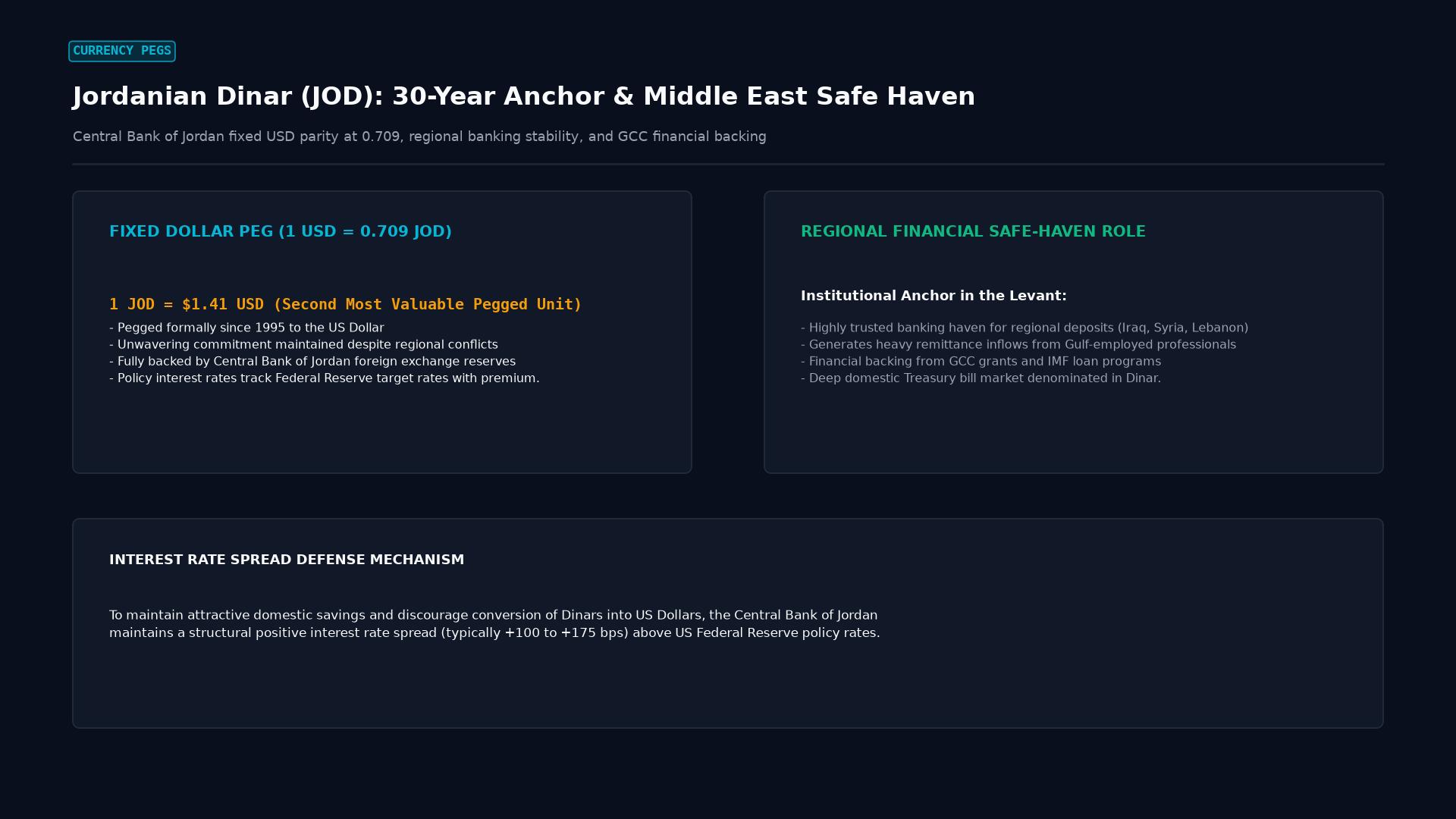 Figure: Central Bank of Jordan fixed USD parity at 0.709, regional banking stability, and GCC financial backing
The Fixed Exchange Rate Peg: History and Mechanics
The modern institutional foundation of the Jordanian Dinar was established in October 1995, when the CBJ formally pegged the dinar directly to the United States Dollar at a fixed rate of:
1 USD = 0.7090 JOD <---> 1 JOD = 1.41044 USDPrior to October 1995, Jordan pegged the dinar to the Special Drawing Right (SDR) basket calculated by the International Monetary Fund. Following severe regional instability and a sharp currency devaluation in 1988–1989 that cut the dinar’s value in half, the CBJ adopted the bilateral dollar peg to serve as an unshakeable nominal anchor for domestic prices, import contracts, and investor confidence.
Under this regime, the CBJ guarantees unlimited, two-way convertibility between the Jordanian Dinar and the US Dollar for licensed commercial banks at narrow statutory spreads (typically buying at 0.708 JOD per USD and selling at 0.710 JOD per USD).
Monetary Policy Implications: The Trilemma in Action
According to the Mundell-Fleming Impossible Trinity, a sovereign nation cannot simultaneously maintain:
- A fixed foreign exchange rate
- Free cross-border capital mobility
- An independent monetary policy
Because Jordan allows open capital transfers and fixes the JOD to the US dollar, the Central Bank of Jordan forfeits domestic interest rate independence. Whenever the US Federal Reserve adjusts the federal funds rate, the CBJ mirrors the rate decision almost immediately.
To prevent domestic capital from leaving the country in search of higher offshore returns (preventing deposit dollarization), the CBJ maintains a deliberate interest rate premium on Jordanian Dinar deposits relative to US dollar deposits. This positive spread, typically ranging between 100 and 250 basis points, provides domestic savers and commercial institutions with a compelling financial incentive to keep their liquidity in local dinars.
Macroeconomic Pillars Supporting the Currency Peg
Maintaining an unyielding peg for over three decades without sovereign oil fields requires diverse, resilient sources of foreign exchange reserves. Jordan’s balance of payments rests on several key pillars:
| Pillar | Economic Mechanism | Significance to CBJ Reserves |
|---|---|---|
| Gulf Diaspora Remittances | Hundreds of thousands of skilled Jordanian engineers, bankers, and doctors working in Saudi Arabia, the UAE, and Qatar remit earnings home | Generates $3.5+ billion annually in reliable hard currency inflows |
| Phosphate and Potash Extraction | Large-scale chemical and fertilizer mining by Arab Potash Company and Jordan Phosphate Mines from Dead Sea reserves | Major source of global merchandise trade receipts denominated in US dollars |
| Qualified Industrial Zones (QIZ) | Duty-free garment and textile manufacturing facilities exporting directly to the United States under bilateral free trade agreements | Drives non-commodity industrial exports and dollar-denominated commercial revenues |
| International Sovereign Aid | Bilateral grants, military assistance, and concessionary budgetary loans from the United States, the European Union, and GCC allies | Provides strategic reserve cushions during regional economic disruptions |
| Tourism and Medical Travel | Historic heritage sites (Petra, Jerash, Wadi Rum) combined with Amman’s status as a regional medical healthcare hub | Generates vital service receipts that replenish commercial bank foreign currency accounts |
Deposit Dollarization and Banking Stability
The primary barometer of domestic confidence in Jordan’s monetary stability is the deposit dollarization ratio: the percentage of total commercial bank deposits held in foreign currencies (predominantly US dollars) versus local Jordanian dinars.
During periods of calm, the dollarization ratio declines toward 18% to 20%, as local corporations and households take advantage of the higher interest yields paid on JOD savings accounts. During regional geopolitical flare-ups, the ratio may tick upward as a segment of the public converts funds into dollars.
However, because the banking sector in Jordan is well-capitalized, strictly audited, and backed by CBJ foreign exchange reserves that routinely cover more than seven to eight months of national imports (well above the IMF’s recommended three-month safety threshold), the peg has weathered the 2008 financial crisis, regional political upheavals, and global pandemic shocks without breaking.
Trading and Commercial Realities
For corporate treasurers, importers, and international investors, interacting with the JOD involves specific institutional norms:
- Absence of Speculative FX Volatility: Spot USD/JOD does not exhibit the day-to-day volatility seen in freely floating currencies like the EUR, GBP, or emerging market units like the TRY or ZAR. The rate is effectively flat at the 0.709 peg.
- Cross-Currency Rates: Non-dollar cross rates, such as EUR/JOD, GBP/JOD, or JPY/JOD, fluctuate strictly in lockstep with the movements of those foreign currencies against the US dollar in global markets.
- Interbank Settlement: Commercial settlements pass smoothly through the CBJ’s RTGS (Real-Time Gross Settlement) platform, with local commercial banks (such as Arab Bank, Housing Bank for Trade and Finance, and Bank al Etihad) providing deep corporate liquidity for legitimate trade invoices.
Key Takeaways
- The JOD (Jordanian Dinar) is the national currency of Jordan, strictly pegged to the US Dollar at 1 USD = 0.709 JOD since October 1995.
- Because of the fixed peg, the dinar is one of the highest-valued nominal currency units globally, with 1 JOD equivalent to roughly 1.41 USD.
- To defend the peg under the open capital account, the Central Bank of Jordan matches US Federal Reserve interest rate actions while maintaining an attractive yield premium on local dinar deposits.
- The currency’s foreign exchange reserve buffer is supported by Gulf remittances, phosphate and potash exports, textile manufacturing under free trade agreements, tourism, and sovereign foreign grants.
- The deposit dollarization ratio serves as the central bank’s primary indicator of domestic market confidence.
Frequently Asked Questions
Why is the Jordanian Dinar worth more than the US Dollar?
The high nominal value of the Jordanian Dinar is a mathematical result of its fixed peg, established in 1995 at 1 USD = 0.7090 JOD. Nominal exchange rates reflect historical accounting choices rather than the absolute size or wealth of an economy.
Does the Central Bank of Jordan have independent control over interest rates?
Under the economic Trilemma, Jordan’s commitment to a fixed dollar peg and free capital movement eliminates domestic monetary policy autonomy. The CBJ must follow the US Federal Reserve’s interest rate moves to prevent capital flight and preserve the peg.
What are the main risks to the Jordanian Dinar’s peg?
The main risks stem from severe regional geopolitical conflicts that disrupt trade transit routes and tourism, sharp drops in foreign budgetary aid, or deep contractions in remittances from Jordanian workers employed in the Gulf states.
Ready to trade forex?
Open a free demo account with a regulated broker. Practice with virtual funds before risking real money.