TRY
The ISO 4217 currency code for the Turkish Lira, the official legal tender of the Republic of Turkey and the Turkish Republic of Northern Cyprus, issued and managed by the Central Bank of the Republic of Turkey.
TRY (Turkish Lira)
The Turkish Lira (ISO code: TRY, symbol: ₺) is the official currency of the Republic of Turkey and the de facto legal tender in the Turkish Republic of Northern Cyprus. Subdivided into 100 kuruş, the modern lira is issued and regulated by the Central Bank of the Republic of Turkey (Türkiye Cumhuriyet Merkez Bankası, or CBRT/TCMB).
In global foreign exchange markets, the Turkish lira represents one of the most actively analyzed and historically volatile emerging market (EM) currencies. Characterized by high trading volumes in the USD/TRY and EUR/TRY pairs, the lira has served as a primary barometer for investor sentiment regarding unorthodox monetary policy, aggressive inflation cycles, sovereign external debt rollover risks, and dramatic shifts between credit stimulus and orthodox monetary tightening.
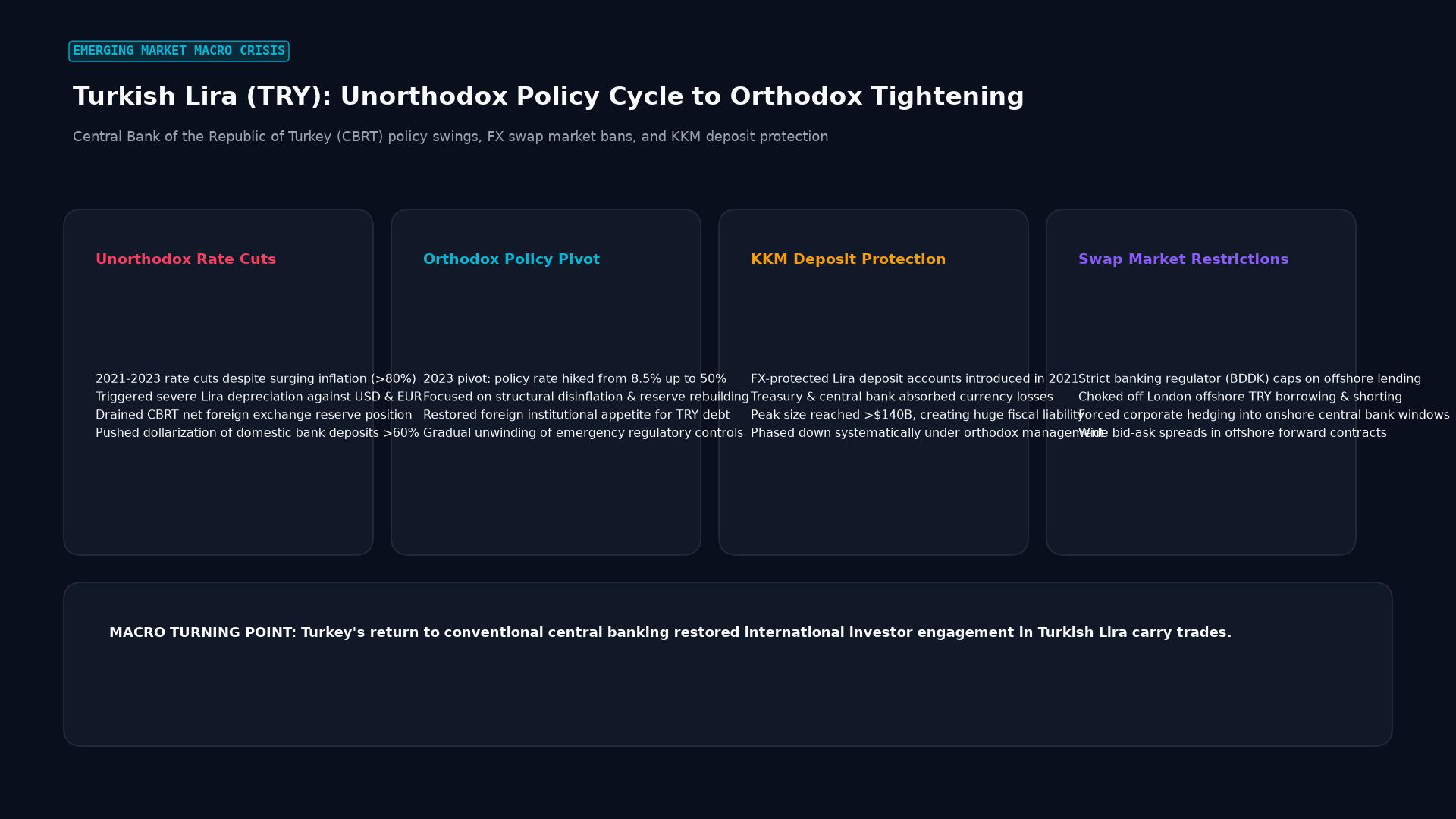 Figure: Central Bank of the Republic of Turkey (CBRT) policy swings, FX swap market bans, and KKM deposit protection
Historical Context: From Chronic Inflation to Modern Redenomination
The Turkish monetary system underwent severe structural transformations during the late 20th and early 21st centuries:
- The High-Inflation Era (1970s–2000s): Chronic fiscal deficits, monetized sovereign debt, and recurring banking crises led to decades of high inflation, frequently exceeding 70% to 100% per annum. By the late 1990s, exchange rates reached millions of liras per US dollar, earning the Turkish lira the distinction of being named the world’s least valuable currency unit by the Guinness Book of Records in 1995 and 1996.
- Redenomination in 2005 (The New Turkish Lira, TRY): Following the stabilization program overseen by the International Monetary Fund (IMF) after the 2001 Turkish banking crisis, the Grand National Assembly passed Law No. 5083. On January 1, 2005, Turkey redenominated its currency, dropping six zeros: $$1 \text{ New Turkish Lira (TRY)} = 1,000,000 \text{ Old Turkish Lira (TRL)}$$ The currency was initially designated as Yeni Türk Lirası (YTL) before reverting to its traditional name Türk Lirası (TRY) in 2009.
- The Unorthodox Rate Experiment (2018–2023): In sharp contrast to conventional central banking economic doctrine, Turkey pursued an unorthodox policy holding that high interest rates cause high inflation. Despite headline CPI surging above 80%, the CBRT executed successive interest rate cuts between 2021 and early 2023. The lira experienced historic depreciation, falling from roughly 3.75 USD/TRY in early 2018 to over 26.00 USD/TRY by mid-2023.
- The Pivot to Monetary Orthodoxy (Post-June 2023): Following presidential elections in May 2023, Turkey reconstituted its economic administration. Under new technocratic leadership at the Treasury and CBRT, monetary policy reversed decisively: the policy repo rate was aggressively increased from 8.5% to 50.0% to rebuild foreign currency reserves, eliminate domestic distortions, and re-anchor inflation expectations.
Monetary Policy Framework of the CBRT
The CBRT’s primary statutory objective is domestic price stability. Operationally, the central bank utilizes an array of interest rate and macroprudential instruments:
Benchmark Instruments
- One-Week Repo Auction Rate: The official benchmark policy rate at which the CBRT provides liquidity to commercial banks through competitive repo tenders.
- Overnight Lending and Borrowing Corridor: An interest rate corridor allowing the central bank to manage marginal liquidity during periods of interbank stress.
- Late Liquidity Window (LLW): An emergency funding channel historically utilized to enforce monetary tightening without formally changing the benchmark repo rate.
The FX-Protected Deposit Mechanism (KKM)
In December 2021, facing severe dollarization and a run on the lira, the Turkish government introduced the Kur Korumalı Mevduat (KKM) scheme:
- Domestic depositors converted foreign exchange or deposited liras into specialized bank accounts.
- The state guaranteed that if the depreciation of the lira against the US dollar exceeded the bank’s interest rate, the Treasury and the CBRT would reimburse the difference to the depositor.
- While KKM temporarily halted the acute currency run, it concentrated immense fiscal liability on the central bank balance sheet. Starting in late 2023, the CBRT initiated a systematic campaign to unwind KKM by raising domestic lira deposit rates, incentivizing savers to transition back to standard Turkish lira deposits.
+------------------------------------------------------------------------+
|           Chronological Timeline of Turkish Lira Policy Cycles         |
+------------------------------------------------------------------------+
| Period          | Policy Approach           | Benchmark Policy Rate    |
| 2005 - 2012     | Orthodox IMF Transition   | Lowering from 18% to 5%  |
| 2013 - 2017     | Multiple Rate Corridors   | Floating corridor (5-10%)|
| 2018 - 2020     | Currency Crisis Defenses  | Hiked to 24%, cut back   |
| 2021 - Mid 2023 | Unorthodox Rate Cuts      | Slashed from 19% to 8.5% |
| Mid 2023 - Pres.| Aggressive Orthodoxy      | Aggressively hiked to 50%|
+------------------------------------------------------------------------+
Macroeconomic Drivers and FX Market Mechanics
1. Structural Energy Trade Deficits
Turkey imports more than 90% of its domestic oil, natural gas, and coal consumption. When global energy prices surge, Turkey’s current account deficit expands rapidly, requiring substantial foreign capital inflows or central bank reserve sales to fund imported fuel deliveries.
2. High External Debt Amortization Needs
Turkish commercial banks and private corporations hold substantial short-term external foreign currency debt (predominantly in USD and EUR). The recurring need to refinance or roll over hundreds of billions of dollars in foreign loans generates constant underlying demand for hard currencies.
3. Offshore Swap Restrictions and Market Squeezes
To deter short-selling of the lira during periods of acute stress, the Banking Regulation and Supervision Agency (BDDK) and the CBRT enacted strict limits on the volume of currency swaps domestic commercial banks could execute with foreign counterparties in London:
- These restrictions sharply curtailed offshore lira liquidity.
- In times of stress, offshore overnight TRY borrowing rates in London have occasionally spiked to triple-digit or quadruple-digit annualized yields (e.g., 1,000%+), as foreign investors seeking to cover short positions found no local liras available for borrowing.
- While effective at preventing speculative runs, these controls reduced international participation in Turkish financial assets, driving foreign investors toward non-deliverable forwards (NDF) or sidelines.
       Uncovered Interest Rate Parity (UIP) Approximation in TRY:

       E(Delta S) = (i_TRY - i_USD) - Risk_Premium

       Where:
       i_TRY = Domestic Turkish benchmark interest rate (e.g., 50%)
       i_USD = US Federal Reserve benchmark SOFR rate (e.g., 5%)
       E(Delta S) = Expected rate of depreciation of USD/TRY
       Risk_Premium = Sovereign credit default spread and political risk margin
When Turkey’s benchmark interest rate is 50% and US rates are 5%, the theoretical carry trade yield is 45% annualized. However, if the market expects the lira to depreciate against the dollar by more than 45% over the same holding period, the carry trade becomes net negative in real terms.
Trading USD/TRY and Hedging Dynamics
| Metric | Offshore NDF Market (London) | Onshore Spot & Futures (Borsa Istanbul - BIST) |
|---|---|---|
| Settlement | Cash settled in USD | Physical delivery or cash in TRY |
| Participant Base | International hedge funds, global banks | Domestic corporates, local retail, local banks |
| Regulatory Risk | Insulated from Turkish onshore capital limits | Subject to CBRT and BDDK macroprudential mandates |
| Liquidity Hours | Global 24-hour OTC trading | Turkish standard market operating hours |
| Typical Tenors | 1 month, 3 months, 6 months, 12 months | Standard monthly futures contracts on VIOP |
Practical Case Study: Corporate Forward Hedging in Istanbul
Consider Marmara Automotive Parts (MAP), a Turkish manufacturer based in Bursa that imports specialized automotive electronics from Germany and sells finished components to domestic assembly plants.
Exposure Parameters
- Payment Obligation: EUR 2,000,000 payable to a German supplier in 90 days.
- Spot Rate: EUR/TRY = 36.00
- Unhedged Liability: $$2,000,000 \times 36.00 = \text{TRY } 72,000,000$$
Market Data
- 90-day Turkish interbank interest rate ($r_{\text{TRY}}$) = 48% per annum
- 90-day Euribor rate ($r_{\text{EUR}}$) = 3.6% per annum
- Theoretical Forward Rate Calculation: $$F = S \times \left[\frac{1 + \left(r_{\text{TRY}} \times \frac{90}{360}\right)}{1 + \left(r_{\text{EUR}} \times \frac{90}{360}\right)}\right]$$ $$F = 36.00 \times \left[\frac{1 + (0.48 \times 0.25)}{1 + (0.036 \times 0.25)}\right] = 36.00 \times \left[\frac{1.12}{1.009}\right] = 36.00 \times 1.10999 \approx 39.96 \text{ EUR/TRY}$$
Hedging Decision Matrix
- Executing Forward Contract: MAP locks in the purchase of EUR 2,000,000 at 39.96 EUR/TRY. Total known cost in 90 days = TRY 79,920,000. Price risk is eliminated.
- Remaining Unhedged: If MAP leaves the exposure open, and unexpected geopolitical tensions cause the EUR/TRY rate to surge to 44.00, the corporate liability expands to TRY 88,000,000, creating an unbudgeted loss of TRY 8,080,000.
- Carry Cost: The forward premium reflects the 44.4% annualized interest rate differential between the lira and the euro, making forward hedging expensive but vital for enterprise solvency.
Frequently Asked Questions
What does the symbol ₺ represent?
The symbol ₺ is the official currency sign for the Turkish lira, officially introduced by the Central Bank of the Republic of Turkey in March 2012 following a nationwide design competition. The design resembles an anchor, symbolizing financial stability, integrated with two upward-slanting parallel lines representing rising economic potential.
Why is trading the Turkish Lira considered high risk for retail forex traders?
Trading the Turkish lira entails high risk because the currency exhibits extreme volatility, periodic liquidity squeezes, and rapid directional gaps. During periods of currency depreciation or unexpected regulatory interventions, spreads on pairs like USD/TRY can widen dramatically, and overnight rollover swap fees for holding short USD/TRY positions can be exceptionally punitive.
What is the KKM scheme and how did it affect the lira?
The Kur Korumalı Mevduat (KKM) was a government-sponsored foreign exchange-protected deposit system launched in December 2021. It guaranteed that domestic depositors holding Turkish lira deposits would be compensated by the state if the rate of currency depreciation exceeded bank interest payments. While it stabilized short-term panic, it created massive contingent liabilities for the central bank, which has been methodically phasing the program out since late 2023.
Ready to trade forex?
Open a free demo account with a regulated broker. Practice with virtual funds before risking real money.