SZL
SZL (Swazi Lilangeni, plural Emalangeni) is the official currency of the Kingdom of Eswatini, pegged at 1:1 parity with the South African Rand (ZAR) under the Common Monetary Area (CMA).
What is the Swazi Lilangeni (SZL)?
The Swazi Lilangeni (ISO code: SZL, plural: Emalangeni, symbols: L singular, E plural) is the official legal tender of the Kingdom of Eswatini (formerly known as the Kingdom of Swaziland until April 2018). Issued, regulated, and defended by the nation’s central monetary authority, the Central Bank of Eswatini (CBE) (Umntsholi Wemaswati), the currency is subdivided into 100 cents.
The Lilangeni operates within a multilateral currency union known as the Common Monetary Area (CMA) alongside South Africa, Lesotho, and Namibia.
Under the statutory terms of the Multilateral Monetary Agreement, the Lilangeni is pegged at a fixed 1:1 parity with the South African Rand (ZAR):
$$\text{Fixed Exchange Parity}: 1 \text{ Lilangeni (SZL)} = 1 \text{ South African Rand (ZAR)}$$
Under this monetary arrangement, the South African Rand circulates freely throughout Eswatini and is accepted as legal tender alongside the Lilangeni. However, the Lilangeni is not legal tender inside South Africa and cannot be spent outside Eswatini’s borders.
To maintain the fixed 1:1 link, the Central Bank of Eswatini is required by treaty to back all circulating Emalangeni with an equivalent holding of South African Rand or convertible foreign exchange reserves.
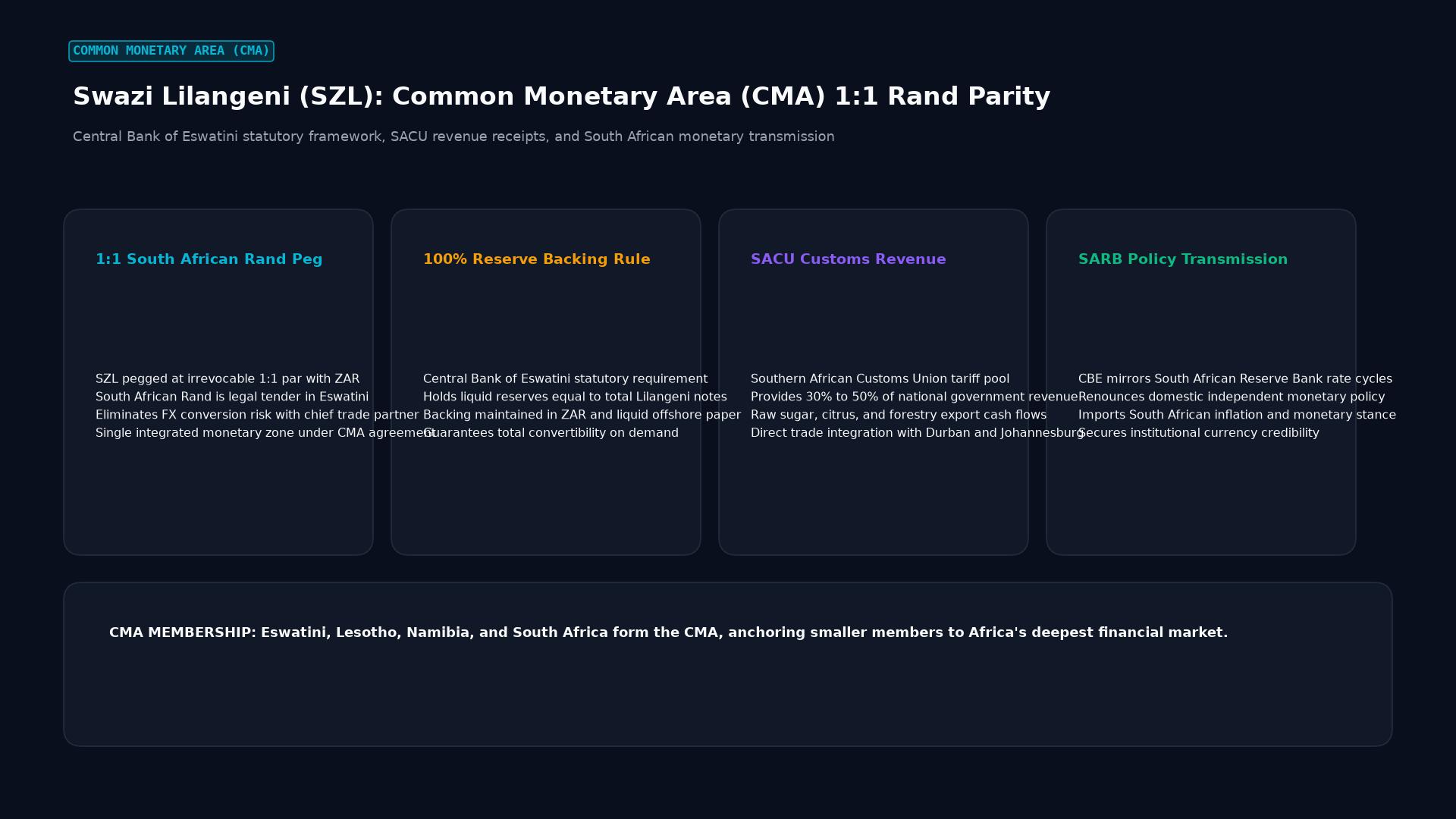 Figure: Central Bank of Eswatini statutory framework, SACU revenue receipts, and South African monetary transmission
Historical Origins and the 2018 Name Change
The monetary history of Eswatini reflects the kingdom’s preservation of sovereign tradition within the broader Southern African economic orbit.
Introduction of the Lilangeni (September 6, 1974)
Following national independence from the United Kingdom in September 1968, the Kingdom of Swaziland initially continued using the South African Rand as its official currency:
- On September 6, 1974, on the sixth anniversary of national independence, King Sobhuza II inaugurated the Monetary Authority of Swaziland and issued the Lilangeni:
- The currency entered circulation alongside the Rand at a strict 1:1 parity.
- The name “Lilangeni” is derived from the traditional Siswati language, and its plural form, Emalangeni, appears on all banknotes of E10, E20, E50, E100, and E200.
1910-1974: British High Commission & South African Monetary Orbit
Direct circulation of British Sterling, South African Pound, & Rand
                      │
                      ▼
September 6, 1974: Introduction of the Lilangeni
Monetary Authority of Swaziland issues sovereign notes (1:1 with ZAR)
                      │
                      ▼
July 1979: Creation of the Central Bank of Swaziland
Formal central bank legislation expands supervisory powers
                      │
                      ▼
1986: Trilateral Monetary Agreement (Modern CMA)
South Africa, Swaziland, and Lesotho formalize Common Monetary Area;
Eswatini opts out of making Rand mandatory legal tender, but allows
free commercial circulation at par
                      │
                      ▼
April 2018: Renaming to the Kingdom of Eswatini
King Mswati III changes national name; central bank rebranded as
the Central Bank of Eswatini (CBE)
The 2018 National Rebranding
On April 19, 2018, during the joint celebration of his 50th birthday and the 50th anniversary of national independence, King Mswati III officially decreed that the country would discard its colonial-era English name (Swaziland) and revert to its indigenous Siswati name: The Kingdom of Eswatini (“Land of the Swazis”).
Consequently:
- The central bank was renamed the Central Bank of Eswatini (CBE).
- While the international ISO 4217 currency code remained SZL, all newly printed banknotes and minted coins were updated with the institutional title Central Bank of Eswatini and Umntsholi Wemaswati.
The Common Monetary Area (CMA) Architecture
The Common Monetary Area (CMA) is one of the oldest operational currency unions in the developing world, originating in 1910 and formalized in its modern legal structure through the Multilateral Monetary Agreement (MMA) of 1992.
                           THE COMMON MONETARY AREA (CMA)

                            [ SOUTH AFRICA (ZAR) ]
                           Anchor Economy & Issuer of
                           the South African Rand (SARB)
                                         │
                 ┌───────────────────────┼───────────────────────┐
                 │                       │                       │
                 ▼                       ▼                       ▼
        [ ESWATINI (SZL) ]      [ LESOTHO (LSL) ]       [ NAMIBIA (NAD) ]
         Swazi Lilangeni          Lesotho Loti            Namibian Dollar
          1:1 with ZAR            1:1 with ZAR             1:1 with ZAR
Pillars of the CMA for Eswatini:
- Fixed 1:1 Exchange Parity: The Lilangeni cannot appreciate or depreciate against the South African Rand. One Lilangeni equals one Rand.
- Free Movement of Capital: Capital, business investment, and banking wire transfers flow between Eswatini and South Africa with zero cross-border exchange control restrictions or tariffs.
- Monetary Policy Transmission: Because capital moves freely and the exchange rate is fixed, the Central Bank of Eswatini cannot set an independent monetary policy. The CBE’s Monetary Policy Consultative Committee (MPCC) keeps its Discount Rate closely aligned with the Repo Rate set by the South African Reserve Bank (SARB) in Pretoria to prevent interest rate arbitrage and cross-border capital flight.
- Access to South African Financial Markets: Eswatini commercial banks and the central bank enjoy direct access to the deep capital and money markets of Johannesburg, allowing them to invest surplus liquidity in high-yield South African government bonds (SAGBs) and treasury bills.
Treaty Obligations: 100% Reserve Backing Mechanics
Under the Multilateral Monetary Agreement, Eswatini’s right to issue its own sovereign banknotes comes with strict legal responsibilities.
       Central Bank of Eswatini (CBE) Issues Emalangeni Notes & Coins
                                │
                                ▼
       Mandatory 100% Reserve Backing Requirement (CMA Treaty)
                                │
                                ▼
       CBE Must Hold Matching Reserves in South African Rand (ZAR)
       or Freely Convertible Foreign Exchange / Gold Assets
                                │
                                ▼
       Reserves Deposited in Custodial Accounts at the SARB (Pretoria)
       Guarantees Full Convertibility of Every Issued Note into ZAR
If the Central Bank of Eswatini issues E1 billion in paper currency into domestic circulation:
- The CBE must hold at least R1 billion in South African Rand assets or convertible hard currencies (USD, EUR, GBP) in its official reserves.
- This 100% reserve backing guarantees that if an investor or commercial bank presents Lilangeni cash to the central bank, the CBE has the liquid assets to convert it into South African Rand immediately.
- This arrangement eliminates the risk of an unbacked currency run, ensuring confidence across domestic and foreign businesses.
Macroeconomic Profile and Southern African Integration
Eswatini’s real economy is integrated with South Africa:
+------------------------------------------------------------------------------------+
|                         ESWATINI TRADE & FISCAL SENSITIVITY                        |
+-------------------+----------------------------------------------------------------+
| TRADE METRIC      | ECONOMIC SCALE & SOUTH AFRICAN EXPOSURE                        |
+-------------------+----------------------------------------------------------------+
| Import Origin     | South Africa provides over 75% of total merchandise imports    |
|                   | (including all electricity imports, fuel, and consumer goods). |
+-------------------+----------------------------------------------------------------+
| Export Markets    | South Africa absorbs over 65% of national merchandise exports. |
+-------------------+----------------------------------------------------------------+
| SACU Revenue Pool | Southern African Customs Union tariff revenues provide 35% to  |
| (Fiscal Lifeline) | 50% of the total annual Eswatini government state budget.      |
+-------------------+----------------------------------------------------------------+
1. Sugar and Agro-Industrial Concentrate Manufacturing
Agriculture and agro-processing represent the foundation of the private economy:
- Sugar Cane Production: Eswatini is one of Africa’s leading sugar producers. Irrigated sugar estates across the Lowveld (Mhlume, Simunye, Big Bend) supply raw and refined sugar to regional and European markets.
- Confectionery and Beverage Concentrates: The industrial hub of Matsapha hosts major multinational manufacturing facilities, most notably a major global concentrate manufacturing plant for The Coca-Cola Company. Soft drink concentrate exports represent one of Eswatini’s largest foreign exchange earners.
2. The SACU Revenue Volatility Problem
Eswatini belongs to the Southern African Customs Union (SACU), the world’s oldest operating customs union (established in 1910), alongside South Africa, Botswana, Lesotho, and Namibia.
Under the SACU revenue-sharing formula:
- All customs tariffs and excise duties collected across the external borders of the five member nations are pooled into a common account administered by the South African Reserve Bank.
- Eswatini receives an annual payout from this pool.
Because SACU receipts fluctuate based on South African import volumes and global economic cycles, sudden drops in the SACU pool can trigger severe fiscal deficits in Mbabane.
During SACU revenue declines, the government must draw down its cash reserves, creating downward pressure on the CBE’s official international reserve buffers.
Currency Microstructure: Circulation in Eswatini vs. South Africa
The operational reality of using the currency differs depending on which side of the border a transaction occurs:
+------------------------------------------------------------------------------------+
|                         SZL VS. ZAR SPENDING PROTOCOLS                             |
+---------------------+-------------------------------+------------------------------+
| GEOGRAPHIC LOCATION | SWAZI LILANGENI (SZL)         | SOUTH AFRICAN RAND (ZAR)     |
+---------------------+-------------------------------+------------------------------+
| Inside Eswatini     | Primary Official Currency;    | Universal Legal Acceptance;  |
| (Mbabane, Manzini)  | Accepted by all merchants,    | Accepted interchangeably at  |
|                     | banks, and ATMs nationwide.   | exact 1:1 parity everywhere. |
+---------------------+-------------------------------+------------------------------+
| Inside South Africa | NOT ACCEPTED in retail shops; | Sole Official Currency;      |
| (Johannesburg, etc) | Must be converted at banks or | Accepted nationwide.         |
|                     | airport exchange bureaus.     |                              |
+---------------------+-------------------------------+------------------------------+
Practical Travel Guidance
Because South African merchants outside the border do not accept Emalangeni banknotes:
- Travelers departing Eswatini should exchange their remaining Lilangeni banknotes into South African Rand or spend them before exiting the kingdom.
- ATMs across Eswatini dispense both Emalangeni and South African Rand notes, with Rand banknotes being favored by travelers planning cross-border transit through South Africa.
Key Takeaways
- Official Currency of Eswatini: The Lilangeni (plural: Emalangeni; symbols: L, E) is issued by the Central Bank of Eswatini (CBE).
- Fixed 1:1 CMA Parity: The Lilangeni is pegged 1:1 to the South African Rand under the Common Monetary Area agreement, sharing monetary policies with the SARB.
- Dual Circulation: South African Rand banknotes and coins circulate freely across Eswatini and are accepted alongside local currency at par.
- 100% Reserve Requirement: The Central Bank of Eswatini is required by treaty to back all issued Emalangeni with Rand or convertible foreign exchange reserves.
- Asymmetric Legal Tender: While Rand notes are accepted across Eswatini, Emalangeni notes are not legal tender in South Africa.
- SACU Fiscal Exposure: Eswatini’s public finances and foreign reserves depend on tariff distributions from the Southern African Customs Union (SACU).
Frequently Asked Questions (FAQ)
Can I spend South African Rand in Eswatini?
Yes. Under the terms of the Common Monetary Area (CMA) agreements, South African Rand banknotes and coins circulate freely throughout Eswatini. All retail shops, restaurants, gas stations, and hotels accept the Rand interchangeably with the Lilangeni at an exact 1:1 parity without any exchange fees. Change from a retail purchase is frequently given in a mix of both Emalangeni and Rand notes and coins.
Can I spend Swazi Emalangeni in South Africa?
No. The Swazi Lilangeni is not legal tender inside the Republic of South Africa. South African retail merchants, restaurants, toll gates, and ordinary businesses will refuse to accept Emalangeni banknotes. If you hold Emalangeni cash when leaving Eswatini, you should exchange them for South African Rand at a commercial bank in Mbabane or at an authorized foreign exchange bureau at the border post or airport before entering South Africa.
How does the Central Bank of Eswatini set its interest rates?
The Central Bank of Eswatini (CBE) sets its benchmark discount rate by closely tracking the policy repo rate established by the South African Reserve Bank (SARB) in Pretoria. Because capital moves freely between Eswatini and South Africa under the Common Monetary Area agreement, any large difference in interest rates would cause capital to flow across the border to chase higher yields. Consequently, when the SARB raises or cuts interest rates in South Africa, the Central Bank of Eswatini’s Monetary Policy Consultative Committee typically adjusts domestic rates to match the South African benchmark.
Ready to trade forex?
Open a free demo account with a regulated broker. Practice with virtual funds before risking real money.