South African Rand (ZAR)
The South African Rand (ISO: ZAR) is the official currency of South Africa and the Common Monetary Area (Namibia, Lesotho, Eswatini), functioning in global foreign exchange as a high-beta emerging market commodity and carry trade currency.
What Is the South African Rand (ZAR)?
The South African Rand (ISO code: ZAR) is the sovereign currency of the Republic of South Africa. Introduced in February 1961 to coincide with the establishment of the Republic, the Rand replaced the South African Pound at a rate of 2 Rands = 1 Pound (1 Rand = 10 shillings). The currency takes its name from the Witwatersrand (“ridge of white waters”), the geological formation around Johannesburg that hosted the world’s richest gold deposit discovery in 1886.
Beyond South Africa itself, the Rand anchors the Common Monetary Area (CMA), an economic union encompassing Namibia, Lesotho, and Eswatini. In these neighboring member states, local currencies (the Namibian Dollar, Lesotho Loti, and Swazi Lilangeni) are pegged at a mandatory 1:1 parity with the Rand and circulate alongside it.
In international foreign exchange markets, the Rand ranks among the most actively traded emerging-market currencies. Due to South Africa’s deep domestic capital markets, sophisticated financial sector, and liquid sovereign bond market, institutional global macro desks frequently utilize the ZAR as a liquid proxy for overall developing-world economic sentiment.
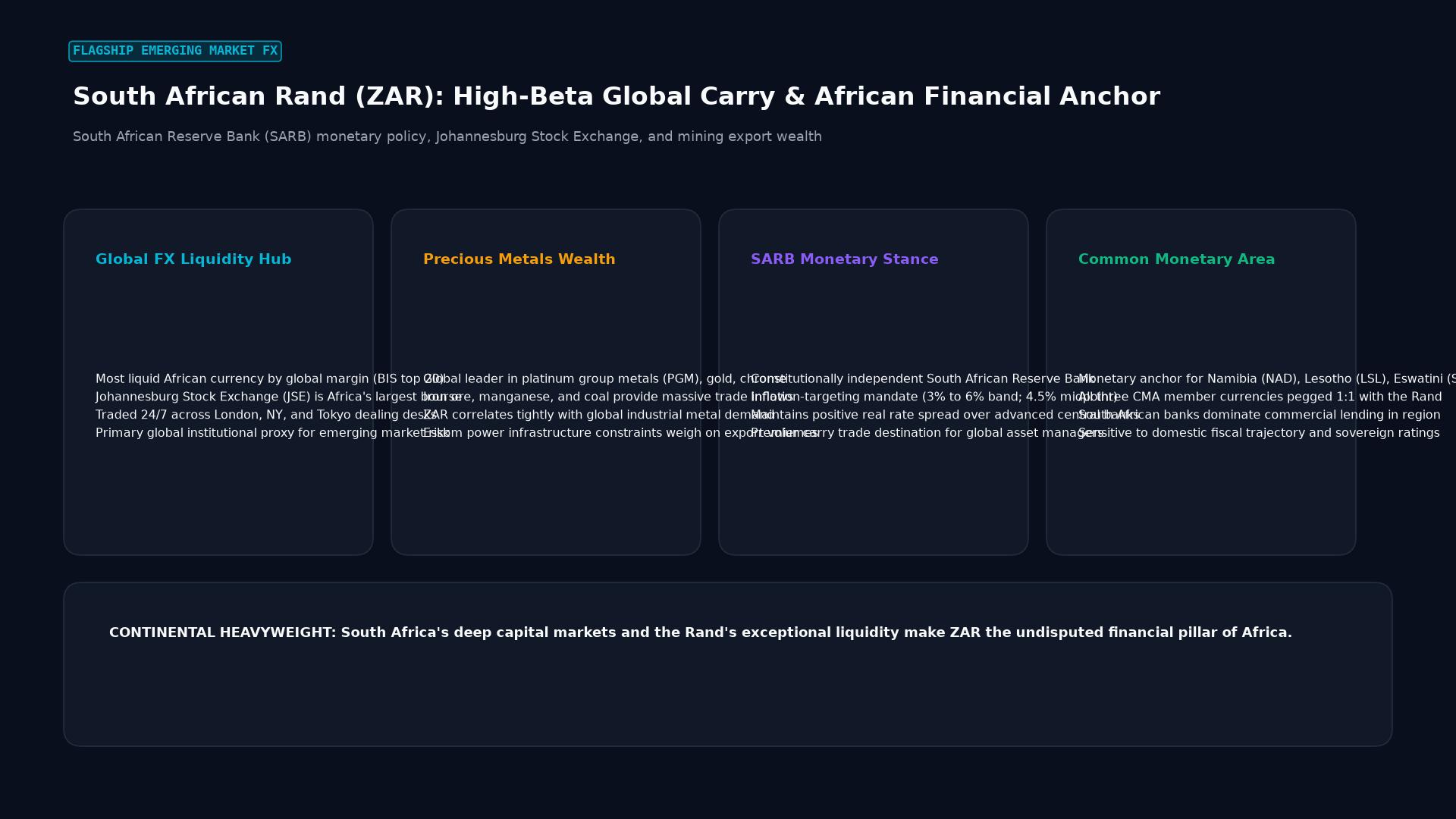 Figure: South African Reserve Bank (SARB) monetary policy, Johannesburg Stock Exchange, and mining export wealth
Economic Drivers & Quantitative Transmission
The valuation of USD/ZAR and EUR/ZAR is driven by a combination of domestic mining fundamentals, global risk appetite, and sovereign interest rate differentials:
1. Commodity Terms of Trade Sensitivity
South Africa is a dominant global supplier of platinum group metals (PGM), gold, chrome, manganese, and coal. Econometric models specify the equilibrium real exchange rate ($\text{REER}$) as a function of the commodity export price index:
$$\Delta \ln(\text{USD/ZAR})t = \alpha + \beta_1 \Delta \ln(\text{PGM Index}t) + \beta_2 (r{\text{SARB}} - r{\text{US}})_t + \beta_3 \Delta \text{VIX}_t + \epsilon_t$$
Where:
- $\beta_1 < 0$: A rise in international precious metal prices increases South African export revenues, appreciating the Rand against the Dollar.
- $\beta_2 < 0$: A wider positive interest rate spread maintained by the South African Reserve Bank (SARB) over the US Fed Funds rate attracts carry trade inflows.
- $\beta_3 > 0$: A spike in global market panic (VIX) triggers an immediate sell-off in high-beta emerging-market currencies.
2. High-Yield Carry Trade Dynamics
The South African Reserve Bank historically maintains real interest rates well above the rate of domestic inflation to anchor price stability and attract offshore capital to finance South Africa’s persistent current account deficit. This makes the Rand a perennial target for cross-currency carry trades against funding currencies like the Japanese Yen (JPY) and Swiss Franc (CHF).
Comparative Matrix: Emerging-Market Carry Currencies
| Currency | ISO | Central Bank Benchmark | Primary Export Drivers | FX Liquidity Rank |
|---|---|---|---|---|
| South African Rand | ZAR | SARB Repo Rate | Platinum, Gold, Iron Ore, Coal | Top 20 globally (Deepest in Africa) |
| Mexican Peso | MXN | Banxico Overnight | Automotive, Electronics, Crude Oil | Top 15 globally (Nearshoring proxy) |
| Brazilian Real | BRL | BCB Selic Rate | Soybeans, Iron Ore, Crude Oil | Top 25 globally (High agricultural beta) |
| Turkish Lira | TRY | CBRT One-Week Repo | Textiles, Automotive, Machinery | High turnover; extreme inflation risk |
Real-World Case Study: “Nenegate” and Sovereign Shock (December 2015)
The Rand’s vulnerability to domestic governance and institutional credibility was demonstrated on December 9, 2015, during an episode financial media dubbed “Nenegate.”
Anatomy of a Domestic Currency Shock:
1. The Incident: South African President Jacob Zuma abruptly dismissed respected Finance Minister Nhlanhla Nene, replacing him with an inexperienced political backbencher, David van Rooyen.
2. Market Reaction: Global investors interpreted the move as an attempt to capture the National Treasury and compromise fiscal discipline regarding costly nuclear procurement programs.
3. The Crash:
   * USD/ZAR exploded from 14.50 to a historic record high of 16.10 within 48 hours (over 10% currency depreciation).
   * Benchmark 10-year sovereign government bond yields surged over 180 basis points, freezing domestic banking liquidity.
   * South African banking equities lost over R170 billion in market capitalization in two trading sessions.
4. The Reversal: Following intense pressure from commercial banking CEOs and senior ruling party officials, Zuma was forced to replace van Rooyen with veteran former Finance Minister Pravin Gordhan after just four days, triggering a relief rally in the Rand.
The episode underscored that despite strong commodity fundamentals, the Rand trades with an acute risk premium tied directly to domestic institutional independence.
Frequently Asked Questions (FAQ)
Why is the South African Rand classified as a commodity currency?
South Africa’s export revenue depends heavily on mineral resources, particularly platinum group metals (the country holds over 70% of global platinum reserves), gold, manganese, iron ore, and diamonds. When industrial demand and prices for these raw materials rise globally, multinational corporations must purchase Rands to settle export transactions and pay domestic mining operational costs, driving up the currency’s value. Conversely, falling commodity prices rapidly deteriorate South Africa’s trade balance and weaken the Rand.
How does the Common Monetary Area (CMA) function with the Rand?
Under the Multilateral Monetary Agreement, Namibia, Lesotho, and Eswatini have pegged their national currencies at a strict 1:1 parity with the South African Rand. While these countries issue their own banknotes, the Rand is accepted as legal tender throughout the CMA. To maintain this fixed peg, member central banks must back their domestic currency liabilities with foreign exchange reserves held in Rands and follow the monetary policy decisions set by the South African Reserve Bank (SARB).
Why does the Rand experience higher volatility than many other emerging-market currencies?
The Rand’s high volatility is a byproduct of its superior liquidity. South Africa has the most sophisticated financial market on the African continent, with a fully convertible currency, zero foreign exchange controls for non-resident investors, and deep 24-hour interbank trading. Consequently, when global macro hedge funds need to hedge emerging-market risk or reduce risk-on exposure during a global sell-off, they can sell the Rand immediately without causing the liquidity freezes seen in more restrictive emerging markets.
Ready to trade forex?
Open a free demo account with a regulated broker. Practice with virtual funds before risking real money.