LSL
LSL is the ISO 4217 currency code for the Lesotho Loti, the national currency of the Kingdom of Lesotho, issued by the Central Bank of Lesotho and pegged at a strict 1:1 parity with the South African Rand under the Common Monetary Area agreement.
What Is the LSL?
The LSL is the three-letter ISO 4217 currency code for the Lesotho Loti (plural: Maloti), the official currency of the Kingdom of Lesotho. Subdivided into 100 lisente (singular: sente), the loti is issued, managed, and regulated by the Central Bank of Lesotho (Banka e Kholo ea Lesotho - CBL), headquartered in the capital city of Maseru.
In international macroeconomics, the Lesotho Loti offers a premier case study in regional monetary integration. Geographically, Lesotho is an enclaved sovereign nation entirely surrounded by the Republic of South Africa. Because of its complete geographical enclosure and overwhelming trade dependence on its larger neighbor, Lesotho operates within the Common Monetary Area (CMA), maintaining a permanent 1:1 fixed parity peg between the Lesotho Loti and the South African Rand (ZAR).
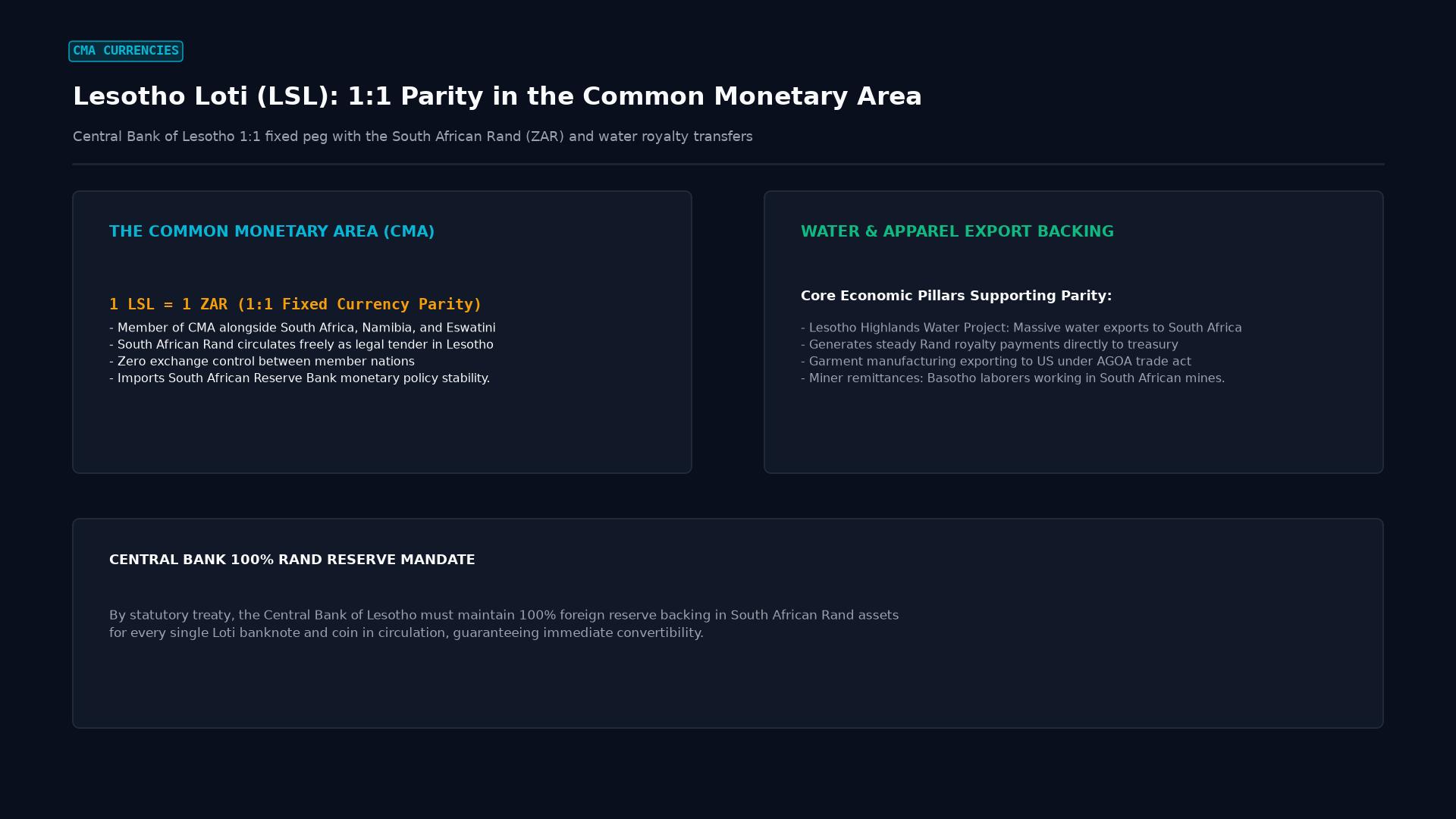 Figure: Central Bank of Lesotho 1:1 fixed peg with the South African Rand (ZAR) and water royalty transfers
The Common Monetary Area (CMA) Framework
The institutional foundation of the LSL is governed by the Common Monetary Area multilateral agreement, comprising South Africa, Lesotho, Namibia, and Eswatini:
1. The 1:1 Currency Parity Peg
Under the terms of the CMA treaty, one Lesotho Loti is legally defined as equal in value to one South African Rand:
1 LSL = 1 ZARThis exchange rate is fixed by international treaty rather than determined by speculative market bidding. There are no currency conversion fees or administrative spreads when exchanging South African Rand for Lesotho Maloti inside Lesotho.
2. Dual Legal Tender in Lesotho
While the Lesotho Loti is the national currency, the South African Rand enjoys official legal tender status throughout Lesotho. Commercial merchants, hospitality resorts, petrol stations, and government utility departments accept South African Rand banknotes and coins alongside Maloti at exact face value.
However, the reverse does not apply: the Lesotho Loti is not legal tender inside South Africa. Merchants in South African cities like Johannesburg or Durban do not accept Maloti cash, though South African commercial banks near the border convert Maloti back into Rand.
3. Mandatory 100% Reserve Backing
To guarantee the integrity of the fixed peg and eliminate the risk of a currency run, the Central Bank of Lesotho is legally bound by the CMA treaty to maintain foreign exchange reserves equal to 100% of the total amount of Maloti issued into circulation.
These statutory reserves must be held in interest-bearing South African Rand deposits at the South African Reserve Bank, South African sovereign Treasury bills, or physical Rand cash vault reserves. If domestic demand for Maloti expands, the CBL can issue new banknotes only if it deposits an equivalent amount of South African Rand into its reserve vaults.
Macroeconomic Pillars Supporting the Lesotho Economy
Because Lesotho cannot unilaterally devalue its currency to stimulate trade, the nation’s balance of payments depends on five structural economic pillars:
| Economic Pillar | Operational Mechanism | Impact on Foreign Exchange Reserves |
|---|---|---|
| Southern African Customs Union (SACU) | Common external tariff pool shared among South Africa, Botswana, Lesotho, Namibia, and Eswatini | Foundational fiscal revenue; SACU receipts routinely account for 30% to 50% of total state budget revenue |
| Lesotho Highlands Water Project (LHWP) | Massive engineering dams (Katse and Mohale) delivering fresh mountain water to South Africa’s industrial Gauteng hub | Generates reliable, long-term monthly royalties and clean hydroelectric power |
| Diamond Mining Sector | High-value artisanal and commercial kimberlite pipe mines (such as the world-renowned Lētšeng mine) | Produces exceptional high-clarity rough diamonds, representing a major source of global export earnings |
| Apparel Manufacturing (AGOA) | Garment factories in Maseru exporting denim jeans and knitwear duty-free to the United States | Largest private-sector employer; highly sensitive to United States trade policy renewals |
| Migrant Labor Remittances | Basotho miners, construction staff, and agricultural professionals working across South Africa | Inflows of South African Rand remitted directly to rural households |
Monetary Policy Transmission Under the CMA
Under the Mundell-Fleming economic trilemma, because Lesotho maintains an open capital account with South Africa and fixes its currency 1:1 with the Rand, the Central Bank of Lesotho forfeits independent domestic interest rate policy.
Whenever the Monetary Policy Committee (MPC) of the South African Reserve Bank raises or lowers its benchmark repo rate, the Central Bank of Lesotho’s MPC must match the move almost immediately.
If the CBL were to set its policy interest rate significantly lower than South Africa’s rate, commercial capital would instantly flee across the border into South African commercial bank accounts to capture higher yields, rapidly depleting the CBL’s foreign reserve backing. Consequently, interest rates on personal loans, mortgages, and commercial credit in Lesotho are tied directly to South African financial conditions.
Foreign Exchange Microstructure and FX Trading
For international financial institutions, corporate treasurers, and global currency desks, interacting with the LSL involves specific institutional conventions:
- Proxy Trading via the South African Rand: In global foreign exchange markets, there is no active, independent spot or derivatives trading for USD/LSL or EUR/LSL. Institutional desks trade the highly liquid South African Rand (USD/ZAR) as the exact financial proxy for the Lesotho Loti.
- Freedom of Capital Transfer within the CMA: Capital transfers between Lesotho and South Africa face zero exchange control restrictions, allowing multinational corporations operating in Maseru to sweep cash into South African treasury accounts seamlessly.
- External Exchange Controls: Capital leaving the Common Monetary Area (for instance, wiring funds from Maseru to London, New York, or Tokyo) is subject to harmonized CMA foreign exchange regulations administered under South African Reserve Bank guidelines to prevent illicit capital flight.
Key Takeaways
- The LSL (Lesotho Loti) is the official currency of the Kingdom of Lesotho, issued by the Central Bank of Lesotho.
- The currency is pegged at permanent 1:1 parity with the South African Rand (ZAR) under the Common Monetary Area (CMA) treaty.
- The South African Rand circulates as legal tender inside Lesotho alongside the Loti, but the Loti does not circulate inside South Africa.
- The Central Bank of Lesotho must maintain 100% reserve backing in South African Rand assets for every Loti in circulation.
- National fiscal health and foreign reserves depend heavily on Southern African Customs Union (SACU) revenue sharing, the Lesotho Highlands Water Project royalties, diamond mining, and textile manufacturing.
Frequently Asked Questions
Can an international traveler spend South African Rand inside Lesotho?
Yes. South African Rand banknotes and coins are accepted across Lesotho, from hotels and restaurants to local market vendors and transport operators. Because the exchange rate is permanently fixed at 1:1, there is no exchange calculation or fee.
What is the Lesotho Highlands Water Project (LHWP)?
The Lesotho Highlands Water Project is a multi-phase water supply and hydroelectric scheme. High-altitude mountain water collected behind Lesotho’s dams is transferred through gravity tunnels into South Africa’s Vaal river system to supply water to Johannesburg and Pretoria, providing Lesotho with substantial monthly royalties and domestic electricity.
Why does the Lesotho Loti trade at the exact same value as the South African Rand?
The loti is tied to the rand through a binding international treaty (the Common Monetary Area agreement) that legally guarantees 1:1 convertibility. The Central Bank of Lesotho backs every loti with matching rand reserves, ensuring absolute parity.
Ready to trade forex?
Open a free demo account with a regulated broker. Practice with virtual funds before risking real money.