TJS
The ISO 4217 currency code for the Tajikistani Somoni, the official legal tender of the Republic of Tajikistan issued and managed by the National Bank of Tajikistan.
TJS (Tajikistani Somoni)
The Tajikistani Somoni (ISO code: TJS) is the official national currency of the Republic of Tajikistan. Subdivided into 100 dirams, the somoni was introduced on October 30, 2000, replacing the transitional Tajikistani ruble at an exchange ratio of 1 somoni to 1,000 rubles. Named in honor of Ismail Samani (Ismoili Somoni), the 9th-century founder of the Samanid dynasty, the currency is issued, supervised, and defended by the central monetary authority, the National Bank of Tajikistan (NBT, or Bonki Millii Tojikiston).
From an international macroeconomics and foreign exchange perspective, the somoni is a small-economy, non-convertible frontier market currency. Its external valuation, domestic liquidity, and structural balance of payments are heavily defined by two primary variables: cross-border labor remittances generated by Tajik migrant workers in the Russian Federation, and export earnings derived from raw aluminum processing and cotton agriculture.
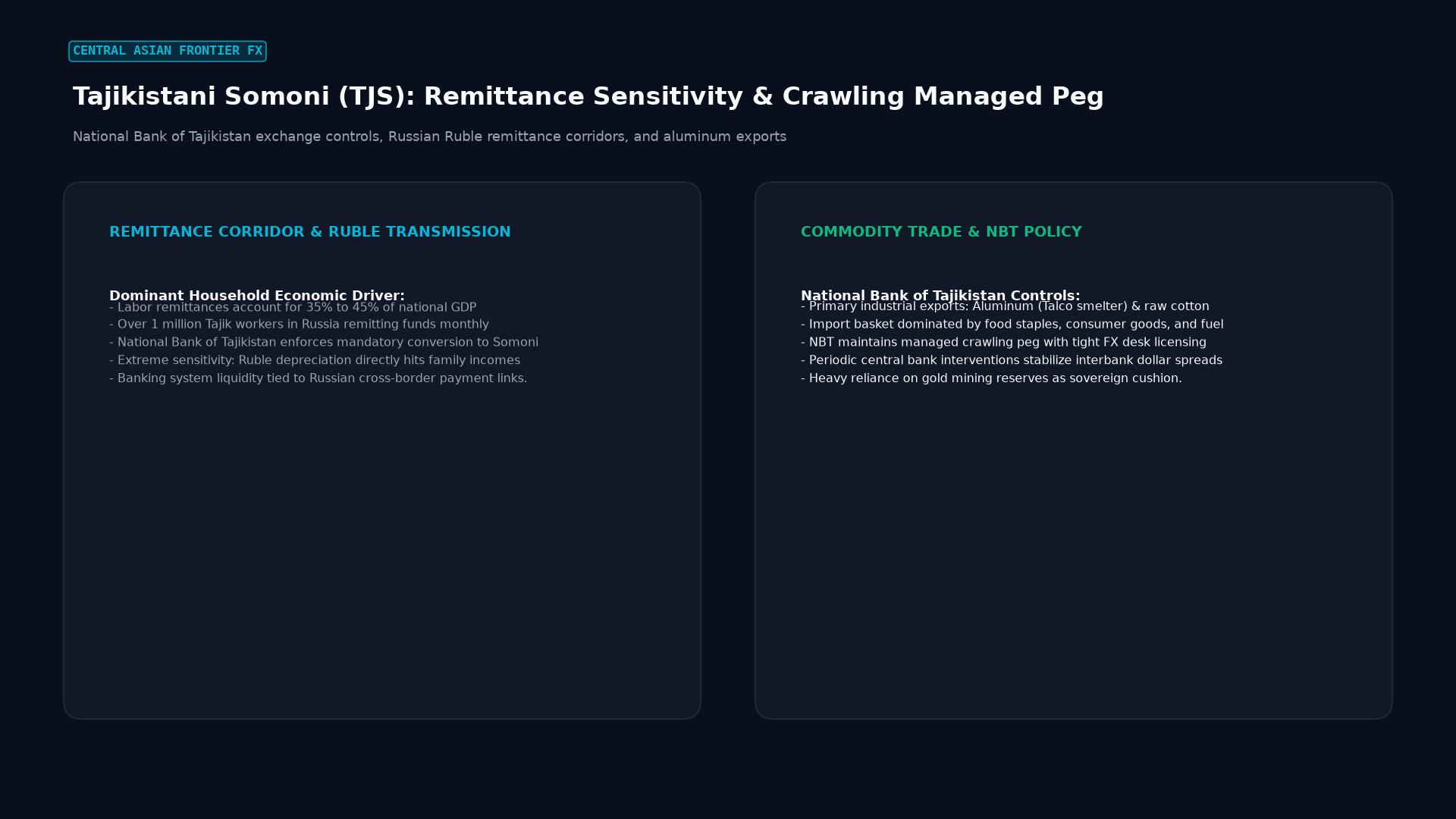 Figure: National Bank of Tajikistan exchange controls, Russian Ruble remittance corridors, and aluminum exports
Historical Context and Currency Evolution
Following the dissolution of the Soviet Union in late 1991, Tajikistan was plunged into a devastating five-year civil war (1992-1997) that demolished industrial infrastructure and disrupted fiscal administration. Tajikistan remained inside the post-Soviet ruble zone longer than almost any other successor republic:
- Pre-1995 Monetary Chaos: Until May 1995, Russian rubles circulated as legal tender alongside various Soviet-era legacy banknotes. This left the fledgling state vulnerable to exported Russian inflation and currency smuggling.
- Tajikistani Ruble (TJR): On May 10, 1995, the Tajikistani ruble was launched as an emergency transitional currency at an exchange rate of 1 Tajik ruble = 100 Russian rubles. Rapid fiscal monetisation, wartime deficits, and severe supply constraints led to chronic inflation, eroding public trust in paper money.
- Introduction of the Somoni (2000): Following the stabilization of the political environment and economic normalization supervised by the International Monetary Fund (IMF), the government launched the Somoni on October 30, 2000. Banknotes denominated in dirams and somoni entered circulation, while the old Tajik rubles were phased out through November 2000.
The somoni successfully anchored the national payment system, but persistent structural current account deficits have driven secular depreciation against the US dollar and other hard reserve currencies over the subsequent decades.
Monetary Policy Framework of the National Bank of Tajikistan
The National Bank of Tajikistan operates under an inflation-targeting framework, using the refinancing rate as its primary benchmark policy instrument. The monetary regime must manage structural liquidity imbalances, shallow domestic debt markets, and high financial dollarization.
FX Regime: Managed Floating with Interbank Constraints
Tajikistan officially maintains a managed floating exchange rate regime. In practice, the NBT exercises tight supervisory oversight and frequent direct interventions:
- Official Fixing Rate: Calculated daily by the NBT on the basis of weighted average transaction rates recorded on the interbank foreign exchange market and over-the-counter credit organization transactions.
- Corridor Limits: The NBT enforces narrow margins around the official rate within which commercial credit institutions and foreign exchange bureaus are authorized to buy and sell cash foreign currency.
- Liquidity Restrictions: During periods of acute foreign exchange shortages, the NBT conducts direct rationing, allocating foreign reserves to systemic banks for priority imports (petroleum products, basic grains, pharmaceuticals) while restricting speculative capital movements.
       Macroeconomic Equilibrium Condition:

       CAB + FAB = Delta FX_Reserves

       Where:
       CAB = (X_Alum + X_Cot + X_Gold - M_Goods) + Remittances
       FAB = Net Foreign Direct Investment + Bilateral Loans (e.g., China Exim Bank)
If net remittance inflows drop sharply or Russian financial sanctions restrict cross-border wire transfers, the current account balance deteriorates rapidly, forcing the NBT to choose between draining its international reserve buffer or allowing the somoni to devalue.
Key Drivers of Somoni Valuation
1. Labor Remittances from Russia
Tajikistan ranks among the most remittance-dependent economies in the world. Personal remittances sent home by Tajik expatriates working in Russia have historically ranged between 28% and 40% of Tajikistan’s annual gross domestic product (GDP).
Remittance dynamics create a unique cross-currency transmission channel:
- Workers earn wages in Russian rubles (RUB).
- Remittances are routed into Tajikistan through digital payment systems and money transfer operators.
- Under NBT regulations enacted in 2016, incoming cross-border personal money transfers received in foreign currency must be paid out to beneficiaries inside Tajikistan strictly in domestic somoni, converted at the official NBT rate of the transaction day.
- Consequently, sharp movements in the value of the Russian ruble directly impact the somoni’s equilibrium rate. If the ruble depreciates steeply against the US dollar, the purchasing power of remittances collapses, depressing domestic demand and driving pressure on the TJS/USD exchange rate.
2. Export Concentration: Aluminum and Cotton
Tajikistan’s merchandise export base is concentrated in basic commodities:
- Aluminum Processing: The state-owned Tajikistan Aluminum Company (TALCO) in Tursunzoda runs one of the largest aluminum smelting facilities in Central Asia. TALCO imports raw alumina and exports refined aluminum ingots, making the country sensitive to global aluminum price shifts on the London Metal Exchange (LME).
- Raw Cotton: Agriculture provides employment for a vast segment of the rural population. Cotton fibers are exported to regional textile hubs, making domestic rural liquidity seasonal and weather-dependent.
- Gold and Precious Metals: In recent years, the NBT has accumulated domestically mined gold to build sovereign reserve buffers, monetizing mining output directly onto the central bank balance sheet.
3. Bilateral Debt and Chinese Infrastructure Financing
Tajikistan has borrowed heavily from the Export-Import Bank of China to fund critical national transport and energy infrastructure, including highways through the Pamir mountains and electrical transmission grids. Debt service obligations denominated in foreign hard currencies create persistent structural outflows, elevating long-term sovereign foreign exchange requirements.
Comparison: Central Asian Currencies
| Currency Code | Country | Central Bank | Exchange Rate Regime | Primary Economic Anchor |
|---|---|---|---|---|
| TJS | Tajikistan | National Bank of Tajikistan | Managed float | Remittances (RUB), Aluminum, Cotton |
| KGS | Kyrgyzstan | National Bank of the Kyrgyz Republic | Managed float | Remittances (RUB), Gold (Kumtor), Re-exports |
| UZS | Uzbekistan | Central Bank of Uzbekistan | Crawling managed float | Natural gas, Gold, Textiles, Remittances |
| KZT | Kazakhstan | National Bank of Kazakhstan | Floating with interventions | Crude oil, Uranium, Ferrous metals |
| TMT | Turkmenistan | Central Bank of Turkmenistan | Fixed official peg (multi-tier) | Natural gas exports (China pipeline) |
Practical Trading Realities and Foreign Exchange Constraints
For international currency managers and corporate treasuries, the Tajikistani somoni presents unique operational parameters:
- Lack of Offshore Derivatives: There is no liquid offshore non-deliverable forward (NDF) market for the TJS. Hedging currency risk on corporate exposures inside Tajikistan must generally be managed through operational balancing, pricing structures, or local currency borrowings.
- Convertibility Barriers: Commercial banks in Tajikistan face compliance mandates regarding foreign currency sales. Entities seeking to convert large somoni balances into USD or EUR must present documented proof of underlying economic transactions, such as valid import contracts, customs declarations, or verified loan servicing schedules.
- Bilateral De-Dollarization: Given trade patterns, bilateral settlements with Russia and China are increasingly routed through direct ruble-somoni and yuan-somoni bank settlement clearing lines, bypassing intermediate conversions through US dollars.
Hypothetical Case Study: Corporate Currency Risk at an Import Distributor
Consider Dushanbe Distribution Logistics (DDL), an importer of European commercial agricultural machinery based in Dushanbe.
Transaction Parameters
- Order Commitment: DDL signs a contract on March 1 to purchase specialized irrigation equipment from an Italian manufacturer for EUR 500,000, payable upon delivery on October 1.
- Local Revenue Base: DDL contracts to sell this equipment to domestic cotton agricultural cooperatives for a fixed sum of TJS 6,250,000, payable upon delivery.
- Initial Exchange Rate: On March 1, the spot exchange rate stands at: $$\text{EUR/TJS} = 11.50$$ The expected cost of the machinery is: $$500,000 \times 11.50 = \text{TJS } 5,750,000$$ Projected gross margin: $$6,250,000 - 5,750,000 = \text{TJS } 500,000 \quad (8.0%)$$
Currency Shock Scenario
During the summer, extreme volatility in the Russian economy drives a 25% depreciation in the Russian ruble, leading to a contraction in worker remittance transfers to Tajikistan. Domestic foreign exchange shortages emerge in Dushanbe. The NBT allows the somoni to adjust downward to preserve hard reserves.
- On October 1, the spot exchange rate reaches: $$\text{EUR/TJS} = 13.20$$
- DDL must convert somoni to pay the Italian supplier EUR 500,000: $$\text{Total Cost} = 500,000 \times 13.20 = \text{TJS } 6,600,000$$
- Net financial outcome: $$6,250,000 - 6,600,000 = -\text{TJS } 350,000$$ DDL incurs an operational loss of TJS 350,000 due to unhedged exchange rate depreciation.
Strategic Mitigation
To avoid unhedged losses in an environment lacking exchange-traded forward contracts, multinational suppliers operating in frontier markets like Tajikistan utilize:
- Hard-currency pegging clauses in domestic sales contracts (pricing equipment in somoni indexed to the official EUR/TJS rate on invoice settlement date).
- Advanced letter-of-credit (LC) funding where foreign exchange is secured at contract initiation.
- Pre-export customer advance financing.
Frequently Asked Questions
What is the difference between the Tajikistani ruble and the Tajikistani somoni?
The Tajikistani ruble (TJR) was the provisional national currency used between May 1995 and October 2000. It suffered from hyperinflation caused by civil war disruptions and fiscal deficits. The Tajikistani somoni (TJS) was introduced in October 2000 at a redenomination rate of 1 somoni = 1,000 old rubles to re-establish monetary credibility, backed by structural macroeconomic reforms supervised by the IMF.
Why is the value of the Tajikistani somoni linked to the Russian ruble?
Tajikistan’s economy depends heavily on remittances sent home by hundreds of thousands of Tajik citizens working in the Russian Federation. Because these workers earn wages in Russian rubles, any sharp depreciation of the ruble reduces the foreign currency equivalent entering Tajikistan’s financial system. In addition, Russia remains Tajikistan’s largest trading partner for energy imports, meaning ruble fluctuations alter the bilateral terms of trade.
Can retail investors trade TJS on standard retail forex brokerage platforms?
No. The Tajikistani somoni is not traded on international retail forex platforms or major financial exchanges. Because of strict exchange controls, capital mobility restrictions, and lack of a liquid interbank market outside Dushanbe, the somoni is categorized as an illiquid frontier currency. Physical currency exchange is primarily conducted at licensed banks and authorized exchange offices within Tajikistan.
Ready to trade forex?
Open a free demo account with a regulated broker. Practice with virtual funds before risking real money.