TMM
The legacy ISO 4217 currency code for the first Turkmenistani Manat, which served as the official legal tender of Turkmenistan from November 1, 1993, until its replacement by the modern Manat (TMT) on January 1, 2009.
TMM (Turkmenistani Manat, First Generation)
The currency code TMM designates the first iteration of the Turkmenistani Manat, the sovereign currency of Turkmenistan from November 1, 1993, until December 31, 2008. The manat replaced the post-Soviet Russian ruble at an initial conversion rate of 1 manat = 500 rubles. Subdivided into 100 teńńe, the first manat experienced prolonged monetary instability, severe inflation, multiple parallel exchange rate regimes, and extensive state intervention before being redenominated.
On January 1, 2009, the Central Bank of Turkmenistan (Türkmenistanyň Merkezi Banky) retired the TMM in favor of the second manat (assigned ISO code TMT) at a conversion ratio of 5,000 old manat (TMM) = 1 new manat (TMT). Understanding the structural dynamics of the TMM provides financial historians and macroeconomists with insight into the challenges of post-Soviet transition economies, currency overvaluation, resource-curse dynamics, and multi-tier exchange rate distortion.
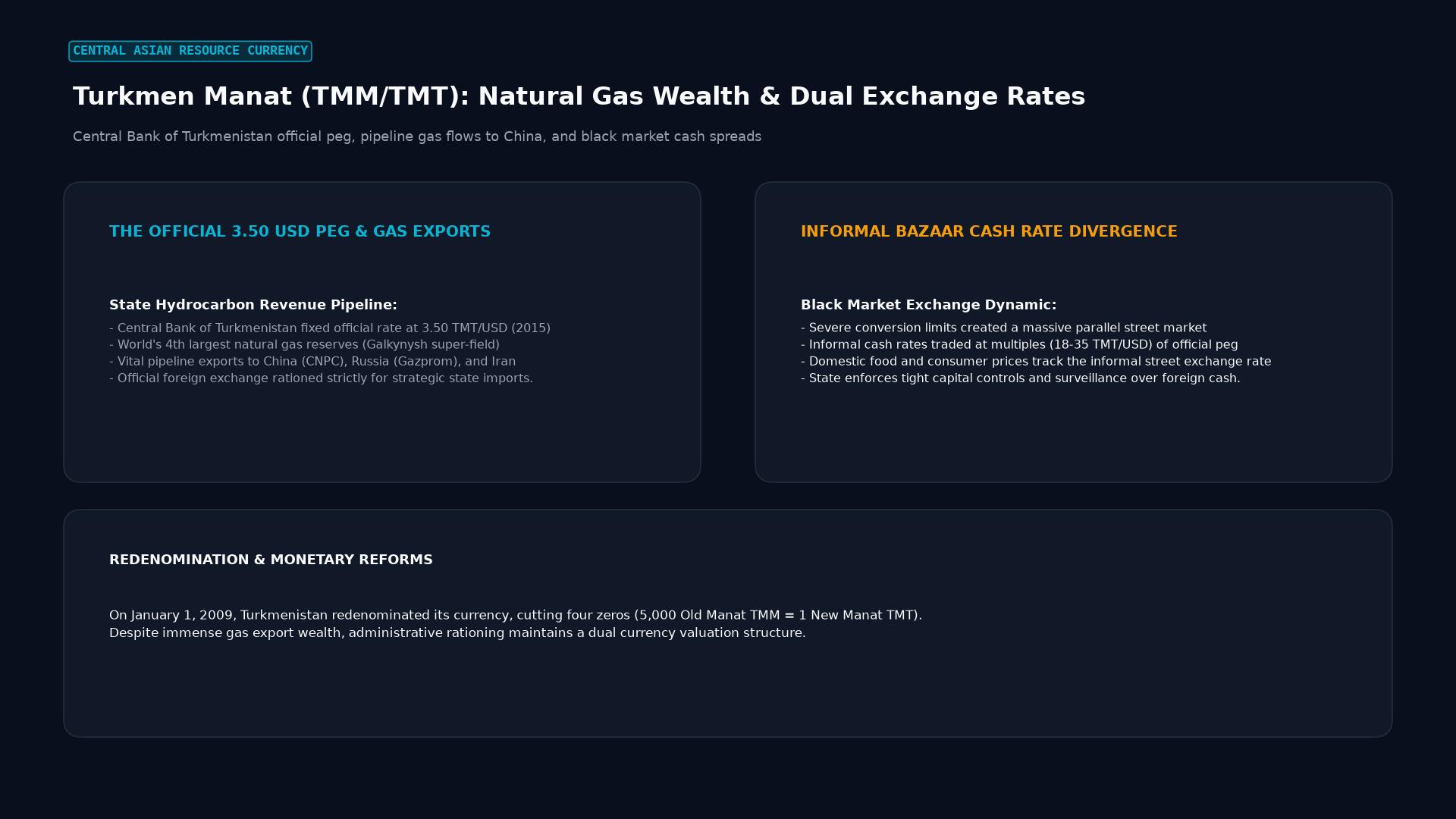 Figure: Central Bank of Turkmenistan official peg, pipeline gas flows to China, and black market cash spreads
Historical Genesis and Post-Soviet Monetary Separation
Following the collapse of the USSR in December 1991, Turkmenistan attempted to remain within the common ruble area. However, hyperinflation emanating from the Central Bank of Russia and competitive credit expansion among newly independent republics created unsustainable macroeconomic chaos.
- Launch in November 1993: Turkmenistan formally exited the ruble zone on November 1, 1993. The first manat was issued at an introductory exchange rate of 1 TMM = 500 Russian rubles, or approximately 2 TMM per 1 US dollar.
- Immediate Inflationary Spiral: Without institutional independence, the Central Bank of Turkmenistan was deployed to directly finance massive agricultural subsidies, public sector payrolls, and prestigious state-directed capital construction projects.
- Loss of Anchor: By late 1995, annual consumer price inflation surged past 1,000%. The official peg to the US dollar was repeatedly adjusted downward, but state adjustments lagged behind market reality.
- Demonetization of Coins: Rapid depreciation quickly rendered the fractional teńńe coins economically obsolete. Denominations escalated from 1, 5, and 10 manat banknotes in 1993 to notes of 1,000, 5,000, and ultimately 10,000 TMM by the late 1990s and early 2000s.
The Dual Exchange Rate Architecture
The most defining institutional characteristic of the TMM era was the prolonged coexistence of an artificially strong official exchange rate alongside an unauthorized parallel commercial street market.
The Official Rate vs. The Black Market
The Turkmen government enforced strict foreign exchange allocation rules. State-owned enterprises (SOEs) operating in priority sectors, such as oil extraction, natural gas development, cotton processing, and state-backed grain distribution, were permitted to acquire foreign currency at the subsidized official rate:
- In the early 2000s, the official exchange rate was administratively fixed at 5,200 TMM per 1 USD.
- Outside of favored state entities, private citizens, retail merchants, and non-sanctioned businesses were legally barred from purchasing foreign currency at the central bank window.
- As a consequence, a vibrant parallel black market developed. On the street market, the US dollar traded between 24,000 TMM and 25,000 TMM per 1 USD, representing a divergence of nearly 400% to 500% from the official rate.
       Exchange Rate Divergence Formula:

       Premium = [(E_Parallel - E_Official) / E_Official] * 100

       With E_Official = 5,200 TMM/USD and E_Parallel = 24,000 TMM/USD:

       Premium = [(24,000 - 5,200) / 5,200] * 100 = 361.5%
This massive gap created severe economic distortions:
- Rent-Seeking and Arbitrage: Economic actors with privileged access to official foreign currency allocations could import goods at the 5,200 rate, sell them on the domestic market at prices reflecting the 24,000 rate, and pocket immense economic rents.
- Dismantling of Non-Resource Exports: Domestic producers outside the energy sector could not compete against subsidized official imports, stunting economic diversification.
- Understated GDP and Distorted National Accounts: Calculating Turkmenistan’s gross domestic product using the official rate inflated the country’s dollar-denominated output to unrealistic levels, whereas using the parallel rate reflected stark poverty indicators.
Hydrocarbon Dynamics and Sovereign Balance of Payments
Turkmenistan holds some of the world’s largest proven natural gas reserves, centered around the supergiant Galkynysh gas basin and Dauletabad fields. The macroeconomic destiny of the TMM was tied to gas export politics.
Throughout the 1990s and early 2000s, Turkmenistan was geographically constrained by the Soviet-era Central Asia-Center (CAC) pipeline system controlled by Russia’s Gazprom:
- Gas shipments were frequently subject to price disputes, payment arrears, and transit shutdowns.
- Barter trade often substituted for cash settlement, depriving the Central Bank of hard foreign currency earnings needed to stabilize the domestic currency.
- When export cash receipts arrived, they were diverted into extra-budgetary state funds (such as the Foreign Exchange Reserve Fund, directly controlled by the executive presidency) rather than channeled through transparent foreign exchange auctions.
The 2008-2009 Currency Reform and Transition to TMT
Following the death of President Saparmurat Niyazov in late 2006, the new administration initiated extensive economic stabilization measures aimed at dismantling the destructive dual-currency regime.
Phase 1: Unification of the Exchange Rate (2008)
In April and May 2008, the Central Bank of Turkmenistan unified the official and parallel exchange rates. A single commercial bank exchange rate was established at approximately 14,250 TMM per 1 USD, devaluing the official rate while strengthening the street market toward a sustainable clearing point. Interbank currency auctions were introduced.
Phase 2: Structural Redenomination (January 1, 2009)
Having stabilized the unified rate, the government executed a full monetary redenomination:
- Conversion Ratio: 5,000 TMM (old manat) = 1 TMT (new manat).
- New Banknotes: The state introduced modern banknotes featuring historical Turkmen figures, replacing the ubiquitous portraits of the former president.
- Dual Circulation Period: The old TMM banknotes remained legal tender alongside new TMT notes throughout 2009. Commercial banks were mandated to exchange old notes without fee or commission until the end of 2010, with central bank exchange facilities extended further.
- Unified Peg Established: The new currency was pegged at 2.85 TMT per 1 USD (equivalent to 14,250 TMM), providing monetary stability for several years before subsequent macroeconomic shocks forced an adjustment to 3.50 TMT in 2015.
+-------------------------------------------------------------------------+
|                  Chronology of Turkmen Currency Codes                   |
+-------------------------------------------------------------------------+
| Period            | ISO Code | Baseline Peg / Valuation Mode            |
| 1993 - 2000       | TMM      | High inflation, multiple devaluations    |
| 2000 - 2008       | TMM      | Dual rate: 5,200 Official / 24,000 Black |
| 2008 (Mid)        | TMM      | Unified clearing rate: 14,250 TMM/USD    |
| 2009 - 2014       | TMT      | Redenominated 5,000:1; Pegged at 2.85    |
| 2015 - Present    | TMT      | Pegged at 3.50; Parallel market renewed  |
+-------------------------------------------------------------------------+
Analytical Lessons from the TMM Monetary Regime
The collapse and ultimate redenomination of the TMM offer core case study lessons in applied monetary economics:
- Infeasibility of Fixed Pegs Without Convertibility: An official fixed exchange rate unsupported by open central bank foreign exchange window convertibility simply pushes economic activity into unauthorized parallel markets.
- Fiscal Dominance Destroys Credibility: When central banks are subordinated to sovereign budgetary funding requirements, money supply growth outpaces real GDP, guaranteeing currency degradation.
- Redenomination Demands Macroeconomic Realignment: Removing zeros from banknotes is an accounting convention that fails unless accompanied by fiscal balance, price liberalization, and unification of foreign exchange clearing mechanisms.
Frequently Asked Questions
What was the official replacement ratio between the TMM and the modern TMT?
The official replacement ratio was 5,000 old manat (TMM) to 1 new manat (TMT), enacted on January 1, 2009. For example, a 10,000 TMM banknote was exchanged for 2 new TMT manat. At the time of redenomination, the unified exchange rate was 2.85 TMT per 1 US dollar.
Can old TMM banknotes still be exchanged or redeemed today?
No. The formal transitional exchange window managed by the Central Bank of Turkmenistan has expired. TMM banknotes are demonetized, have no legal tender status, and hold value only as historical artifacts or collectibles for numismatists.
Why did Turkmenistan maintain a dual exchange rate during the TMM era?
The state maintained a dual exchange rate to subsidize critical state-owned enterprises, manage capital flight, and artificially lower the cost of government equipment imports for massive infrastructure programs. However, this policy severely distorted domestic pricing, discouraged private sector investment, and caused extensive economic rent-seeking until unified in 2008.
Ready to trade forex?
Open a free demo account with a regulated broker. Practice with virtual funds before risking real money.