Dual Exchange Rate
A dual exchange rate (two-tier exchange rate system) is a currency regime where a sovereign nation maintains two distinct exchange rates simultaneously, typically separating commercial trade from financial capital flows.
What Is a Dual Exchange Rate?
A dual exchange rate (historically termed a two-tier exchange rate system or multiple currency practice) is a macroeconomic regime in which a national government or central bank establishes and enforces two separate exchange rates for the exact same sovereign currency simultaneously.
Rather than allowing all foreign exchange transactions to clear at a single market equilibrium rate, a dual exchange rate regime intentionally segments the foreign exchange market into two distinct, insulated categories:
- The Commercial (Official) Rate: An artificially overvalued, government-pegged rate reserved strictly for prioritized national needs—such as importing vital necessities (food, life-saving medicines, petroleum) and servicing sovereign foreign debt.
- The Financial (Market or Parallel) Rate: A heavily depreciated, floating, or government-controlled secondary rate applied to non-essential consumer goods, overseas tourism, luxury imports, and private capital account transfers.
When governments fail to provide sufficient foreign currency reserves at the official rate, the secondary tier frequently detaches into an informal or illicit parallel black-market exchange rate, creating profound economic distortions and arbitrage opportunities.
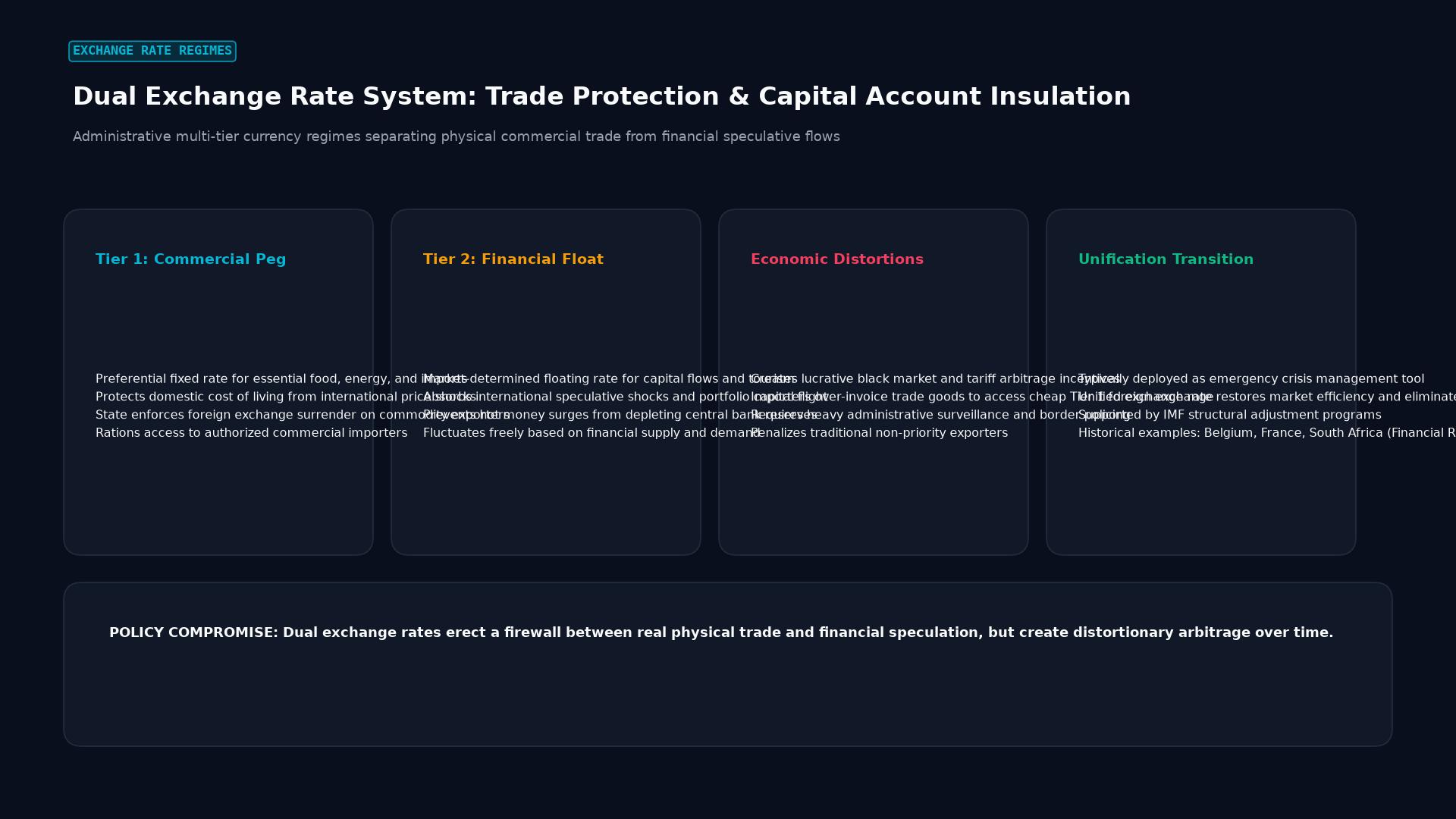 Figure: Administrative multi-tier currency regimes separating physical commercial trade from financial speculative flows
Key Takeaways
- Insulating National Reserves: The theoretical objective of a dual exchange rate is to prevent speculative capital flight from draining the central bank’s foreign reserves while keeping essential domestic food and medicine affordable.
- The Parallel FX Premium: The percentage spread between the official rate and the free-market/black-market rate measures the true underlying overvaluation and fiscal stress of the sovereign economy.
- Severe Economic Distortions: Dual regimes inevitably spawn pervasive corruption, rent-seeking, smuggling, over-invoicing of imports, and under-invoicing of exports.
- IMF Opposition: The International Monetary Fund (IMF) strongly discourages multiple currency practices under Article VIII of its Articles of Agreement, requiring nations to unify exchange rates as a mandatory condition for sovereign bailout loans.
The Economics of Market Segmentation: Commercial vs. Financial
Governments typically enact dual exchange rates during acute balance-of-payments crises, rationing foreign currency according to state priorities:
| Exchange Rate Tier | Relative Valuation | Permitted Market Participants | Core Economic Function |
|---|---|---|---|
| Tier 1: Commercial (Official) Rate | Heavily Overvalued (e.g., Official: $1 USD = 200 Pesos) | State-owned enterprises, licensed pharmaceutical importers, basic food distributors | Dampens domestic cost-push inflation on survival necessities |
| Tier 2: Financial / Parallel Rate | Heavily Depreciated (e.g., Parallel: $1 USD = 1,000 Pesos) | Private corporations, retail consumers, tourists, foreign investors | Forces discretionary consumers to pay the true market cost of foreign currency |
$$\text{Parallel Market Premium} = \left( \frac{\text{Parallel Market Rate} - \text{Official Rate}}{\text{Official Rate}} \right) \times 100%$$
When this premium exceeds 50% to 100%, the formal economic system begins to break down, as business entities divert all energy into currency arbitrage.
Pervasive Distortions: The Anatomy of Currency Arbitrage
While intended as temporary stabilization measures, dual exchange rates create powerful incentives for fraudulent financial engineering:
1. Over-Invoicing of Imports
Importers bribe customs officials to approve invoices claiming that a shipment of medical supplies cost $10,000,000 USD at the cheap official rate, when the true wholesale cost was only $2,000,000. The importer acquires $10 million in official foreign reserves from the central bank, pays the supplier $2 million, and sells the remaining $8 million on the black market at a massive 400% markup, pocketing millions in riskless profit.
2. Under-Invoicing of Exports & Smuggling
Exporters of domestic commodities (such as grain, oil, or minerals) are legally required to surrender their foreign earnings to the central bank at the punitively low official rate. To avoid this confiscation, exporters smuggle goods across borders or falsify shipping manifests, leaving their hard currency in offshore tax havens.
How Dual Exchange Rates Fuel Corruption:
Obtain USD at Cheap Official Rate (1:200) ──► Falsify Import Customs Invoices
                                                           │
                                                           ▼
Pocket Difference & Sell on Black Market (1:1,000) ◄── Smuggle Goods Offshore
Historical and Contemporary Case Studies
Dual and multiple exchange rate systems have appeared across both developed and emerging nations:
1. The Belgium-Luxembourg Two-Tier System (1957–1990)
During the European post-war reconstruction, Belgium operated a successful, regulated two-tier foreign exchange market: an official market for commercial trade (pegged via central bank intervention) and a free market for financial capital flows. The system successfully dampened speculative capital flows for decades until its formal abolishment in 1990 ahead of the Eurozone creation.
2. Argentina: The “Dólar Blue” Phenomenon (2019–2023)
To halt capital flight, Argentina imposed the cepo cambiario (exchange controls), creating a dizzying array of over a dozen simultaneous exchange rates:
- Official Rate: Kept artificially strong by the central bank.
- Dólar Blue: The informal, physical cash street rate traded in clandestine financial houses (cuevas), which traded at more than three times the official rate.
- Financial Rates (Dólar MEP & CCL): Legal stock-market bond swaps used by institutions to acquire offshore dollars.
- The Culmination: In December 2023, newly elected President Javier Milei devalued the official peso by over 50% in a single day, embarking on a systematic campaign to eliminate subsidies and unify all exchange rates into a single market rate.
3. Nigeria’s Multi-Tier NGN System (2016–2023)
The Central Bank of Nigeria (CBN) maintained an official pegged rate for government transactions alongside the NAFEX window for investors and a booming parallel street black-market rate. The wide disparity starved domestic industry of raw materials and discouraged foreign direct investment until the CBN officially unified the market in June 2023.
Frequently Asked Questions
Why don’t governments simply devalue their currency instead of creating dual rates?
Sovereign governments resist outright devaluations because devaluing an official currency makes foreign debt payments instantly more expensive, surges food and fuel prices, and frequently triggers political unrest, riots, or electoral defeat. A dual exchange rate is often an attempt by politicians to delay painful fiscal adjustments.
How does a dual exchange rate regime end?
Dual regimes almost invariably end in currency unification accompanied by a sharp, formal devaluation of the official rate toward the market rate, fiscal austerity, and the dismantling of exchange controls, typically supported by an IMF stabilization package.
What is the difference between a dual exchange rate and a black market?
A dual exchange rate is an official, government-sanctioned policy where two legal tiers exist by law. A black market is an illicit, unauthorized parallel market that emerges spontaneously when the government’s official exchange controls fail to supply sufficient foreign currency to meet public demand.
Ready to trade forex?
Open a free demo account with a regulated broker. Practice with virtual funds before risking real money.