Hyperinflation
Hyperinflation is an extreme, uncontained macroeconomic breakdown in which an economy's price level rises exponentially, conventionally defined as exceeding 50% per month, triggering the total collapse of confidence in the domestic fiat currency.
What Is Hyperinflation?
Hyperinflation is the most destructive monetary crisis an economy can experience. It occurs when price increases accelerate at an astronomical, out-of-control pace, causing the domestic currency to lose its purchasing power by the day or even by the hour. Under hyperinflation, money ceases to perform its essential economic functions as a store of value, unit of account, and medium of exchange.
The standard academic definition of hyperinflation was established in 1956 by American economist Phillip Cagan in his seminal study, The Monetary Dynamics of Hyperinflation. Cagan defined hyperinflation as beginning in the month when the monthly inflation rate exceeds 50% (which compounds to an annualized inflation rate of over 12,875%), and ending when the monthly inflation rate drops below 50% and remains there for at least one full year.
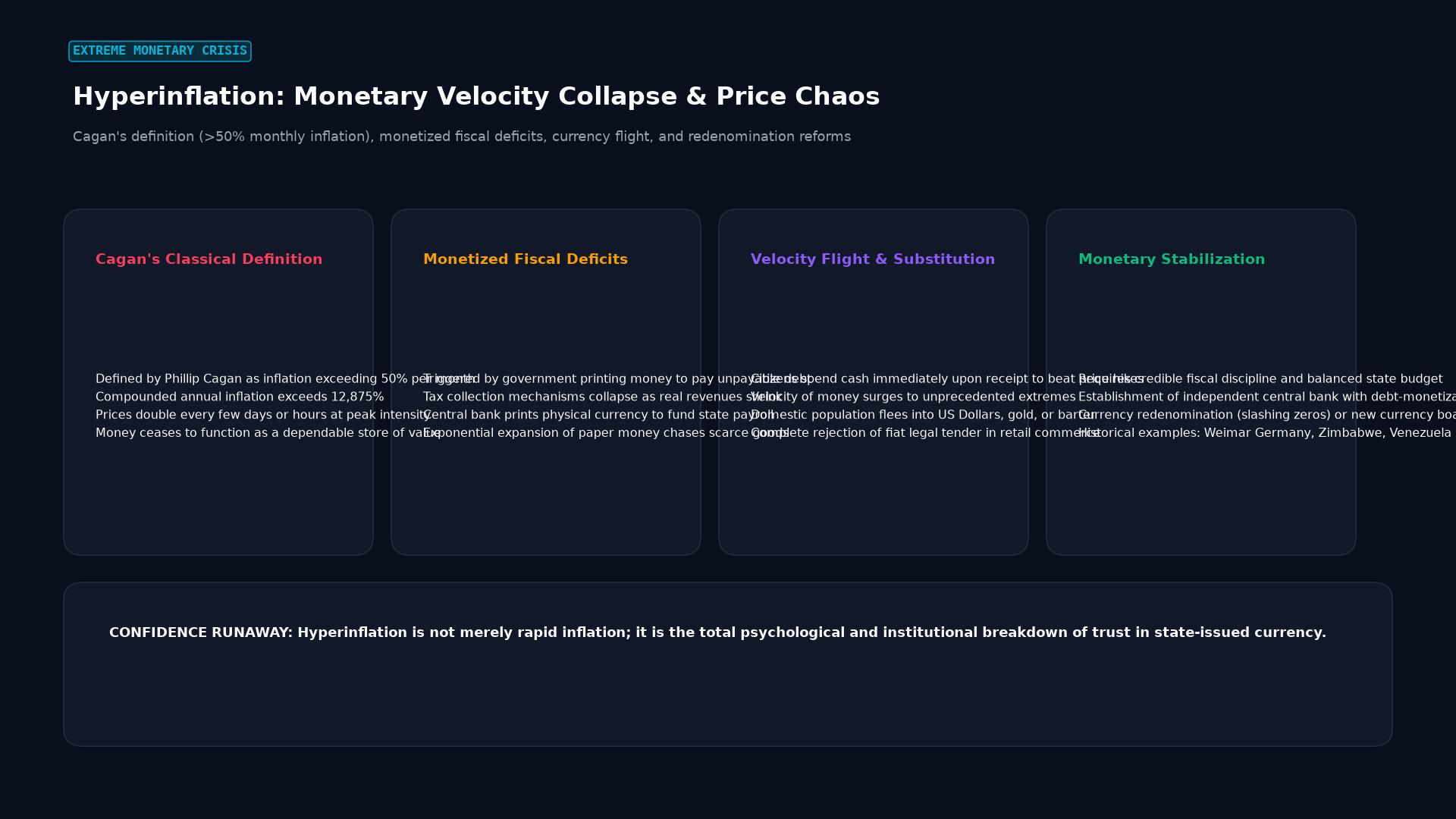 Figure: Cagan’s definition (>50% monthly inflation), monetized fiscal deficits, currency flight, and redenomination reforms
The Underlying Monetary Mechanics: Velocity and Monetization
Contrary to common perception, hyperinflation is rarely caused solely by ordinary economic overheating or wage increases. It is almost universally a fiscal and political phenomenon rooted in debt monetization:
1. Uncontrolled Fiscal Deficits and Unbacked Printing
When a government’s expenditures vastly outpace tax revenues, and international or domestic bond markets refuse to purchase sovereign debt, the state turns to the central bank as a financing instrument. The central bank prints paper currency or creates digital credits directly to pay government payrolls, military salaries, and public subsidies.
2. The Explosion of Money Velocity ($MV = PY$)
In the Classical Quantity Theory of Money ($M \times V = P \times Y$), price levels ($P$) are governed by the money supply ($M$) and the velocity of money ($V$—the speed at which banknotes change hands). During hyperinflation, velocity detonates. Citizens realize that holding cash overnight erodes their wealth. As soon as workers receive their wages, they immediately rush to grocery stores or black-market currency traders to convert paper banknotes into shelf-stable goods, gold, or foreign hard currencies (like the US Dollar). This desperate dumping of currency drives prices upward even faster than the physical printing presses can produce new notes.
3. The Olivera-Tanzi Effect
Hyperinflation destroys government tax collection through the Olivera-Tanzi Effect. Because there is an inevitable administrative delay between when a tax liability is assessed and when it is collected, the real purchasing power of the tax receipts collapses to near-zero by the time the government receives payment. This forces the government to print even larger quantities of money to cover basic expenditures, accelerating the death spiral.
Notable Historical Episodes
History records multiple devastating hyperinflation crises that reshaped nations and global politics:
| Episode | Peak Inflation Rate | Time for Prices to Double | Key Catalyst |
|---|---|---|---|
| Weimar Germany (1923) | ~3.25 × 10^6 % per month | Every 3.7 days | Massive World War I reparations, Ruhr occupation, state printing of Papiermarks. |
| Hungary (1946) | 4.19 × 10^16 % per month | Every 15.3 hours | Total World War II physical devastation; 100-quintillion pengő note issued. |
| Zimbabwe (2008) | 79.6 billion % per month | Every 24.7 hours | Land seizures, collapse of agricultural exports, and unchecked central bank monetization. |
| Venezuela (2016–2019) | Over 1,000,000% annually | Every few days | Oil output collapse, state corruption, and aggressive monetization of state oil firm PDVSA. |
Weimar Germany: Exchange Rate of 1 US Dollar in German Marks (1921-1923)
Jan 1921:   64 Marks
Jan 1922:   192 Marks
Jan 1923:   17,972 Marks
Jul 1923:   353,412 Marks
Nov 1923:   4,200,000,000,000 Marks (4.2 Trillion Marks per $1 USD)
How Hyperinflation Is Terminated: Stabilization Programs
Hyperinflation cannot be cured by cosmetic price controls or anti-gouging laws, which only produce empty grocery shelves and thriving black markets. Ending hyperinflation requires sweeping structural monetary reforms:
- Halting the Printing Press: The central bank must legally terminate direct deficit monetization, forcing the government to balance its budget through real spending reductions.
- Establishing Central Bank Independence: Policymakers must separate central bank governance from political interference.
- Monetary Reform or Dollarization: The legacy currency is typically scrapped. Governments either introduce a new currency backed by hard assets (such as the German Rentenmark in late 1923, backed by mortgages on industrial land) or abandon domestic currency entirely by adopting a foreign hard currency like the US Dollar (as Ecuador did in 2000 and Zimbabwe in 2009).
Key Takeaways
- Hyperinflation is defined academically as price inflation exceeding 50% in a single month.
- It is triggered when bankrupt sovereign governments print unbacked currency to monetize fiscal deficits.
- As the public loses confidence, money velocity explodes because citizens rush to exchange cash for real goods.
- Under the Olivera-Tanzi effect, tax revenues collapse in real purchasing power, worsening the fiscal deficit.
- Halting hyperinflation requires eliminating fiscal monetization, establishing monetary discipline, and replacing or pegging the ruined currency.
Frequently Asked Questions
What is the difference between chronic high inflation and hyperinflation?
High inflation (e.g., 20% to 40% per year, as seen in parts of Latin America or Turkey) is severe and erodes standards of living, but prices are still quoted in the domestic currency and economic contracts continue. Hyperinflation (exceeding 50% per month) completely destroys the monetary mechanism; stores reprice menus multiple times daily, and commerce reverts to bartering or foreign currencies.
Can hyperinflation happen to a global reserve currency like the US Dollar?
While high inflation can occur in major economies due to fiscal stimulus or energy shocks, true hyperinflation in the US Dollar is extremely improbable. The US benefits from independent central banking institutions, an enormous global demand for dollars as the world’s reserve currency, and deep, liquid capital markets that finance government borrowing without direct central bank monetization.
What assets preserve wealth during hyperinflation?
Physical real estate, agricultural land, productive businesses, gold bullion, and foreign hard currencies (such as USD, CHF, or EUR) historically preserve purchasing power during hyperinflationary collapses, while domestic cash, savings accounts, and local-currency sovereign bonds are completely wiped out.
Ready to trade forex?
Open a free demo account with a regulated broker. Practice with virtual funds before risking real money.