Total Return Swap (TRS)
A bilateral financial derivative contract in which one party (the total return payer) transfers the total economic performance of a reference asset—including capital gains and cash distributions—to another party (the total return receiver) in exchange for regular floating financing payments.
What Is a Total Return Swap (TRS)?
A Total Return Swap (TRS) is an over-the-counter (OTC) credit and equity derivative agreement that allows an investor to capture the full economic performance of an underlying reference asset without ever legally owning or holding that asset on their balance sheet.
In a standard TRS agreement:
- The Total Return Receiver (typically a Hedge Fund or Family Office): Receives all contractual economic benefits generated by the reference asset (e.g., share price appreciation, bond price gains, cash dividends, and coupon payments).
- The Total Return Payer (typically a Prime Broker or Investment Bank): Purchases and physically holds the reference asset on its balance sheet. In exchange for passing through the asset’s total return, the bank receives a regular floating financing payment (e.g., SOFR + 150 basis points) from the receiver.
Crucially, the risk transfer is completely symmetrical: if the reference asset drops in value, the receiver must compensate the payer for the exact amount of the capital loss, plus pay the ongoing financing charges.
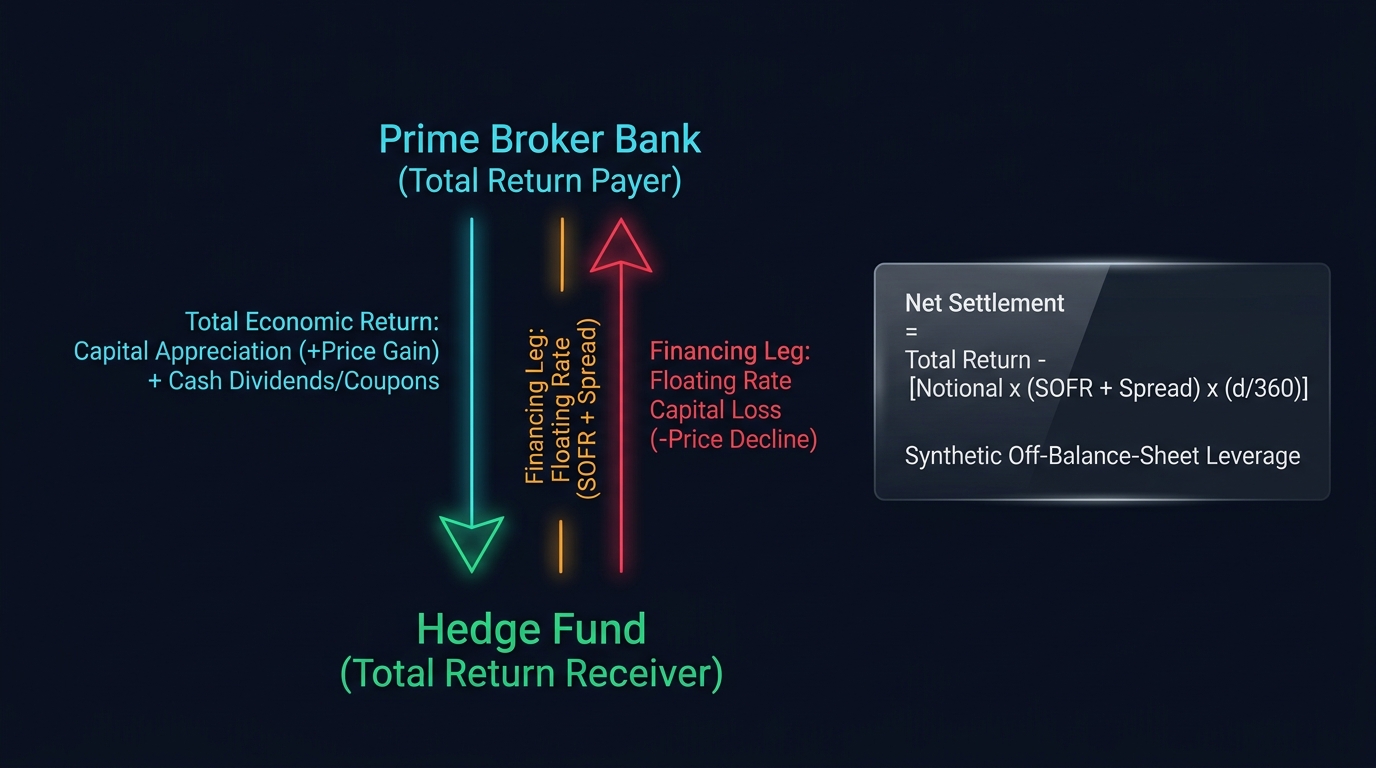
                      TOTAL RETURN SWAP (TRS) CASH FLOW ARCHITECTURE

               ┌──────────────────────────────────────────────┐
               │    PRIME BROKER / BANK (TOTAL RETURN PAYER)  │
               │  - Physically buys & holds reference asset   │
               └──────────────┬───────────────────────────────┘
                              │
    ┌─────────────────────────┴─────────────────────────┐
    │                                                   │
    ▼ 1. Capital Appreciation (+ΔP)                     ▲ 2. Financing Spread (SOFR + Spread)
    ▼ 2. Dividends / Bond Coupons                       ▲ 3. Capital Depreciation (-ΔP)
    │                                                   │
    └─────────────────────────┬─────────────────────────┘
                              │
               ┌──────────────┴───────────────────────────────┐
               │     HEDGE FUND (TOTAL RETURN RECEIVER)       │
               │  - Captures 100% synthetic exposure          │
               │  - Employs massive non-disclosed leverage    │
               └──────────────────────────────────────────────┘
Cash Flow Mechanics and Netting Calculations
A Total Return Swap features periodic settlement dates (typically monthly or quarterly) where cash flows are mathematically netted:
$$\text{Net Settlement Amount} = \left[ (\text{Capital Appreciation} + \text{Income Distributions}) \right] - \left[ \text{Notional Value} \times (R_{\text{benchmark}} + \text{Spread}) \times \frac{d}{360} \right]$$
Scenario A: The Reference Asset Appreciates
- Notional Position: $100,000,000 in corporate bonds.
- Annual Financing Rate: SOFR (5.00%) + 100 bps spread = 6.00%.
- Quarterly Financing Cost: $$100,000,000 \times 0.06 \times (90/360) = \mathbf{$1,500,000}$.
- Bond Performance: Price appreciates by $3.00%$ ($+$3,000,000$) and pays a quarterly coupon of $1.50%$ ($+$1,500,000$). Total Economic Return = +$4,500,000.
- Net Cash Flow: The bank pays the hedge fund $$4,500,000 - $1,500,000 = \mathbf{+$3,000,000}$.
Scenario B: The Reference Asset Depreciates
- Reference asset collapses by $5.00%$ ($-$5,000,000$) with zero income.
- Net Cash Flow: The hedge fund must pay the bank the capital loss ($-$5,000,000$) plus the quarterly financing charge ($-$1,500,000$), transferring a net $-$6,500,000$ to the bank.
Strategic Motivations: Why Institutions Trade TRS
Total Return Swaps provide distinct operational advantages that cannot be achieved through traditional cash purchases:
| Operational Dimension | Total Return Swap (TRS) | Direct Physical Ownership |
|---|---|---|
| Capital Commitment | Minimal (Hedge fund posts only 5% to 15% margin collateral) | 100% of purchase price (or standard 50% Reg T margin) |
| Balance Sheet Footprint | Completely off-balance-sheet synthetic derivative | Recorded directly on corporate/fund balance sheet |
| Regulatory Ownership Reporting | Historically exempt from public SEC 13F and 13D disclosure filings | Mandatory public 13D filing if equity stake exceeds 5% |
| Voting Rights | None (Legal voting rights remain with the bank holding the shares) | Full shareholder corporate voting rights |
| Cross-Border Tax Advantages | Synthetically bypasses local foreign dividend withholding taxes | Subject to statutory local dividend withholding tax schedules |
Real-World Institutional Case Study: The 2021 Archegos Capital Meltdown
The catastrophic structural risks of Total Return Swaps were exposed in March 2021 during the collapse of Archegos Capital Management, a private family office run by former Tiger Asia manager Bill Hwang:
       ARCHEGOS CAPITAL: THE $36 BILLION TRS LIQUIDATION

 The Synthetic Scheme:
 - Archegos used Total Return Swaps across multiple competing prime brokers
   (Credit Suisse, Nomura, Morgan Stanley, Goldman Sachs, UBS).
 - Hwang posted roughly $10 billion in collateral to acquire over $50 BILLION
   in concentrated synthetic stock exposure (ViacomCBS, Discovery, Baidu).
 - Critical Regulatory Loophole: Because trades were OTC swaps, NO SINGLE BROKER
   knew that Archegos had duplicated identical 5x leveraged TRS positions across peer banks.

 The Collapse:
 1. In late March 2021, ViacomCBS issued a secondary equity offering; stock dropped 9%.
 2. Archegos was hit with massive variation margin calls across all prime brokers.
 3. Hwang failed to meet the margin calls; prime brokers seized his TRS collateral
    and raced to dump over $30 billion in underlying stock into the open market.

 The Aftermath:
 - ViacomCBS and Discovery shares crashed by over 50% in two sessions.
 - Prime brokers suffered catastrophic counterparty credit losses:
   Credit Suisse lost $5.5 Billion (catalyzing its eventual 2023 collapse),
   Nomura lost $2.9 Billion, and Morgan Stanley lost $900 Million.
Regulatory Aftermath: The Modern Push for TRS Transparency
The Archegos crisis prompted international regulatory bodies—including the U.S. Securities and Exchange Commission (SEC) and the European Securities and Markets Authority (ESMA)—to introduce sweeping regulatory reforms under SEC Rule 10B-1:
- Mandating that any market participant amassing large synthetic equity swap positions exceeding predetermined thresholds must publicly report their beneficial economic exposure.
- Enforcing stricter Initial Margin (IM) requirements under the global non-cleared derivatives framework (BCBS-IOSCO), forcing prime brokers to demand significantly higher cash buffers before issuing synthetic leverage.
Frequently Asked Questions
Who legally owns the underlying asset in a Total Return Swap?
The total return payer (the bank or prime broker) legally owns the underlying asset. The bank registers the shares or bonds on its own custodial accounts and exercises any associated shareholder voting rights. The receiver owns purely a contractual bilateral right to the net financial performance.
What is the difference between a Total Return Swap and a Contract for Difference (CFD)?
A Contract for Difference (CFD) is essentially a retail-oriented, standardized version of a Total Return Swap. While institutional hedge funds negotiate bespoke multi-million-dollar TRS agreements governed by the ISDA Master Agreement, retail brokers offer CFDs on standardized terms with automated platform stop-outs for retail margin traders.
What happens if the prime broker in a TRS defaults?
If the total return payer (the investment bank) becomes insolvent, the hedge fund faces acute counterparty credit risk. Even if the reference stock surged by 100%, the hedge fund may not recover its gains; it becomes an unsecured general creditor in the bankrupt bank’s estate, unless variation margin was held in segregated third-party custody under a strict Credit Support Annex (CSA).
Ready to trade forex?
Open a free demo account with a regulated broker. Practice with virtual funds before risking real money.