Credit Default Swap (CDS)
A Credit Default Swap (CDS) is a financial derivative agreement where the protection buyer pays an ongoing fee (the CDS spread) to the protection seller in exchange for a contingent payout if a reference entity suffers a credit event such as default or restructuring.

What Is a Credit Default Swap (CDS)?
A Credit Default Swap (CDS) is the most widely traded over-the-counter (OTC) credit derivative instrument in global finance. It functions essentially as a synthetic insurance policy against credit default. Under a CDS contract, the protection buyer transfers the credit risk of a specific reference entity (a corporate borrower or sovereign government) to the protection seller without requiring the transfer of the underlying physical debt or bond.
In exchange for this default guarantee, the protection buyer pays the seller a recurring, annualized quarterly premium—known as the CDS spread (quoted in basis points per year on the notional amount). If the reference entity fulfills all its debt obligations until contract maturity, the CDS expires without payout, and the seller retains the cumulative premium fees. However, if the reference entity experiences an official Credit Event (such as bankruptcy, failure to pay, or debt restructuring), the seller is legally obligated to compensate the buyer for the difference between the face value and the post-default recovery value of the debt.
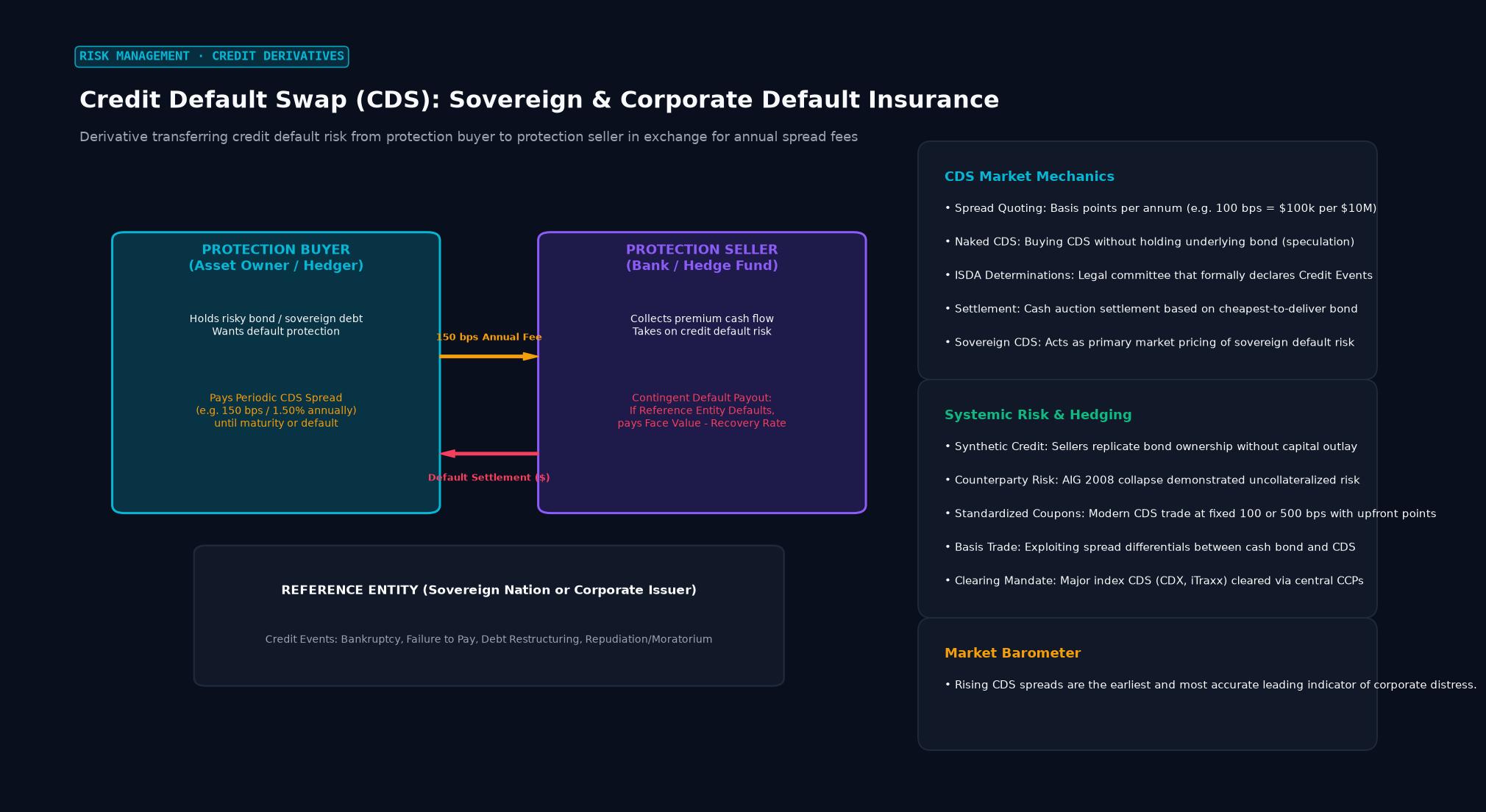 Figure: Derivative transferring credit default risk from protection buyer to protection seller in exchange for annual spread fees
Key Takeaways
- Credit Risk Decoupling: CDS contracts permit market participants to trade and manage default risk independently from the physical cash bond market.
- The CDS Spread Metric: Quoted in basis points (bps) per annum: a CDS spread of 200 bps means paying $20,000 annually to insure $1,000,000 of notional debt ($2.0%$).
- Naked CDS Speculation: Market participants do not need to own the underlying bond to purchase a CDS. Buying a “naked CDS” represents a leveraged, directional short bet against the financial solvency of a corporation or nation.
- Sovereign CDS as FX Indicator: In currency markets, sovereign CDS spreads act as a real-time barometer of country risk and currency devaluation probability; widening CDS spreads consistently precede currency selloffs.
Defining Credit Events: The ISDA Determination Committee
Under standard ISDA (International Swaps and Derivatives Association) documentation, a CDS is triggered only if an official Credit Event occurs. These decisions are legally adjudicated by regional ISDA Determinations Committees (DCs) comprising leading dealer banks and buy-side institutions:
| Credit Event | Description | Practical Example |
|---|---|---|
| Bankruptcy | The reference entity enters formal judicial liquidation or insolvency proceedings | Lehman Brothers filing for Chapter 11 in September 2008 |
| Failure to Pay | The borrower fails to make a scheduled interest coupon or principal payment beyond statutory grace periods | Argentina missing sovereign Eurobond coupon payments |
| Restructuring | A distressed bond exchange where bondholders are forced to accept lower coupons, extended maturities, or principal haircuts | Greece’s 2012 Private Sector Involvement (PSI) debt write-down |
| Repudiation / Moratorium | A sovereign government formally rejects its legal obligation to repay debt | A sovereign treasury issuing a debt moratorium decree |
Settlement Mechanisms: Physical vs. Auction Settlement
When an ISDA Determinations Committee declares that a credit event has taken place, the CDS contract must be settled:
ISDA Credit Event Declared ──► Creditex/Markit Credit Auction ──► Final Recovery Rate Set (e.g. 40%) ──► Cash Payout (60%)1. The Credit Auction Cash Settlement Process
In modern markets, contracts are settled through a centralized, standardized Credit Auction operated by Creditex and Markit:
- The auction determines the fair market Recovery Value ($R$) of the defaulted deliverable bonds (e.g., establishing a clearing price of $0.40 on the dollar, or $40%$).
- The protection seller must pay the protection buyer the cash difference between par ($100%$) and the recovery rate:
$$\text{Cash Payout} = \text{Notional Amount} \times (1 - \text{Recovery Rate})$$
$$\text{Example: } $10,000,000 \text{ Notional} \times (1.00 - 0.40) = $6,000,000 \text{ Cash Payout}$$
Sovereign CDS Spreads as a Forex Leading Indicator
While originally designed for fixed-income desks, Credit Default Swaps provide currency traders with a high-conviction macro barometer:
- Credit-Currency Transmission Loop: When international investors lose confidence in an emerging market or peripheral sovereign nation, they purchase sovereign CDS protection.
- Spread Widening: The sovereign CDS spread blows out from 120 bps to 450 bps.
- Yield Curve Repricing: Local domestic government bond yields surge to compensate for default risk, increasing sovereign borrowing costs and choking off economic growth.
- Currency Plunge: Foreign institutional capital liquidates domestic assets and repatriates funds into U.S. Dollars, driving the domestic sovereign currency down by hundreds of pips.
Sovereign Risk Spikes ──► CDS Spreads Surge ──► Bond Yields Blow Out ──► Currency DepreciatesReal-World Case Study: Sovereign CDS and the 2010–2012 Eurozone Debt Crisis
During the European sovereign debt crisis, Credit Default Swaps served as the primary battleground for speculative pricing:
The PIIGS Contagion:
- Between 2010 and 2012, sovereign CDS spreads for peripheral Eurozone nations (Greece, Ireland, Italy, Portugal, and Spain) widened dramatically.
- Greek 5-Year Sovereign CDS spreads skyrocketed from under 100 bps prior to the crisis to over 2,500 bps (25% per year), signaling imminent default.
- Currency desks tracking the CDS spreads of Southern European nations recognized that the European Central Bank’s integrity was at stake.
- Forex Consequence: EUR/USD collapsed from above
1.4500down toward1.2000. It was only when ECB President Mario Draghi famously declared in July 2012 that the central bank would do “whatever it takes” to preserve the Euro—followed by the creation of Outright Monetary Transactions (OMT)—that sovereign CDS spreads collapsed and EUR/USD stabilized.
Frequently Asked Questions
Can an individual retail trader buy a Credit Default Swap?
Directly, no. CDS contracts are non-standardized Over-the-Counter (OTC) derivatives traded between institutional entities (investment banks, hedge funds, sovereign wealth funds, and insurers) with minimum transaction notionals of $5 million to $10 million. However, retail traders can gain exposure to credit risk through exchange-traded funds (such as high-yield bond ETFs) or trade currency pairs sensitive to sovereign CDS movements.
What is the role of AIG in the history of Credit Default Swaps?
During the 2000s, AIG Financial Products (AIGFP) wrote hundreds of billions of dollars in unhedged, naked CDS protection on Collateralized Debt Obligations (CDOs) backed by U.S. subprime mortgages without posting adequate collateral. When the housing market collapsed in 2008, AIG faced tens of billions in collateral margin calls, requiring an unprecedented $180 billion U.S. government bailout to prevent systemic collapse.
What is the difference between a CDS and a bond insurance policy?
Unlike insurance policies, the buyer of a CDS is not required to own the underlying bond or prove an actual legal loss to receive a payout. Additionally, CDS contracts are marked to market continuously and can be traded, novated, or unwound before maturity.
Ready to trade forex?
Open a free demo account with a regulated broker. Practice with virtual funds before risking real money.