Tradeable Amount
The permissible volume, contract size, or minimum and maximum transaction increment of a financial asset that can be executed on a brokerage platform, electronic communication network, or centralized exchange.
What Is a Tradeable Amount?
In financial market execution and platform architecture, the tradeable amount specifies the contract size, volume constraints, and transactional boundaries within which an order can be legally routed and executed.
Depending on the asset class and broker infrastructure, tradeable amounts encompass three critical parameters:
- Minimum Tradeable Amount: The smallest allowable transaction increment accepted by the exchange or broker matching engine (e.g., 0.01 lots / 1,000 units in retail forex, or 1 fractional share in modern equity trading).
- Maximum Tradeable Amount: The upper ceiling on single-ticket order size (e.g., 50.00 or 100.00 lots in retail FX, or 10,000 shares in equities), established to prevent large market orders from completely sweeping order book liquidity and suffering catastrophic slippage.
- Lot Step (Granularity): The permissible incremental stepping between order sizes (e.g., stepping in increments of 0.01 lots: 0.11, 0.12, 0.13).
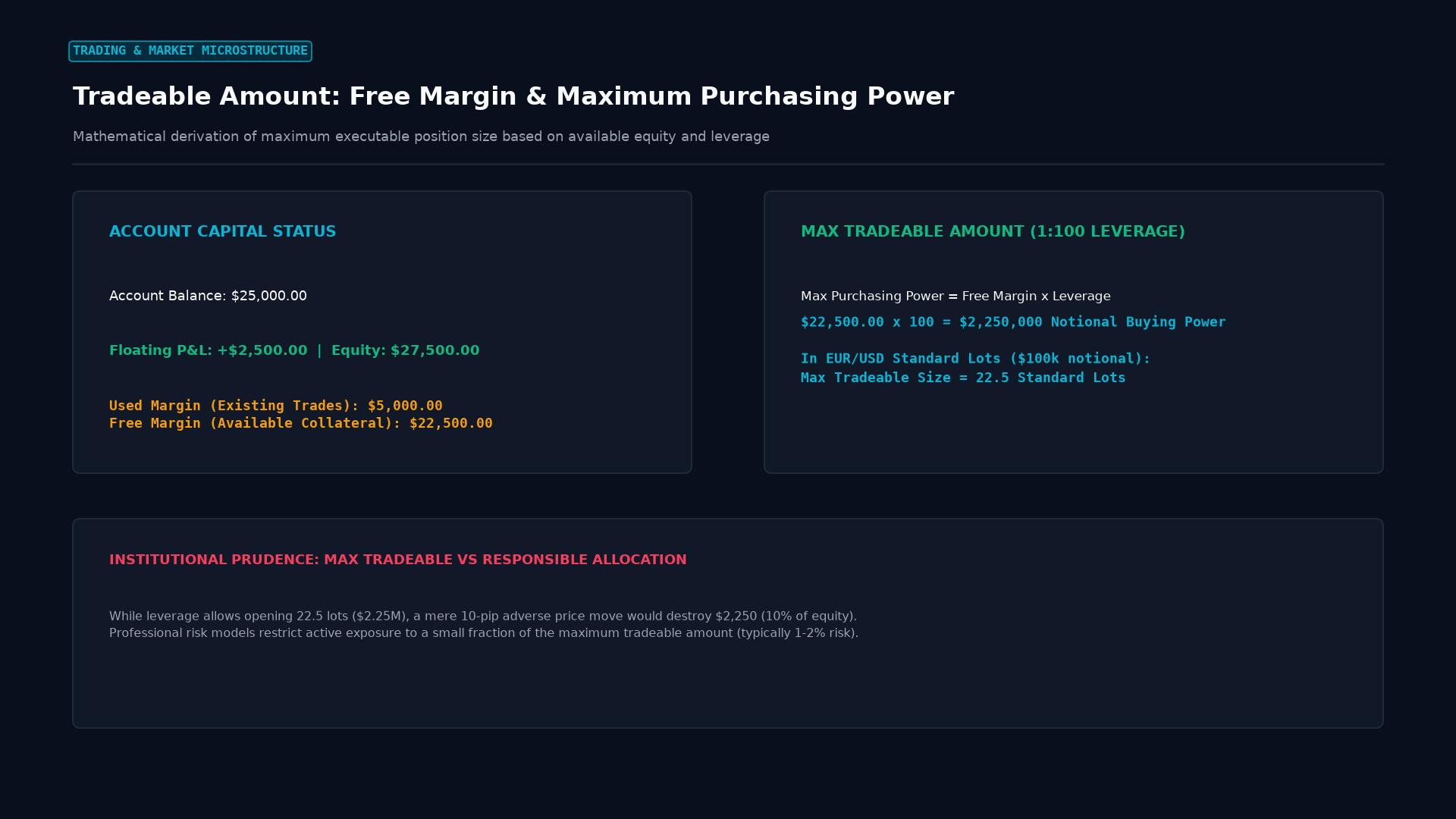 Figure: Leverage mathematics: account equity and free margin determining maximum tradeable notional purchasing power and responsible risk limits.
Tradeable Amount Conventions Across Asset Classes
The flexibility of tradeable amounts varies drastically across different global exchanges and market structures:
| Asset Class | Minimum Tradeable Amount | Maximum Single-Order Limit | Stepping Granularity | Flexibility |
|---|---|---|---|---|
| Spot Forex (Retail) | 0.01 Lots (1,000 Base Units) | 50.00 – 100.00 Lots per ticket | 0.01 Lot increments | Extremely High (Precise risk calibration) |
| Interbank FX (EBS/Reuters) | 1,000,000 Units ($1M Notional) | Custom bilateral credit limits | $1M blocks (Regular) | Standardized institutional blocks |
| Equities (Fractional) | 0.0001 Shares (or $1.00 minimum) | Exchange circuit-breaker caps | Fractional dollar or share | High on modern neobrokers |
| Futures Contracts | 1 Whole Contract (Strict) | Varies by exchange rulebook | Rigid integer contracts (1, 2, 3) | Low (Cannot trade partial contracts) |
The Mathematics of Position Sizing Using Tradeable Amounts
In professional risk management, the tradeable amount is never chosen arbitrarily. It is mathematically calculated to ensure that if a trade hits its stop-loss, the dollar loss conforms exactly to the trader’s predetermined risk budget (typically 1% to 2% of total account equity):
$$\text{Required Tradeable Units} = \frac{\text{Account Equity} \times \text{Risk %}}{\text{Stop-Loss Distance (in Pips)} \times \text{Pip Value per Unit}}$$
Practical Calculation Example: EUR/USD
- Account Equity: $25,000
- Risk Budget: 1.0% ($250.00 risk ceiling)
- Entry Price: 1.0850
- Stop-Loss Level: 1.0810 (Stop distance = 40 pips)
- Pip Value per standard lot: $10.00 ($0.10 per micro lot of 1,000 units)
$$\text{Tradeable Lots} = \frac{$250.00}{40 \text{ pips} \times $10.00/\text{lot}} = \mathbf{0.625 \text{ Lots}}$$
Because the broker’s minimum tradeable step size is 0.01 lots, the trader rounds down to 0.62 lots (62,000 units), risking exactly $248.00 and preserving strict capital discipline.
Why Brokers Impose Maximum Tradeable Limits
While beginners focus on minimum order sizes, institutional risk managers pay intense attention to maximum single-ticket limits:
       WHY MAXIMUM TRADEABLE AMOUNT LIMITS EXIST

 Scenario: Trader enters a single Market Buy Order for 200.00 Lots ($20,000,000 EUR/USD)
 ─────────────────────────────────────────────────────────────────────────────
 Top of Order Book (Level 1): Only 15.00 Lots available at 1.08520
 Next Order Book (Level 2):   35.00 Lots available at 1.08525
 Next Order Book (Level 3):   50.00 Lots available at 1.08535
 Next Order Book (Level 4):   100.00 Lots available at 1.08560
 ─────────────────────────────────────────────────────────────────────────────
 Catastrophic Result:
 The massive single ticket blows through the entire book, incurring 4.0 pips
 of negative slippage ($8,000 instant loss) and triggering flash volatility.

 Broker Risk Defense:
 Capping maximum tradeable amount at 50.00 lots forces traders to execute
 via algorithmic slicing (TWAP/VWAP), preserving order book stability.
Real-World Institutional Case Study: Institutional Algorithmic Order Slicing
Institutional hedge funds managing hundreds of millions of dollars cannot simply click “Buy” for their intended tradeable amount. In institutional execution:
- An asset manager wishing to accumulate a $100,000,000 tradeable amount in GBP/USD routes the master ticket to an execution algorithm.
- The algorithm slices the $100M total into hundreds of smaller tradeable amounts (e.g., randomized clips between 0.50 lots and 3.00 lots) executed over a 4-hour window using Time-Weighted Average Price (TWAP) or iceberg orders.
- This automated slicing masks the institutional presence, preventing predatory high-frequency algorithms from detecting the massive tradeable size and front-running prices.
Frequently Asked Questions
What happens if I attempt to enter an order smaller than the minimum tradeable amount?
Your trading platform or API will instantly reject the order with an error message (e.g., “Invalid volume” or “Order size below minimum”). The order will not be sent to the broker’s execution server.
Does a higher tradeable amount increase my trading commission?
In commission-based ECN accounts, commissions are calculated per tradeable lot (e.g., $3.50 per standard lot per side). Trading 1.00 lot incurs a $7.00 round-turn commission, while trading 0.10 lots incurs a proportional $0.70 commission. In spread-only accounts, the transaction cost scales proportionally with the tradeable size through the bid-ask spread.
What is the difference between a “Tradeable Amount” and “Buying Power”?
The tradeable amount is the specific volume of the individual order being placed (e.g., 2.5 lots). Buying power (or leverage capacity) is the maximum total notional value of all positions your account can legally open based on your current cash equity and regulatory margin ratio (e.g., $10,000 equity at 1:30 leverage yields $300,000 in total buying power).
Ready to trade forex?
Open a free demo account with a regulated broker. Practice with virtual funds before risking real money.