Trading Margin Excess
Trading margin excess, commonly known as free margin, represents the surplus equity in a leveraged trading account above the required maintenance margin, defining the capital buffer available for absorbing adverse price movements or underwriting new market exposure.
What Is Trading Margin Excess?
Trading margin excess—widely termed free margin across retail and institutional trading infrastructure—is the unencumbered liquid capital remaining in an active trading account after accounting for the initial and maintenance margin obligations of all open positions. It quantifies the operational solvency and immediate risk-bearing capacity of a portfolio in real time.
In leveraged foreign exchange and derivatives markets, brokers extend purchasing power by requiring traders to pledge a fraction of total contract notional value as collateral (the used margin or required margin). As underlying exchange rates fluctuate, mark-to-market valuations alter account equity tick-by-tick. Trading margin excess acts as the primary buffer against liquidation: if adverse market swings erode this excess to zero, the trader faces a margin call, followed by forced position closures (stop-outs) by the broker’s risk engine if losses continue.
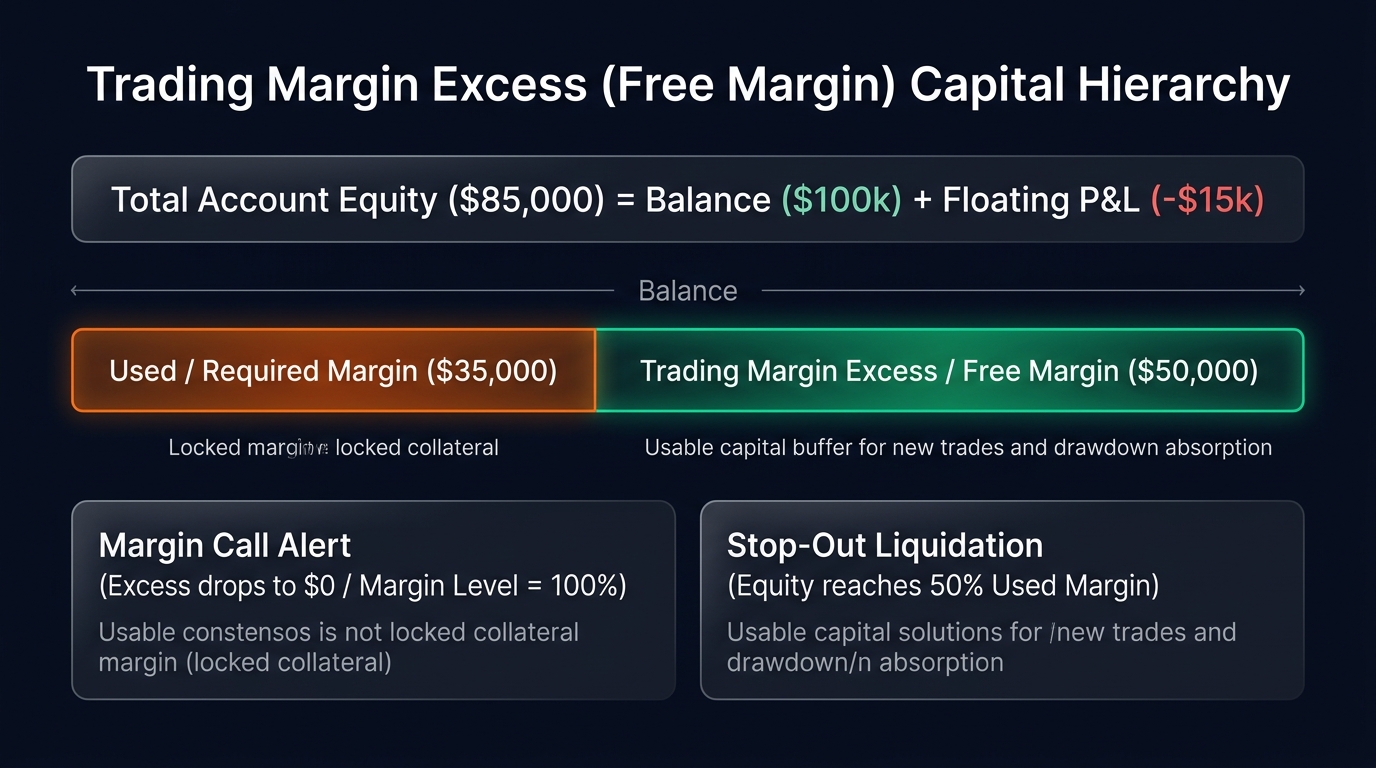
+-----------------------------------------------------------------------+
|                    ACCOUNT CAPITAL ALLOCATION HIERARCHY               |
+-----------------------------------------------------------------------+
|  CASH BALANCE: $100,000  +/-  OPEN FLOATING P&L (-$15,000)            |
|  -------------------------------------------------------------------  |
|                      TOTAL ACCOUNT EQUITY: $85,000                    |
|                                                                       |
|  [===========================] [====================================] |
|   USED / REQUIRED MARGIN      |        TRADING MARGIN EXCESS          |
|          $35,000              |            (FREE MARGIN)              |
|   (Locked Collateral for Open |               $50,000                 |
|            Positions)         |  * Available for new market orders    |
|                               |  * Buffer against adverse drawdown    |
+-------------------------------+---------------------------------------+
|  CRITICAL THRESHOLDS:                                                 |
|  * Margin Call Warning: Equity drops to 100% of Used Margin (Excess=0)|
|  * Forced Liquidation:  Equity drops to 50% or 20% of Used Margin    |
+-----------------------------------------------------------------------+
Mathematical Formulation & Margin Metrics
Understanding margin dynamics requires evaluating the interplay between ledger balance, mark-to-market equity, committed collateral, and regulatory leverage limits.
1. Total Account Equity
Account equity reflects the total liquidation value of the account if every open contract were terminated at prevailing bid/ask prices:
$$\text{Equity} = \text{Cash Balance} + \sum_{i=1}^{n} \text{Unrealized P&L}_i$$
Where $\text{Unrealized P&L}$ factors in gross price movements minus accrued financing fees (swaps/rollovers) and commission charges.
2. Used (Required) Margin
Used margin is the sum of collateral reserves mandated by the prime broker or dealer to support open positions under specific margin ratios ($MR$):
$$\text{Used Margin} = \sum_{i=1}^{n} \left( \text{Notional Value}i \times MR_i \right) = \sum{i=1}^{n} \left( \frac{\text{Notional Value}_i}{\text{Leverage Ratio}_i} \right)$$
For example, carrying 2 standard lots ($200,000 base currency) of EUR/USD under a 1:30 regulatory leverage cap requires:
$$\text{Used Margin} = \frac{$200,000 \times S_{\text{EUR/USD}}}{30}$$
3. Trading Margin Excess (Free Margin)
Trading margin excess is the absolute dollar difference between total equity and committed margin:
$$\text{Margin Excess} = \text{Equity} - \text{Used Margin}$$
When $\text{Margin Excess} > 0$, the trader possesses excess borrowing capacity to open additional positions or withstand negative drawdowns. When $\text{Margin Excess} \le 0$, the trading terminal blocks any new risk-increasing orders.
4. Margin Level Percentage
Automated risk-management engines monitor solvency via the Margin Level:
$$\text{Margin Level (%)} = \left( \frac{\text{Equity}}{\text{Used Margin}} \right) \times 100$$
A margin level of $100%$ indicates that trading margin excess has been entirely exhausted ($\text{Equity} = \text{Used Margin}$).
Margin Taxonomy & Capital Designations
Collateral requirements vary significantly across institutional prime brokerage agreements, central clearing counterparties (CCPs), and retail multi-asset platforms.
| Margin Designation | Purpose | Trigger Point / Calculation | Operational Implication |
|---|---|---|---|
| Initial Margin (IM) | Baseline upfront collateral needed to open a position. | Fixed percentage of contract notional (e.g., 2%–5% in FX). | Determines maximum initial position size allowed by the broker. |
| Maintenance Margin (MM) | Minimum collateral threshold needed to keep positions active. | Set at a regulatory or broker-defined level (often 50%–80% of IM). | Falling below this level generates an urgent margin call. |
| Trading Margin Excess | Unencumbered surplus equity available for deployment. | $\text{Equity} - \text{Used Margin}$. | Dictates maximum additional contract volume or buffer against liquidation. |
| Variation Margin (VM) | Daily or intraday cash flow reconciling mark-to-market swings. | $\Delta \text{Unrealized P&L}$ transferred between clearing accounts. | Debited or credited to the cash balance daily in futures and cleared swaps. |
Margin Call vs. Liquidation (Stop-Out) Thresholds
Brokers maintain automated margin liquidation protocols to protect their balance sheets from client deficit balances:
Margin Level (%)
  ^
  |  > 500%   Normal Operating State: Substantial Trading Margin Excess
  |
  |  200%     Elevated Exposure: Active risk monitoring required
  |
--+-- 100% -- MARGIN CALL LEVEL: Trading Margin Excess = $0
  |           * Terminal blocks new buy/sell orders
  |           * Notification issued to deposit funds or cut exposure
  |
--+-- 50% --- STOP-OUT / LIQUIDATION LEVEL: Severe Capital Erosion
  |           * Risk engine initiates automated liquidation
  |           * Largest losing positions closed at market until Margin Level > 50%
  v
The distance to liquidation in dollar terms ($\Delta \text{Equity}_{\text{stop-out}}$) is expressed as:
$$\Delta \text{Equity}_{\text{stop-out}} = \text{Equity} - \left( \text{Used Margin} \times \text{Stop-Out Level %} \right)$$
If an account has $$10,000$ in equity, $$6,000$ in used margin, and a $50%$ stop-out rule, the account will undergo forced closure once equity declines by:
$$$10,000 - ($6,000 \times 0.50) = $10,000 - $3,000 = $7,000$$
Real-World Institutional Case Study: Negative Oil & The Margin Void (April 2020)
On April 20, 2020, the West Texas Intermediate (WTI) May futures contract plummeted from $$18.27$ to an unprecedented settlement price of $-$37.63$ per barrel. The collapse provided a stark demonstration of how trading margin excess can evaporate instantaneously during extreme market dislocations.
Numerous retail brokerages had calibrated their automated margin models under the assumption that commodity assets could never trade below zero. Retail traders holding long contracts believed their downside was bounded by their initial investment, maintaining margin excess calculations predicated on a minimum price of $$0.01$.
[Normal Market Environment]
Collateral Pledged: $5,000 | WTI Price: $20.00 | Margin Excess: +$2,500

[April 20, 2020: 14:08 - 14:30 EDT Dislocation]
WTI Plunges through $0.00 -> -$10.00 -> -$37.63
Automated Risk Engines Freeze: Non-negative pricing logic fails
Margin Excess Collapses: +$2,500 -> -$50,000 -> -$150,000 per contract
Result: Complete equity wipeout, negative account balances, multi-million dollar broker write-offs
Interactive Brokers, among other institutional clearers, experienced software failures because legacy risk algorithms could not process negative input prices to recalculate trading margin excess. The clearer was forced to absorb approximately $$500$ million in aggregate client losses because margin excess turned sharply negative before trades could be closed in the market. This episode prompted international regulators and exchange clearing houses (CME, ICE) to mandate revised margin models capable of handling negative pricing regimes.
Best Practices for Managing Margin Excess
- Maintain a 300%+ Margin Level Floor: Institutional risk guidelines discourage running aggregate margin levels below $300%$ under standard volatility conditions, preserving adequate margin excess to survive overnight liquidity dry-ups and weekend gaps.
- Account for Weekend and Rollover Widening: Spreads routinely widen fivefold to tenfold during the daily 5:00 PM EST New York cut and weekend market closure. Because mark-to-market calculations utilize the bid price for longs and ask price for shorts, spread widening immediately degrades trading margin excess without any change in the midpoint price.
- Avoid Counter-Trend Martingale Averaging: Opening additional positions into a losing trend rapidly drains margin excess from two directions: increasing used margin requirements while simultaneously reducing equity through accumulating floating losses.
Frequently Asked Questions
Can trading margin excess become negative?
Yes. Trading margin excess becomes negative whenever total account equity falls below the used margin requirement ($\text{Equity} < \text{Used Margin}$), meaning the margin level drops below $100%$. In this state, the trader cannot enter new positions or increase existing ones, and the account enters margin call status.
How does spread widening during market rollover impact margin excess?
During the daily rollover period (typically 17:00 EST), interbank liquidity thins dramatically, causing bid/ask spreads to widen significantly. Because open positions are marked-to-market against the executable liquidation side (longs against the bid, shorts against the ask), wider spreads instantly reduce floating equity, causing a sudden contraction in trading margin excess that can trigger premature stop-outs.
What is the difference between free margin and margin excess?
In professional and retail financial terminology, free margin and trading margin excess are identical concepts. “Trading margin excess” is the formal term predominantly used in prime brokerage statements, regulatory filings, and institutional clearing reports, whereas “free margin” is the ubiquitous label displayed in retail platforms such as MetaTrader and cTrader.
Ready to trade forex?
Open a free demo account with a regulated broker. Practice with virtual funds before risking real money.