Stop Order
A conditional pending instruction placed with a broker or exchange that automatically converts into an aggressive market order once the asset's price touches or crosses a predetermined trigger level known as the stop price.
What Is a Stop Order?
A stop order is a foundational order type in financial trading designed to automate trade execution based on price movement. Unlike a passive limit order (which specifies an exact maximum or minimum acceptable execution price), a stop order remains completely dormant on a broker’s server or exchange matching engine until the market trades at or through a specified stop price.
The moment this trigger condition is satisfied, the stop order automatically wakes up and transforms into an unpriced market order. The broker’s risk and execution engine is then instructed to fill the order immediately at the best currently available market prices.
Stop orders serve two indispensable strategic functions in modern trading:
- Defensive Risk Management (Stop-Loss): Protecting open positions by automatically closing trades if the market moves adversarially beyond an acceptable pain threshold.
- Offensive Momentum Entry (Breakout Trading): Entering a new trade only after the market confirms directional strength by piercing key structural support or resistance levels.
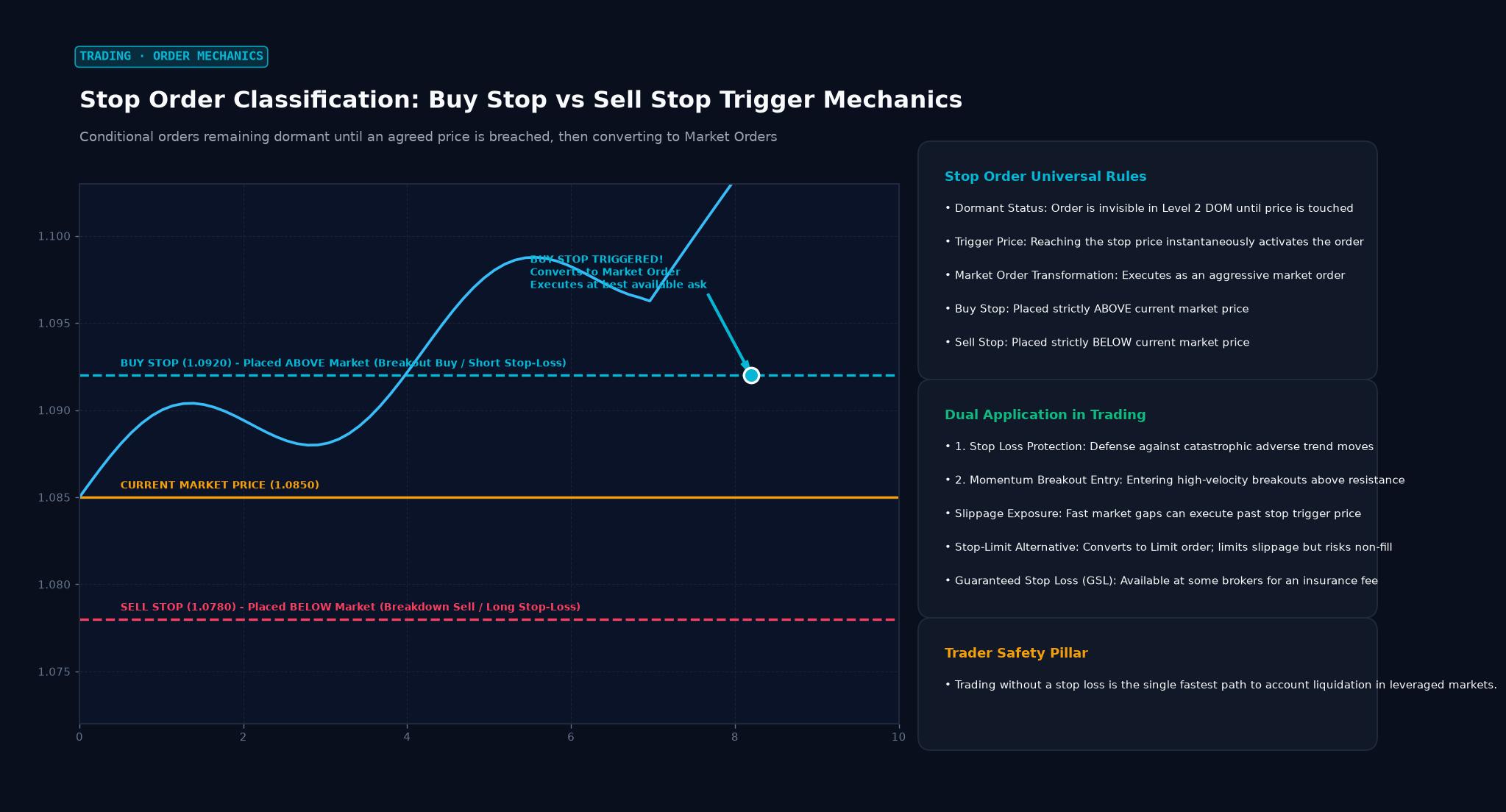 Figure: Conditional orders remaining dormant until an agreed price is breached, then converting to Market Orders
Buy Stop vs. Sell Stop
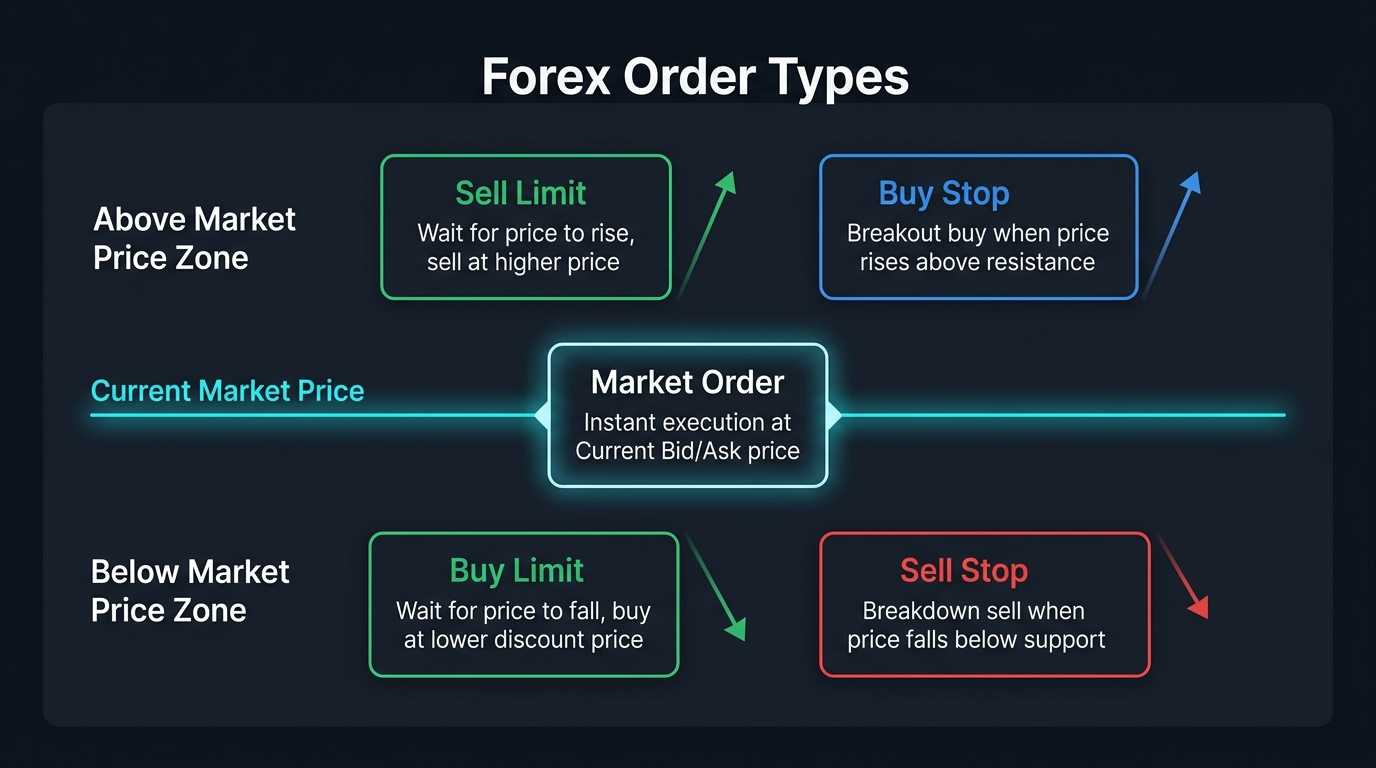
Stop orders are deployed in two distinct operational directions:
1. Buy Stop Order
- Placement: Placed at a price above the prevailing market price.
- Entry Application: Initiating a long position upon an upside breakout of resistance (e.g., buying EUR/USD when it breaks out above 1.1000).
- Protection Application: Serving as a stop-loss to cap losses on an existing short position if the market rallies against the trader.
2. Sell Stop Order
- Placement: Placed at a price below the prevailing market price.
- Entry Application: Initiating a short position upon a downside breakdown of support (e.g., shorting Gold if it pierces below $2,400).
- Protection Application: Serving as a stop-loss to cap losses on an existing long position if the market collapses.
Stop Order vs. Limit Order vs. Stop-Limit Order
Understanding the behavioral trade-offs between execution certainty and price certainty is vital for professional risk management:
| Order Type | Placement Relative to Market | What It Converts Into | Execution Certainty | Price Certainty |
|---|---|---|---|---|
| Stop Order | Worse than current price (Buy above / Sell below) | Market Order | High (Will fill as long as liquidity exists) | Low (Vulnerable to negative slippage in fast markets) |
| Limit Order | Better than current price (Buy below / Sell above) | Remains a Limit Order | Low (Will not fill if price never touches limit) | High (Guaranteed fill at limit price or better) |
| Stop-Limit Order | Worse than current price | Limit Order | Moderate to Low (Can be skipped during rapid crashes) | High (Will not execute beyond the secondary limit price) |
The Slippage Factor: Why Stop Fills Can Differ from the Stop Price
A universal reality of stop orders is that the stop price is a trigger, not an execution guarantee.
Execution slippage is calculated as:
$$\text{Slippage} = |\text{Executed Fill Price} - \text{Stop Trigger Price}|$$
Three structural market environments guarantee significant slippage on stop orders:
- Weekend and Session Gaps: Foreign exchange halts over the weekend. If a geopolitical crisis occurs, Sunday’s opening price can gap 100 pips beyond a trader’s stop-loss. The stop triggers at the market open and fills at the first available bid, absorbing the full 100-pip gap penalty.
- High-Impact Macro Announcements: When the U.S. Bureau of Labor Statistics releases Non-Farm Payrolls, institutional liquidity providers pull bids and asks. Stop orders triggered during this void sweep multiple empty book tiers.
- Cascading Stop Triggers: When thousands of retail participants place stops at identical round psychological barriers (e.g., 1.0500), the simultaneous conversion of thousands of stops into market orders creates an overwhelming imbalance, blowing through available liquidity.
Real-World Institutional Case Study: The 2015 SNB De-Pegging and the Liquidity Black Hole
The inherent execution risk of standard stop orders was etched into financial history on January 15, 2015, when the Swiss National Bank (SNB) removed its 1.2000 floor on EUR/CHF:
       EUR/CHF STOP ORDER CATASTROPHE (JANUARY 15, 2015)

 1.2000 ──┐ [ Multi-Billion Dollar Cluster of Long Stop-Losses at 1.1990 - 1.1950 ]
          │\
 1.1500 ──┼─\  SNB Halts Buying; Major Tier-1 Banks Pull ALL Bid Quotes
          │  \
 1.1000 ──┼───\___ Stop-Loss Orders Trigger: Convert to MARKET SELL ORDERS
          │       \
 1.0000 ──┼────────\___ ZERO BIDS PRESENT IN INTERBANK MATCHING ENGINES
          │            \
 0.8500 ──┼─────────────\___ FIRST EXECUTABLE INTERBANK FILL PRINTS (~0.8500)
└──────────────────────────────────────────────────────────────────- The Illusion of Protection: Retail and institutional traders believed their stop-loss orders placed at 1.1980 protected them, limiting risk to 20 pips.
- The Execution Reality: When the floor was abandoned, interbank market makers (Deutsche Bank, Citi, Barclays) instantly withdrew all bid liquidity from EBS and Reuters.
- The Disaster: The stop-loss orders converted into unpriced market sell orders. Because there were zero buyers in the order book between 1.2000 and 0.8500, orders were filled up to 3,500 pips worse than the stop trigger price. The resulting catastrophic negative equity bankrupted major retail brokerages and institutional hedge funds (such as Everest Capital’s $830 million fund).
Tactical Rules for Deploying Stop Orders
Professional traders protect their capital by applying three rigorous deployment rules:
- Avoid the Obvious Swing Extremes: Market makers and algorithms anticipate retail stop placement just outside obvious swing highs and lows. Position stops at a buffer calculated using Average True Range (ATR) (e.g., $2 \times \text{ATR}_{14}$) to survive normal intraday volatility sweeps.
- Utilize Guaranteed Stop-Loss Orders (GSLOs): Ahead of major binary risk events (e.g., national elections or referendums), utilize broker-offered guaranteed stops. For a small fixed premium, the brokerage contractually guarantees execution at the exact requested price, absorbing all gap and slippage risk on its own balance sheet.
- Pair with Inactivity Rules: During extreme, illiquid holiday trading sessions (such as the week between Christmas and New Year’s), consider removing automated breakout stop orders to avoid being triggered by erratic, low-volume “bad ticks.”
Frequently Asked Questions
What is the exact difference between a Stop Order and a Stop-Loss Order?
A stop order is the broad, technical order type classified by its trigger mechanism. A stop-loss order is simply a stop order deployed specifically to close an open position to restrict capital loss. When a trader uses a stop order to enter a fresh breakout trade, it is called a “Stop-Entry Order.”
Can market makers see my stop order in the order book?
Generally, no. In modern electronic communication networks (ECNs) and centralized exchanges, stop orders are held as dormant pending instructions on your broker’s internal order-management server. They do not appear in the publicly displayed Level 2 order book (Depth of Market) until the trigger price is officially touched and the order converts into a market order.
Why do some traders use Stop-Limit orders instead of Stop orders?
Traders use Stop-Limit orders to protect themselves against severe slippage. A Stop-Limit guarantees that if prices collapse violently, the order will not execute at an unreasonably catastrophic price. However, this introduces the severe risk that if the market gaps through the limit, the order remains completely unfilled, leaving the trader exposed to unlimited ongoing losses.
Ready to trade forex?
Open a free demo account with a regulated broker. Practice with virtual funds before risking real money.