TTD
The ISO 4217 currency code for the Trinidad and Tobago Dollar, the official legal tender of the Republic of Trinidad and Tobago, managed under a de facto stabilized arrangement by the Central Bank of Trinidad and Tobago.
TTD (Trinidad and Tobago Dollar)
The Trinidad and Tobago Dollar (ISO code: TTD, symbol: TT$) is the official national currency of the Republic of Trinidad and Tobago, a twin-island Caribbean nation located off the northeastern coast of Venezuela. Subdivided into 100 cents, the currency is issued, supervised, and defended by the Central Bank of Trinidad and Tobago (CBTT), established under the Central Bank Act of 1964.
In international macroeconomics and commodities finance, Trinidad and Tobago stands apart from its tourism-oriented Caribbean neighbors as a heavily industrialized energy exporter. The country is one of the world’s largest exporters of liquefied natural gas (LNG), ammonia, and methanol. Consequently, the valuation, systemic liquidity, and foreign exchange availability of the TTD are tightly bound to global hydrocarbon commodity prices and the central bank’s managed foreign currency rationing system.
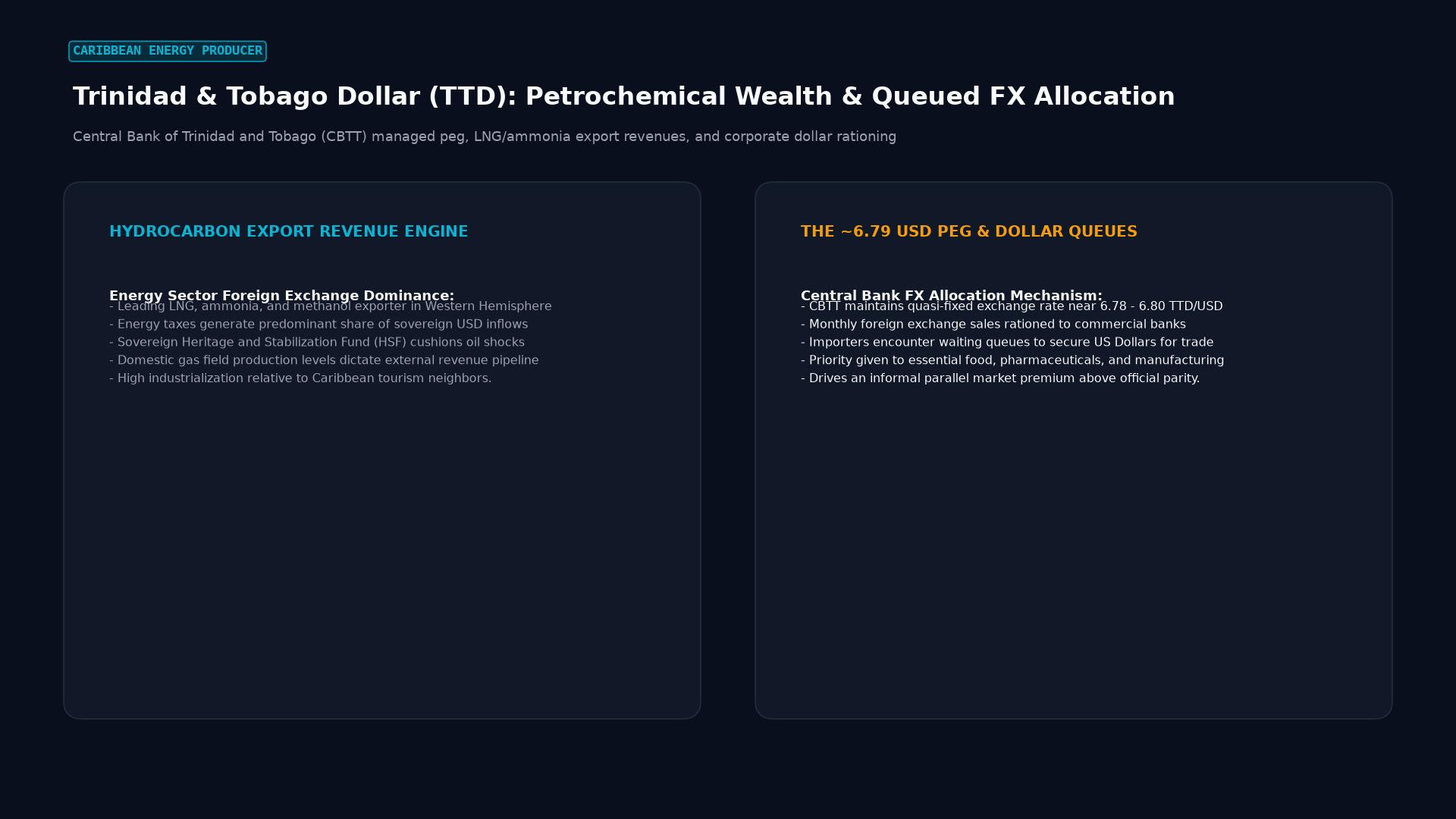 Figure: Central Bank of Trinidad and Tobago (CBTT) managed peg, LNG/ammonia export revenues, and corporate dollar rationing
Historical Context and Currency Evolution
Trinidad and Tobago’s monetary system evolved from British colonial arrangements into modern sovereign central banking:
- The West Indian Dollar Era: Prior to 1964, Trinidad and Tobago utilized the British West Indies dollar (BWI$), issued under the British Caribbean Currency Board (BCCB). The BWI$ was tied to sterling at a fixed parity of 1 BWI$ = 4 shillings and 2 pence.
- Launch of the TTD (1964–1965): Following national independence in 1962, the parliament passed the Central Bank Act of 1964. The Trinidad and Tobago dollar was officially introduced in 1965 at par with the departing West Indian dollar.
- Severance from Sterling to US Dollar: In 1976, reflecting the dramatic shift in bilateral trade flows toward the United States following the discovery of major offshore oil and gas fields, Trinidad and Tobago severed its historic sterling peg and established a fixed peg to the US dollar at TT$ 2.40 = US$ 1.00.
- Oil Collapses and Devaluations (1985–1993): The collapse of global oil prices in the mid-1980s triggered severe balance-of-payments crises, forcing successive devaluations:
- December 1985: Devalued to TT$ 3.60 per USD.
- August 1988: Devalued to TT$ 4.25 per USD as part of an IMF structural adjustment program.
- The 1993 Liberalization and Modern De Facto Peg: In April 1993, the government formally abolished exchange controls and floated the TTD. However, rather than permitting a clean, volatile float, the CBTT quickly adopted a managed float regime, intervening continuously to defend a stable exchange rate corridor, which gradually drifted to approximately 6.75 to 6.80 TTD per 1 USD in recent years.
Monetary Policy and the Foreign Exchange Allocation Mechanism
The Central Bank of Trinidad and Tobago sets monetary policy using its primary policy rate, the Repo Rate. However, the primary operational mechanism impacting corporate business operations is the bank’s direct intervention in the foreign exchange market.
The FX Rationing and Queuing System
Because Trinidad and Tobago maintains an exchange rate that many international organizations (such as the IMF) characterize as overvalued relative to economic fundamentals, private demand for US dollars consistently outstrips the supply provided by commercial banks:
- Energy Sector Tax Receipts: Foreign multinational energy producers (such as bpTT, Shell, and Woodside) pay taxes and royalties to the government in US dollars.
- CBTT Accumulation: These dollar revenues are deposited at the Central Bank.
- Bi-Weekly FX Injections: The CBTT sells hard currency back into the commercial banking system through periodic bi-weekly auctions and allocations.
- Importer Queues: Because the allocated sums are often insufficient to satisfy total domestic import demand, commercial banks operate informal queuing systems, rationing available USD to corporate clients based on priority tiering (basic foods, medical supplies, and raw industrial inputs take precedence over luxury imports and capital transfers).
         Equilibrium Balance Condition in TTD FX Market:

         Supply_FX (Energy Taxes + Non-Energy Exports) < Demand_FX (Total Imports + Capital Outflows)

         Result when Exchange Rate is Fixed:
         Unmet Demand -> Chronic Backlog & Rationing Queue at Commercial Banks
Economic Anchors: Hydrocarbons and the Heritage and Stabilization Fund
The economy of Trinidad and Tobago is heavily concentrated in energy processing:
- Atlantic LNG: Located in Point Fortin, the liquefaction facility is one of the largest LNG export terminals in the Western Hemisphere.
- Point Lisas Industrial Estate: A specialized petrochemical hub housing world-scale plants for ammonia, methanol, urea, and direct reduced iron (DRI).
- Crude Oil: While oil extraction has matured and declined over recent decades, deepwater natural gas exploration remains the primary driver of capital investment.
The Heritage and Stabilization Fund (HSF)
Established by an Act of Parliament in 2007, the Heritage and Stabilization Fund is Trinidad and Tobago’s sovereign wealth fund. The fund fulfills a dual mandate:
- Stabilization: Dampen the impact on public expenditure caused by unexpected volatility in global petroleum and natural gas revenues.
- Heritage: Save a portion of non-renewable hydrocarbon wealth for future generations of citizens.
When international energy tax revenues exceed budgetary projections by more than 10%, the excess must legally be deposited into the HSF. When revenues fall more than 10% below budgetary forecasts, the government can withdraw funds, reducing the need for emergency domestic money creation or abrupt currency devaluations.
+------------------------------------------------------------------------+
|             Structure of the Trinidad and Tobago Economy               |
+------------------------------------------------------------------------+
| Sector                     | Export / FX Contribution | Economic Role  |
| Natural Gas & LNG          | High (~55% of FX)       | Core revenue   |
| Petrochemicals (Methanol)  | High (~25% of FX)       | Industrial base|
| Manufacturing & Services   | Moderate (~12% of FX)   | Regional trade |
| Agriculture                | Negligible (<2% of FX)  | Heavy food imp.|
+------------------------------------------------------------------------+
Comparison: Caribbean Basin Currency Regimes
| Currency | Country | Exchange Rate System | Anchor Mechanism | FX Convertibility |
|---|---|---|---|---|
| TTD | Trinidad & Tobago | De facto stabilized / Managed | USD (~6.78 TTD/USD) | Rationed / Queue-based |
| BBD | Barbados | Fixed peg | USD (2.00 BBD = 1 USD) | Exchange controls |
| JMD | Jamaica | Free-floating / Inflation target | Market determined | Fully convertible |
| XCD | Eastern Caribbean | Currency board | USD (2.70 XCD = 1 USD) | High reserve backing |
| GYD | Guyana | De facto stabilized | USD (~209 GYD/USD) | Resource boom inflow |
Corporate Realities: Operating Under TTD Constraints
Multinational corporations operating in Trinidad and Tobago encounter specific operational challenges:
- Repatriation Delays: International companies generating domestic profits in TTD often face extended waiting periods (weeks to months) to convert local currency profits into US dollars for dividend repatriation to foreign parent companies.
- Use of Dual Invoicing: Domestic commercial vendors often negotiate with commercial clients to settle contracts partly in USD, ensuring access to hard currency to purchase imported inventory.
- Absence of Offshore Liquid Futures: There is no exchange-traded futures contract for TTD on international derivative markets. Foreign exchange risk is managed via local bank forward arrangements or by maintaining USD-denominated offshore accounts.
Frequently Asked Questions
Is the Trinidad and Tobago Dollar pegged to the US Dollar?
Officially, the Central Bank describes the TTD as a managed floating currency. However, international monetary bodies (including the IMF) classify the TTD as maintaining a “de facto stabilized arrangement” because the central bank has tightly bounded the exchange rate within a narrow range between 6.75 and 6.80 TTD per 1 USD for several consecutive years.
Why is there a persistent shortage of US dollars in Trinidad and Tobago?
The shortage occurs because the demand for foreign currency by domestic consumers and commercial importers consistently exceeds the supply released into the commercial banking system by the Central Bank. Because the exchange rate is held artificially stable rather than allowed to float freely to market-clearing levels, the Central Bank must ration dollars, creating commercial queues and waiting periods.
Can tourists spend US dollars directly in Trinidad and Tobago?
While many hotels, duty-free airport shops, and large tourist-oriented establishments accept US dollar cash, standard everyday transactions at local restaurants, supermarkets, and taxis are conducted in Trinidad and Tobago dollars. Commercial change is typically returned in local currency.
Ready to trade forex?
Open a free demo account with a regulated broker. Practice with virtual funds before risking real money.