UGX
The ISO 4217 currency code for the Ugandan Shilling, the official legal tender of the Republic of Uganda, issued and regulated by the Bank of Uganda.
UGX (Ugandan Shilling)
The Ugandan Shilling (ISO code: UGX, symbol: USh) is the official sovereign currency of the Republic of Uganda, a landlocked East African nation. While historically divided into 100 cents, the severe depreciation of past decades has rendered fractional coins obsolete, making the whole shilling the practical base unit of account. The currency is issued, supervised, and defended by the Bank of Uganda (BoU), which was established under the Bank of Uganda Act of 1966.
In international finance and regional African trade, the Ugandan shilling represents one of the most liberalized, free-floating frontier currencies on the continent. Uganda was an early pioneer in Sub-Saharan Africa in abolishing capital account controls in the late 1990s. The currency’s macroeconomic trajectory is shaped by coffee export revenues (Uganda is Africa’s largest exporter of Robusta coffee), gold refining and transit trade, foreign remittances, and substantial foreign direct investment tied to the developing Lake Albert crude oil basin and the East African Crude Oil Pipeline (EACOP).
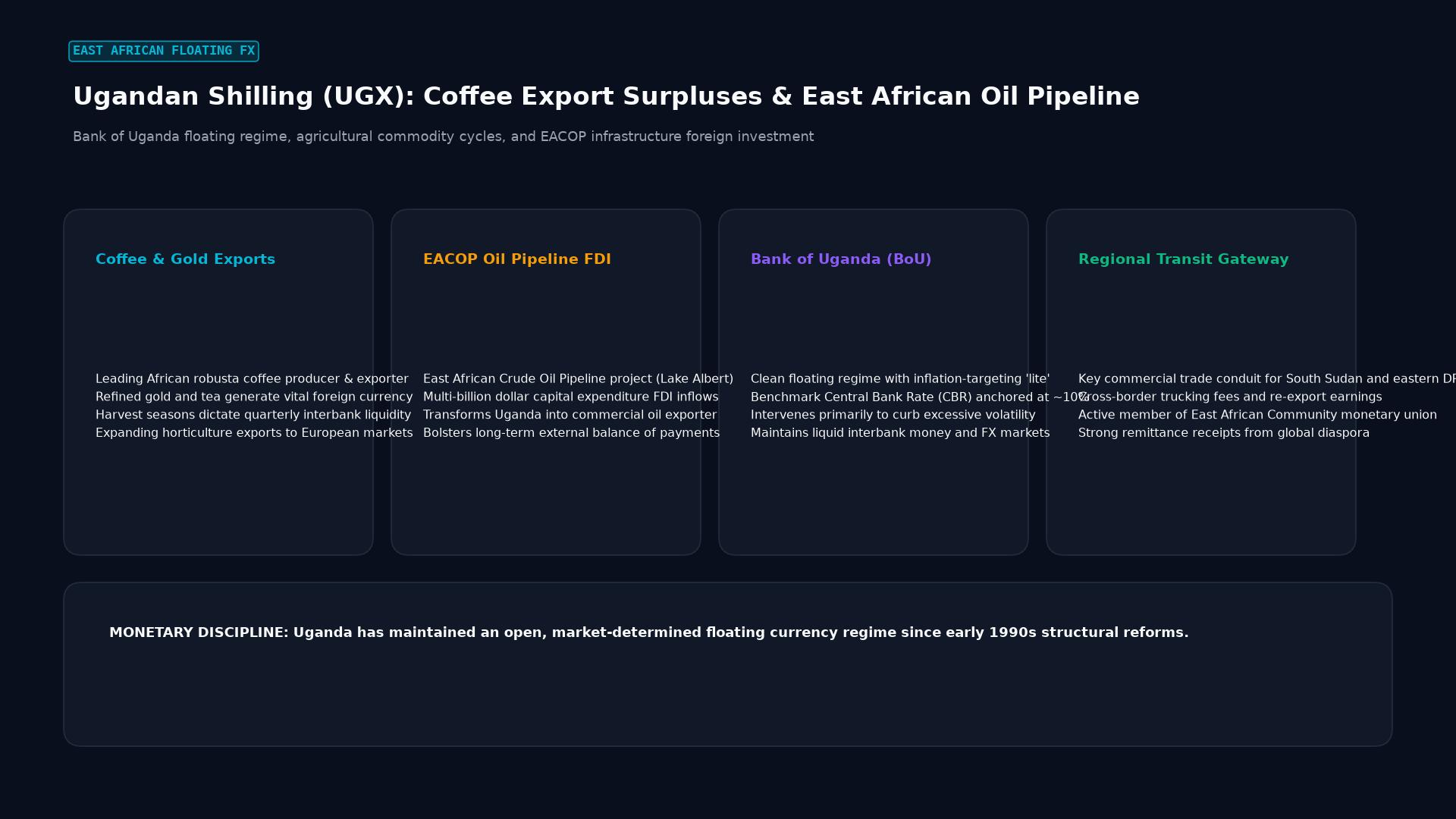 Figure: Bank of Uganda floating regime, agricultural commodity cycles, and EACOP infrastructure foreign investment
Historical Context and Currency Evolution
Uganda’s currency history reflects the country’s turbulent post-independence political and economic journey:
- The East African Shilling (1921–1966): Like its neighbors Kenya and Tanzania, Uganda utilized the East African shilling managed by the East African Currency Board (EACB).
- The First Ugandan Shilling (UGS, 1966–1987): Following independence, the Bank of Uganda launched the first Ugandan shilling in 1966 at 1:1 parity with the regional shilling. During the 1970s and early 1980s, political instability, the expulsion of entrepreneurial minorities, civil conflict, and fiscal monetization caused hyperinflation and currency collapse.
- The 1987 Monetary Reform and Modern UGX: Following the assumption of power by the National Resistance Movement (NRM) in 1986, the government executed structural currency reform on May 15, 1987:
- The new Ugandan shilling (UGX) was introduced at an exchange ratio of: $$1 \text{ UGX} = 100 \text{ Old Shillings (UGS)}$$
- A one-off currency tax of 30% was applied on all cash conversions and bank deposits to reduce systemic excess liquidity and curb inflation.
- Comprehensive Financial Liberalization (1990s): Uganda liberalized its foreign exchange market in 1993, dismantling import licensing and price controls, and fully opened its capital account in 1997, allowing free cross-border movement of investment capital.
Monetary Policy Framework of the Bank of Uganda
The Bank of Uganda operates an Inflation Targeting Lite (ITL) monetary policy framework, using the Central Bank Rate (CBR) as its primary benchmark policy interest rate.
Operational Mechanics
- Inflation Target: The BoT sets a medium-term core inflation target of 5.0%, defining core inflation as headline CPI excluding volatile food crops and energy items.
- Interbank Transmission: The BoU conducts open market operations (OMOs) via repurchase agreements (repos), reverse repos, and the issuance of Bank of Uganda Bills to guide the 7-day interbank money market rate near the CBR.
The Exchange Rate Regime: Independent Float
Unlike many African central banks that maintain administratively managed bands or crawling pegs, Uganda operates an independent floating exchange rate:
- Price Discovery: The USD/UGX exchange rate is determined entirely by willing buyers and sellers on the interbank foreign exchange market.
- Targeted BoU Interventions: The central bank does not defend a specific exchange rate level. It intervenes in the interbank market exclusively for two reasons:
- Sterilization and Reserve Accumulation: Buying foreign exchange in programmed daily or weekly amounts to build national foreign reserves.
- Excess Volatility Mitigation: Selling or buying foreign exchange during sudden, disorderly market illiquidity to dampen sharp spikes without altering underlying market trends.
       BoU Monetary Policy Transmission Mechanism:

       CBR Adjustment -> Interbank Money Rate -> Commercial Bank Lending Rates
                                               -> Yield Curve on T-Bills/T-Bonds
                                               -> Exchange Rate (USD/UGX) -> Core CPI
Macroeconomic Drivers of the UGX
1. Coffee: The Agricultural Anchor
Uganda is Africa’s largest exporter of coffee by volume, renowned for indigenous high-yield Robusta and high-altitude Arabica:
- Coffee export receipts generate hundreds of millions of dollars in seasonal foreign currency inflows.
- Global coffee price spikes on the Intercontinental Exchange (ICE) directly bolster commercial bank foreign exchange liquidity in Kampala, providing immediate support for the UGX.
2. Gold Refining and Regional Transit Trade
In recent years, gold has surpassed coffee as Uganda’s largest nominal export:
- Domestic gold refineries process gold mined within Uganda as well as transit gold from the broader Great Lakes region (including the Democratic Republic of Congo and South Sudan) for export to refining and trading centers in Dubai and Zurich.
3. Oil Development: Lake Albert and EACOP
Uganda possesses an estimated 6.5 billion barrels of crude oil in the Albertine Graben (Tilenga and Kingfisher fields), with roughly 1.4 billion barrels recoverable:
- TotalEnergies and CNOOC lead the multi-billion-dollar development of production facilities alongside the construction of the East African Crude Oil Pipeline (EACOP), a 1,443-kilometer heated pipeline terminating at the Tanzanian port of Tanga.
- Inflows of foreign direct investment (FDI) to construct this infrastructure provide structural support to the capital account, while future commercial oil production will transform Uganda into a crude-exporting economy.
+------------------------------------------------------------------------+
|               Structure of Uganda's External Sector                    |
+------------------------------------------------------------------------+
| Key FX Inflows                        | Key FX Outflows                |
| - Robusta and Arabica Coffee Exports  | - Capital Machinery for EACOP  |
| - Refined Gold & Gemstones            | - Refined Fuel (Diesel/Gasoline|
| - Expatriate Diaspora Remittances     | - Consumer Electronics & Autos |
| - Multilateral Project Financing      | - External Sovereign Debt Serv.|
| - Fish (Nile Perch) & Tea Exports     | - Chemical Fertilizers & Meds  |
+------------------------------------------------------------------------+
Comparison: East African Frontier Currencies
| Metric | Ugandan Shilling (UGX) | Kenyan Shilling (KES) | Rwandan Franc (RWF) |
|---|---|---|---|
| Exchange Rate Regime | Free float | Managed float | Crawling peg |
| Capital Controls | Fully liberalized (zero controls) | Highly liberalized | Moderate restrictions |
| Primary Agricultural FX | Coffee (Robusta) | Tea & Cut Flowers | Coffee & Tea |
| Future Resource Catalyst | Lake Albert Crude Oil / EACOP | Geothermal / Tech Hub | Mining Processing Hub |
| Interbank Market | Highly active OTC interbank | Highly liquid interbank | Centralized bank fixing |
Practical Case Study: Hedging Commodity Export Receipts
Consider Bugisu Arabica Exporters (BAE), a specialty coffee cooperative located in Mbale, on the slopes of Mount Elgon.
Commercial Exposure
- BAE signs a forward delivery contract on September 15 to supply 50 containers of specialty Arabica coffee to a Swiss commodity trading house.
- The contract payment of USD 2,500,000 is due on December 15 upon delivery at the port of Mombasa.
- BAE’s operational costs (paying smallholder farmers at collection stations, wet milling, and road transport to Kenya) are incurred in UGX.
Financial Variables
- Spot exchange rate on September 15: USD/UGX = 3,700
- Projected local operational costs = UGX 8,500,000,000
- Expected revenue at current spot rate: $$2,500,000 \times 3,700 = \text{UGX } 9,250,000,000$$ Expected operating surplus: $$9,250,000,000 - 8,500,000,000 = \text{UGX } 750,000,000$$
Market Risk and Hedging Execution
If heavy foreign direct investment into the EACOP oil project causes the UGX to appreciate sharply to 3,350 USD/UGX by December, BAE’s unhedged revenues would decline to: $$2,500,000 \times 3,350 = \text{UGX } 8,375,000,000$$ This would result in an operational loss of UGX 125,000,000, rendering the harvest unprofitable.
To eliminate this downside risk, BAE executes an onshore deliverable forward contract with Stanbic Bank Uganda:
- 3-Month Forward Rate: USD/UGX = 3,725
- Guaranteed cash proceeds on December 15: $$2,500,000 \times 3,725 = \text{UGX } 9,312,500,000$$
- Result: BAE locks in an operating profit of UGX 812,500,000, insulating rural farmers and operations from foreign exchange volatility.
Frequently Asked Questions
Can foreign investors freely buy and sell Ugandan government bonds?
Yes. Uganda has one of the most open capital accounts in Africa, with no restrictions on foreign ownership of domestic financial assets. Foreign institutional investors can freely participate in primary auctions and secondary trading of Ugandan Treasury bills and bonds via local custodian banks, and can repatriate capital, interest, and dividends without central bank approval or withholding restrictions.
Why does Uganda not use coins for small retail transactions?
Decades of inflation following the 1970s and 1980s reduced the purchasing power of fractional currency units. While coins in denominations of 50, 100, 200, 500, and 1,000 shillings exist and circulate, smaller cent coins have zero economic purchasing power and have been out of circulation for decades.
What is the expected macroeconomic impact of commercial oil production on the UGX?
When commercial crude oil exports begin via the EACOP pipeline, Uganda is projected to earn substantial foreign exchange revenues, improving the sovereign current account and fiscal balance. However, the Bank of Uganda will need to manage the classic “Dutch Disease” risk, where heavy oil revenue inflows cause sharp real currency appreciation that could undermine the competitiveness of traditional agricultural exports like coffee and tea.
Ready to trade forex?
Open a free demo account with a regulated broker. Practice with virtual funds before risking real money.