VEB
The historical ISO 4217 currency code for the original Venezuelan Bolívar, which served as the official legal tender of Venezuela from 1879 until its redenomination as the Bolívar Fuerte (VEF) on January 1, 2008.
VEB (Venezuelan Bolívar, Original Generation)
The currency code VEB designates the original Venezuelan Bolívar, the sovereign currency of the Bolivarian Republic of Venezuela from its formal creation on March 31, 1879, until its comprehensive redenomination on January 1, 2008. Named in honor of the Latin American liberator Simón Bolívar, the currency was initially subdivided into 100 céntimos. Over its 129-year existence, the VEB transitioned from one of the most stable, gold-backed hard currencies in Latin America into the initial stage of a catastrophic, multi-decade inflationary collapse.
On January 1, 2008, the Central Bank of Venezuela (Banco Central de Venezuela, or BCV) retired the VEB, replacing it with the Bolívar Fuerte (assigned ISO code VEF) at a conversion ratio of 1,000 VEB = 1 VEF. This marked the beginning of an unprecedented sequence of currency redenominations: between 2008 and 2021, the Venezuelan state slashed a cumulative 14 zeros from its banknotes across three successive redenomination cycles (VEB to VEF, VEF to VES, and the 2021 re-scaling of the VES).
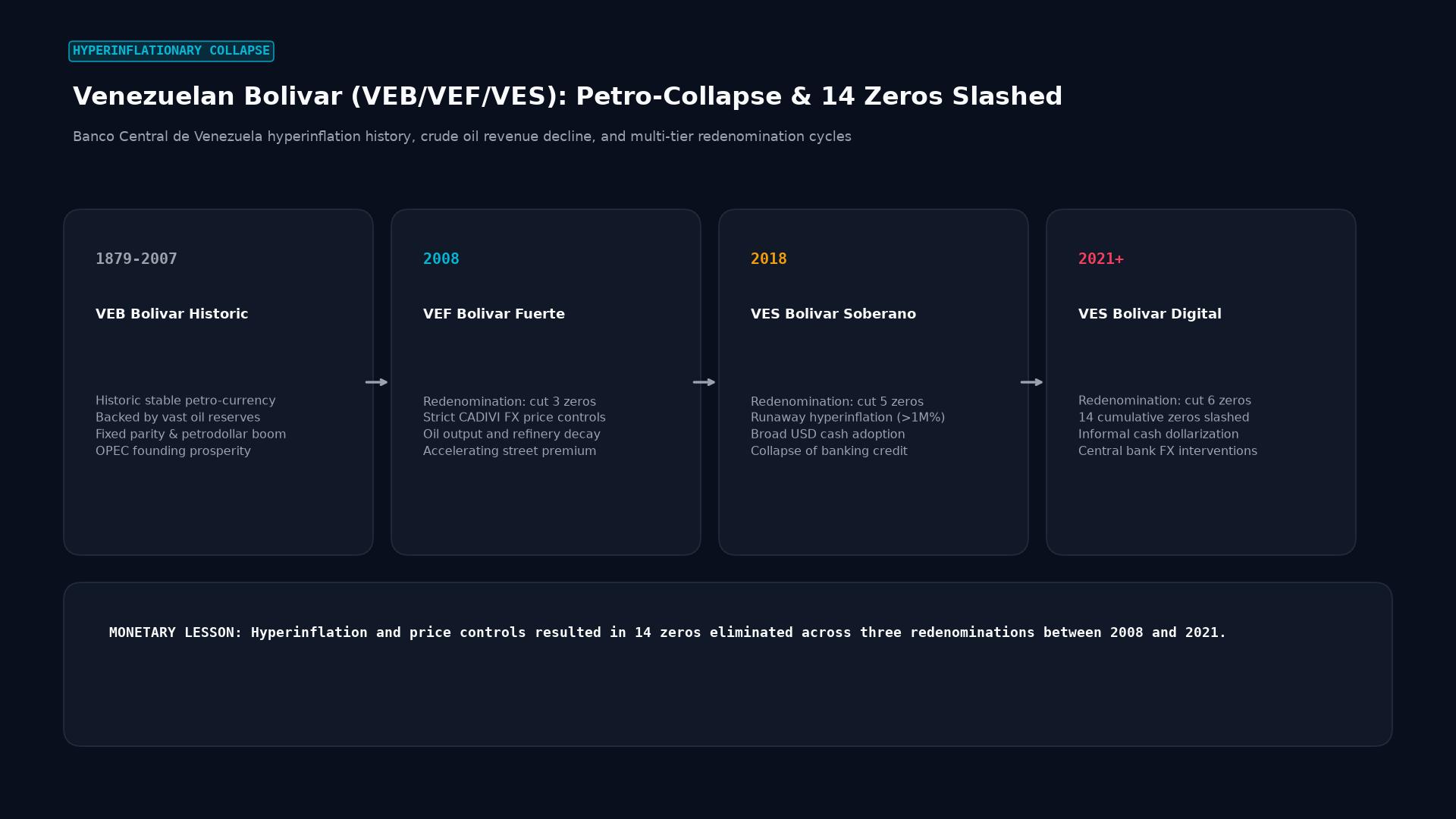 Figure: Banco Central de Venezuela hyperinflation history, crude oil revenue decline, and multi-tier redenomination cycles
The Golden Era: 1879 to the Early 1980s
For much of the 20th century, the Venezuelan bolívar was regarded internationally as an exceptionally strong currency:
- The 1879 Monetary Law: Established the bolívar under a strict bimetallic standard, subsequently transitioned to an orthodox gold standard. Venezuela minted legendary high-purity gold coins (Pachanos) containing 90% pure gold.
- The Hydrocarbon Boom: Following the discovery of massive oil reserves in the Maracaibo Basin during the 1910s and 1920s, Venezuela became the world’s leading crude oil exporter. Enormous foreign currency royalties poured into the national treasury.
- The “Petro-Anchor”: Between 1940 and 1983, the BCV maintained an administrative exchange rate anchored at approximately 3.35 to 4.30 VEB per 1 US dollar. Backed by gold reserves and continuous oil cash inflows from Petróleos de Venezuela (PDVSA), the bolívar was widely accepted across international banks with minimal exchange restrictions.
“Viernes Negro” (Black Friday) and the Onset of Structural Decline
The structural fragility of the VEB was exposed on February 18, 1983, a date commemorated in Latin American financial history as Viernes Negro (Black Friday):
- The External Catalyst: A sharp slump in global crude oil prices coincided with rising international interest rates engineered by US Fed Chairman Paul Volcker, making external sovereign debt servicing unsustainable.
- The End of Parity: Confronted with massive capital flight, President Luis Herrera Campíns suspended free currency convertibility, ending four decades of exchange rate stability.
- Introduction of Multi-Tier Controls (RECADI): The state established the Differential Exchange System (Régimen de Cambios Diferenciales, or RECADI). The BCV operated multiple official tiers (subsidized rates for favored food/medical importers, intermediate rates for state debt, and a floating free-market rate for the general public), institutionalizing bureaucratic corruption, currency arbitrage, and structural misallocation.
The 1990s Inflationary Cycle and Banking Collapse
Throughout the 1990s, Venezuela struggled with widening fiscal deficits and political volatility:
- The 1989 Caracazo: The implementation of an IMF-backed austerity package, including fuel price increases and exchange rate unification, sparked widespread social unrest.
- The 1994 Banking Crisis: Over half of Venezuela’s private commercial banking sector collapsed due to insider lending, insolvency, and fraud. The government executed emergency central bank bailouts equivalent to over 11% of national GDP, monetizing the banking deficit and sending annual inflation soaring past 100% in 1996.
- By the late 1990s, the VEB was depreciating through an official crawling peg band system, moving past 500 VEB per USD.
       Monetization of Fiscal Deficits (Fiscal Dominance):

       Fiscal Deficit = Government Expenditure - Oil Royalty Receipts

       When Oil Royalties Plunge:
       Deficit -> Financed via BCV Unbacked Money Printing -> Hyperinflation

       Quantitative Identity: M * V = P * Y
       Where Money Supply (M) accelerates exponentially while Real Output (Y) contracts.
The CADIVI Era and the Culmination of the VEB (2003–2007)
Following the 2002–2003 national general strike and oil industry shutdown, President Hugo Chávez introduced comprehensive exchange controls on February 5, 2003:
The Establishment of CADIVI
The Commission for the Administration of Foreign Exchange (Comisión de Administración de Divisas, or CADIVI) was granted a legal monopoly over all foreign exchange transactions:
- Prohibition of Free Currency Trade: Private citizens and commercial enterprises were prohibited from purchasing foreign currency without CADIVI bureaucratic authorization.
- Fixed Administrative Rates: The VEB was pegged at 1,600 VEB/USD in 2003, adjusted to 1,920 in 2004, and fixed at 2,150 VEB per 1 USD in 2005.
- Birth of the Parallel Black Market: Because CADIVI disbursed dollars slowly and arbitrarily, a parallel street market (dólar paralelo) emerged, trading at substantial discounts to the official peg.
- The Final Redenomination Decision: By late 2007, everyday cash transactions required stacks of banknotes, as the 50,000 VEB note was worth less than $12 on the parallel market. On March 6, 2007, the BCV decreed the transition to the Bolívar Fuerte.
+------------------------------------------------------------------------+
|          Historical Chronology of Venezuelan Currency Codes            |
+------------------------------------------------------------------------+
| Code | Currency Name      | Active Period   | Primary Redenomination   |
| VEB  | Bolívar (Original) | 1879 - 2007     | Base historical currency |
| VEF  | Bolívar Fuerte     | 2008 - 2018     | 1 VEF = 1,000 VEB        |
| VES  | Bolívar Soberano   | 2018 - 2021     | 1 VES = 100,000 VEF      |
| VES  | Bolívar Digital    | 2021 - Present  | 1 VES = 1,000,000 old VES|
+------------------------------------------------------------------------+
Macroeconomic Lessons from the VEB Collapse
The long trajectory of the VEB provides classic case study insights into monetary economics and resource curse dynamics:
- Dutch Disease and Extreme Monoculture: Unchecked petrodollar inflows during oil booms caused real exchange rate overvaluation, rendering domestic agriculture and manufacturing uncompetitive. When oil prices collapsed, Venezuela lacked an alternative export base to generate foreign exchange.
- The Destructive Nature of Price and Currency Controls: Multi-tier currency regimes like RECADI and CADIVI do not stop currency depreciation. Instead, they incentivize corruption, create perverse arbitrage opportunities, dismantle private supply chains, and exhaust central bank reserves.
- Redenomination Without Fiscal Discipline is Futile: Slicing zeros from banknotes alters the unit of account but does not alter underlying economic incentives. Without eliminating fiscal dominance, balancing the state budget, and granting independence to the central bank, redenomination merely resets the counter for the next hyperinflationary wave.
Frequently Asked Questions
What was the final exchange rate of the VEB before redenomination?
Prior to the January 1, 2008 reform, the official CADIVI exchange rate was administratively fixed at 2,150 VEB per 1 US dollar. However, on the unauthorized parallel market, the dollar was trading between 5,000 and 6,000 VEB per USD. When the Bolívar Fuerte (VEF) was launched, the official rate became 2.15 VEF per USD.
How many total zeros has Venezuela removed from its currency since the VEB era?
Between 2008 and 2021, Venezuela removed a total of 14 zeros across three redenominations:
- 2008 (VEB to VEF): 3 zeros removed (1,000 to 1).
- 2018 (VEF to VES): 5 zeros removed (100,000 to 1).
- 2021 (VES re-scaling): 6 zeros removed (1,000,000 to 1). Thus, $1 \text{ modern VES} = 10^{14} \text{ original VEB}$.
Are original VEB banknotes still redeemable or legal tender?
No. Original VEB banknotes have zero legal tender status and cannot be exchanged at commercial banks or the Central Bank of Venezuela. Because billions of these obsolete notes were rendered valueless by hyperinflation, they circulate primarily as collectibles, novelty souvenirs, or materials for street origami art.
Ready to trade forex?
Open a free demo account with a regulated broker. Practice with virtual funds before risking real money.