XCD
The ISO 4217 currency code for the East Caribbean Dollar, the official legal tender shared by the eight member territories of the Eastern Caribbean Currency Union (ECCU), issued by the Eastern Caribbean Central Bank and pegged to the US dollar at 2.70 XCD = 1 USD.
XCD (East Caribbean Dollar)
The East Caribbean Dollar (ISO code: XCD, symbol: EC$) is the common sovereign currency shared by eight island economies in the Lesser Antilles comprising the Eastern Caribbean Currency Union (ECCU):
- Anguilla (British Overseas Territory)
- Antigua and Barbuda
- Dominica
- Grenada
- Montserrat (British Overseas Territory)
- Saint Kitts and Nevis
- Saint Lucia
- Saint Vincent and the Grenadines
Subdivided into 100 cents, the currency is issued, supervised, and defended by a supranational monetary authority, the Eastern Caribbean Central Bank (ECCB), headquartered in Basseterre, Saint Kitts and Nevis.
In global monetary economics and sovereign currency regime design, the East Caribbean Dollar represents one of the most successful and enduring quasi-currency board arrangements in existence. Established in 1965 to succeed the British West Indies dollar, the XCD has been rigidly pegged to the United States dollar at exactly EC$ 2.70 = US$ 1.00 since July 1976. For half a century, this fixed parity has remained unbroken, delivering monetary stability, low inflation, and investor confidence to small island economies vulnerable to hurricanes, tourism cycles, and external supply shocks.
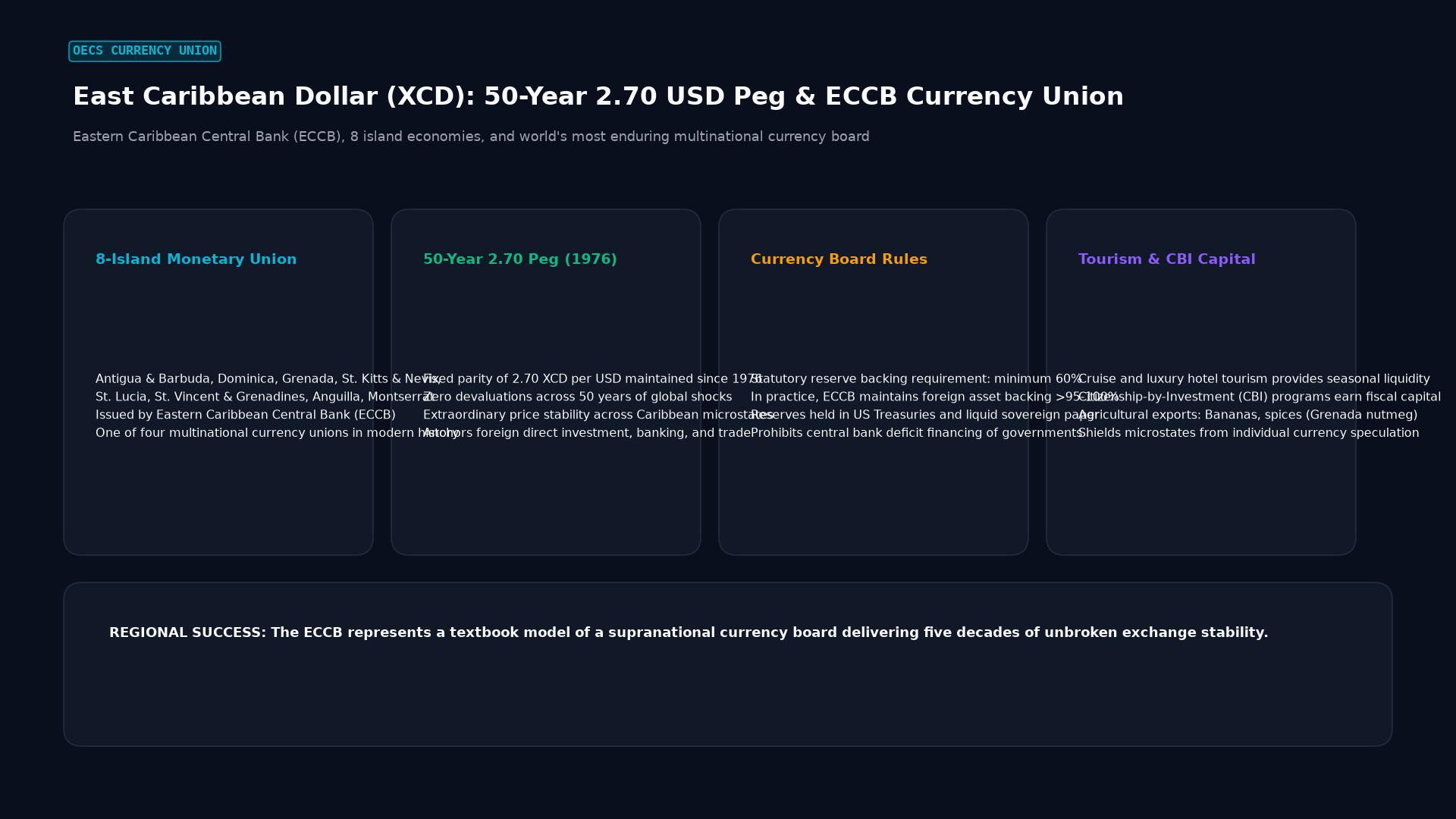 Figure: Eastern Caribbean Central Bank (ECCB), 8 island economies, and world’s most enduring multinational currency board
Historical Genesis: From West Indian Dollar to the 1976 US Dollar Peg
The East Caribbean Dollar emerged from the post-colonial restructuring of the British Caribbean:
- The British Caribbean Currency Board (BCCB, 1950–1965): Following World War II, the British colonial administration established the BCCB to issue the British West Indies dollar (BWI$), tied to the British pound sterling at a fixed parity of BWI$ 4.80 = £1.00 (or 1 BWI$ = 4 shillings and 2 pence).
- Creation of the ECCA and Launch of the XCD (1965): With the dissolution of the West Indies Federation and the departure of Trinidad and Tobago and Guyana into independent central banking, the remaining eastern territories signed the East Caribbean Currency Agreement in 1965. This agreement created the Eastern Caribbean Currency Authority (ECCA) and introduced the East Caribbean Dollar at par with the BWI$.
- Severance from Sterling to the US Dollar Peg (July 1976): Throughout the early 1970s, the British pound suffered repeated devaluations and high domestic inflation. Because the Eastern Caribbean islands traded increasingly with North America for tourism arrivals, food imports, and manufactured goods, the sterling peg imported unwanted monetary volatility. On July 7, 1976, the ECCA severed its link to sterling and pegged the XCD to the US dollar at EC$ 2.70 = US$ 1.00.
- Establishment of the ECCB (1983): On October 1, 1983, the Eastern Caribbean Central Bank Agreement established the modern ECCB, replacing the ECCA with a fully-fledged supranational central bank with statutory supervisory, credit monitoring, and developmental mandates.
The Quasi-Currency Board Architecture
A pure currency board issues domestic currency notes and coins backed 100% by foreign reserve assets, guaranteeing convertibility on demand at a legally fixed exchange rate without executing discretionary monetary policy. The ECCB functions as a quasi-currency board:
1. The Statutory Backing Mandate
Under Article 24(2) of the ECCB Agreement Act, the central bank is legally mandated to maintain a pool of external foreign reserve assets (composed of gold, US Treasury bills, foreign cash balances, and prime sovereign securities) equivalent to at least 60% of its total demand liabilities (banknotes in circulation and commercial bank reserve balances).
2. The Operational 95%+ Target
In practice, to ensure absolute market confidence and protect against sudden catastrophic events (such as hurricanes devastating multiple islands simultaneously), the Monetary Council of the ECCB operates an internal operational policy of maintaining foreign reserve backing between 95% and 100%: $$\text{Reserve Backing Ratio} = \left(\frac{\text{External Foreign Assets}}{\text{Total Demand Liabilities}}\right) \times 100 \ge 95%$$ This high level of backing ensures that every East Caribbean dollar in circulation is fully supported by hard foreign currency assets.
3. Elimination of Fiscal Deficit Monetization
The fundamental pillar preserving the 2.70 peg is the strict prohibition against printing money to finance member governments’ fiscal deficits. While the ECCB provides limited, temporary credit facilities (such as statutory temporary advances capped at strict percentages of government recurrent revenues), national finance ministries cannot compel the central bank to monetize sovereign debt. If an individual member state faces fiscal distress, it must access commercial bond markets (via the Regional Government Securities Market, RGSM) or negotiate structural loans with the IMF or Caribbean Development Bank.
+------------------------------------------------------------------------+
|          Structure of the Eastern Caribbean Currency Union             |
+------------------------------------------------------------------------+
| Island Member Territory | Political Status     | Primary Economic Driver|
| Antigua and Barbuda     | Sovereign State      | Tourism & Offshore Fin |
| Dominica                | Sovereign State      | Agriculture & CBI Inflow|
| Grenada                 | Sovereign State      | Tourism & Spices (Nutmeg)|
| Saint Kitts and Nevis   | Sovereign State      | Tourism & CBI Pioneer  |
| Saint Lucia             | Sovereign State      | Tourism & Manufacturing|
| Saint Vincent & Grenadines| Sovereign State    | Tourism & Agriculture  |
| Anguilla                | UK Overseas Territory| High-End Luxury Tourism|
| Montserrat              | UK Overseas Territory| Reconstruction & Mining|
+------------------------------------------------------------------------+
Macroeconomic Drivers of the ECCU
1. High-End Tourism and Leisure Inflows
Tourism accounts for roughly 50% to 70% of total economic output across most ECCU economies:
- High-end luxury resorts, yacht chartering in the Grenadines, and cruise ship arrivals generate primary commercial demand for services.
- Because the vast majority of tourists arrive from the United States, Canada, and the United Kingdom, the fixed 2.70 peg provides total exchange rate certainty for travel operators and resort developers.
2. Citizenship by Investment (CBI) Programs
Several ECCU states (most notably Saint Kitts and Nevis, Dominica, Grenada, Saint Lucia, and Antigua and Barbuda) operate Citizenship by Investment programs:
- Foreign investors obtain sovereign citizenship in return for substantial capital contributions (typically $100,000 to $200,000+) to national development funds or approved luxury real estate developments.
- CBI receipts have contributed up to 30% to 50% of total fiscal revenues in some member states, providing substantial hard-currency liquidity to the banking system and supporting the ECCB’s foreign asset backing.
3. Vulnerability to Severe Atlantic Hurricanes
Located directly in the Atlantic hurricane belt, the ECCU is acutely vulnerable to extreme weather events:
- Category 5 hurricanes (such as Hurricane Maria in Dominica in 2017, Hurricane Irma in Barbuda in 2017, and Hurricane Beryl in Carriacou and Saint Vincent in 2024) can destroy physical infrastructure equivalent to 100% to 200% of an island’s annual GDP in hours.
- The pooling of foreign reserves across eight territories at the ECCB provides a regional liquidity shield, allowing individual member states to draw upon regional banking liquidity to fund emergency recovery.
Financial Innovation: The DCash Central Bank Digital Currency
In March 2021, the ECCB made financial history by launching DCash, becoming the first currency union central bank in the world to introduce a retail Central Bank Digital Currency (CBDC):
- Architecture: A digital representation of the East Caribbean dollar issued directly on a secure private blockchain ledger.
- Financial Inclusion: Designed to reduce credit card processing fees, bypass high banking costs, and enable instant, zero-cost peer-to-peer retail payments across maritime borders between the eight member islands.
- Redundancy and Lessons: A prolonged technical outage in early 2022 provided critical operational case study lessons for global central banks regarding digital ledger certificate management, offline functionality, and cyber resilience.
Practical Trading and Commercial Mechanics
For international corporate treasuries, asset managers, and individuals:
- Fixed Commercial Buying and Selling Rates: Commercial banks throughout the Eastern Caribbean trade the US dollar within an official corridor pegged to 2.70:
- Central Bank Buying Rate: EC$ 2.6882 = US$ 1.00
- Central Bank Selling Rate: EC$ 2.7169 = US$ 1.00
- Commercial Bank Retail Counter Rate: Typically EC$ 2.67 buy / EC$ 2.72 sell.
- US Dollar Parallel Circulation: In practice, US dollar cash notes circulate widely across all eight islands alongside EC$ banknotes, and are universally accepted by merchants, taxi drivers, and restaurants at the standard commercial conversion rate of EC$ 2.60 to EC$ 2.70 per USD.
- No Offshore Derivative Market: There is no offshore futures or options market for the XCD on international exchanges. Because the 2.70 peg has stood for 50 years without a single realignment, institutional investors treat the XCD as a US dollar proxy asset.
Frequently Asked Questions
Why has the 2.70 peg lasted for nearly 50 years without devaluation?
The peg has endured due to three core structural pillars:
- Supranational Governance: No single island politician or national government can order the ECCB to devalue or print money; monetary policy requires consensus among the eight finance ministers forming the Monetary Council.
- High Reserve Backing: The ECCB maintains near 100% foreign asset backing, far exceeding its statutory 60% floor.
- Fiscal Discipline Mechanisms: Member states cannot run unlimited deficits financed by central bank printing; they must balance budgets or borrow from commercial investors.
Are East Caribbean Dollar banknotes printed in the Caribbean?
No. High-security polymer East Caribbean Dollar banknotes are manufactured under contract by De La Rue in the United Kingdom. The notes feature advanced security elements, unique tactile raised features for the visually impaired, and portraits of shared regional culture and maritime history.
What happens if an individual member of the ECCU defaults on its debt?
Because the ECCB operates as a regional supranational entity, a debt default by an individual member state (as occurred historically when Grenada or Antigua restructured commercial debt) affects that specific sovereign government’s credit rating, but does not compromise the solvency of the ECCB or alter the 2.70 peg. The central bank remains legally insulated from individual sovereign defaults.
Ready to trade forex?
Open a free demo account with a regulated broker. Practice with virtual funds before risking real money.