XOF
The ISO 4217 currency code for the West African CFA Franc, the official legal tender shared by the eight member nations of the West African Economic and Monetary Union (WAEMU / UEMOA), issued by the Banque Centrale des États de l'Afrique de l'Ouest and pegged to the euro at 1 EUR = 655.957 XOF.
XOF (West African CFA Franc)
The West African CFA Franc (ISO code: XOF, symbol: CFA) is the common regional currency shared by eight sovereign nations in West Africa comprising the West African Economic and Monetary Union (Union Économique et Monétaire Ouest-Africaine, or UEMOA / WAEMU):
- Benin
- Burkina Faso
- Côte d’Ivoire
- Guinea-Bissau (which joined in 1997 as the sole Portuguese-speaking member)
- Mali
- Niger
- Senegal
- Togo
Subdivided into 100 centimes (though fractional coins are obsolete in everyday circulation), the currency is issued, supervised, and defended by a supranational central bank, the Central Bank of West African States (Banque Centrale des États de l’Afrique de l’Ouest, or BCEAO), headquartered in Dakar, Senegal.
In global macroeconomics, development finance, and African trade, the XOF represents one of the largest and most enduring currency unions in the developing world. The defining monetary feature of the XOF is its fixed exchange rate peg to the euro, guaranteed by the French Treasury. With Côte d’Ivoire acting as the economic engine (producing over 40% of the world’s cocoa supply) and substantial regional exports of gold, cotton, and agricultural commodities, the XOF provides monetary stability and low inflation, while remaining at the center of historical debates regarding monetary sovereignty and regional integration into the planned Eco currency under the Economic Community of West African States (ECOWAS).
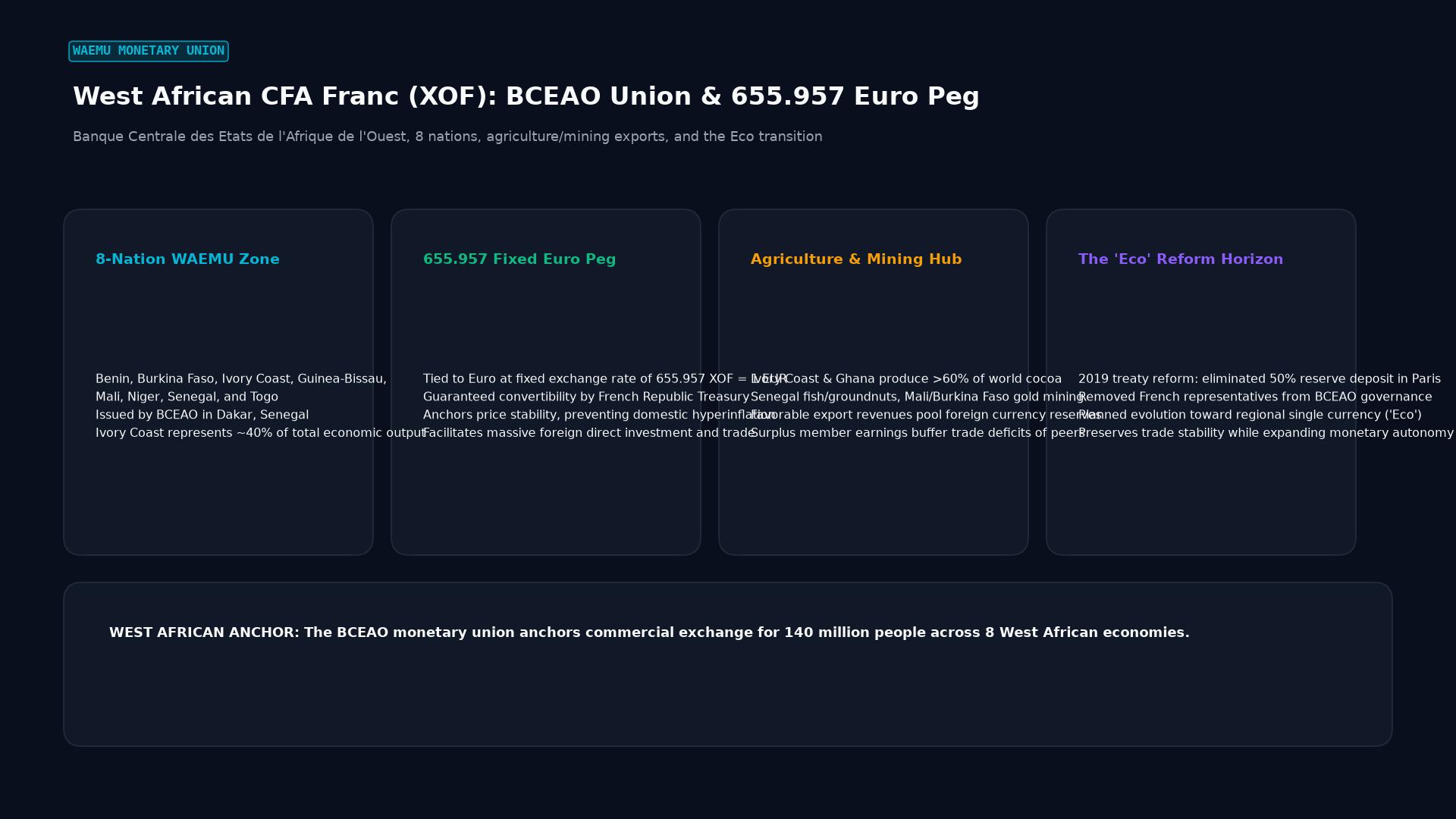 Figure: Banque Centrale des Etats de l’Afrique de l’Ouest, 8 nations, agriculture/mining exports, and the Eco transition
Historical Genesis: From Colonial Currency to Euro Parity
The CFA franc was officially established on December 26, 1945, alongside the ratification of the Bretton Woods Agreements:
- Evolution of the Name: Originally standing for Colonies Françaises d’Afrique, the acronym was revised following national independence in the early 1960s to designate Communauté Financière Africaine (African Financial Community) in West Africa.
- The French Franc Era (1945–1998):
- 1945: 1 CFA = 1.70 French francs (FRF).
- 1948: 1 CFA = 2.00 FRF.
- 1958: Following the creation of the French “new franc”, 1 CFA was reset at 0.02 FRF (or 50 CFA = 1 FRF).
- The 1994 Devaluation: Following prolonged commodity price declines and an overvalued French franc that eroded West African competitiveness, the 14 nations of the CFA zone (both XOF and XAF) met in Dakar on January 12, 1994, and devalued the CFA franc by 50%: $$1 \text{ French Franc (FRF)} = 100 \text{ CFA Francs (XOF)}$$ The devaluation restored the profitability of West African cash crop exports (cocoa, coffee, cotton), but caused immediate hardship for urban populations reliant on imported rice and pharmaceuticals.
- Transition to the Euro (1999): When France transitioned to the euro at the irrevocably fixed rate of 1 EUR = 6.55957 FRF, the West African CFA franc was linked directly to the single European currency without any change in real parity: $$1 \text{ EUR} = 655.957 \text{ XOF}$$ This exact mathematical parity remains unbroken today.
Institutional Pillars of the BCEAO Monetary Architecture
The monetary architecture governing the XOF is anchored by four fundamental treaty principles:
1. Fixed Parity with the Euro
The exchange rate between the euro and the West African CFA franc is permanently fixed at 655.957 XOF per 1 EUR. Commercial transactions, direct investments, and debt payments between the Eurozone and the UEMOA region face zero bilateral exchange rate risk.
2. French Treasury Convertibility Guarantee
The French Treasury guarantees the convertibility of the XOF into euros. If the BCEAO’s foreign exchange reserve buffers are exhausted during severe terms-of-trade crises, the French Treasury provides overdraft facilities, ensuring that commercial banks within UEMOA do not experience cross-border payment default.
3. The Historic Operations Account and the 2019 Abidjan Reforms
Under the original 1973 monetary cooperation treaty, the BCEAO was mandated to deposit 50% of its official foreign exchange reserves in an interest-bearing “operations account” (compte d’opérations) held directly at the French Treasury.
On December 21, 2019, in Abidjan, Ivorian President Alassane Ouattara and French President Emmanuel Macron announced landmark structural reforms to modernize the CFA franc:
- Repatriation of Reserves: The requirement for the BCEAO to deposit 50% of its foreign reserves at the French Treasury was abolished; the BCEAO now manages 100% of its foreign exchange reserves autonomously.
- Exit of French Governance: French representatives stepped down from the BCEAO Monetary Policy Committee and Board of Directors.
- Preservation of the Peg: The French Treasury continues to provide the convertibility guarantee, and the 655.957 parity with the euro remains intact while paving the way for the future regional currency, the Eco.
+------------------------------------------------------------------------+
|          Comparison: West African (XOF) vs. Central African (XAF)      |
+------------------------------------------------------------------------+
| Dimension                | West African CFA (XOF)     | Central African CFA (XAF)  |
| Supranational Authority  | BCEAO (Dakar, Senegal)     | BEAC (Yaoundé, Cameroon)   |
| Economic Powerhouse      | Côte d'Ivoire (~40% of GDP)| Cameroon (~40% of GDP)     |
| Core Export Commodities  | Cocoa, Gold, Cotton, Coffee| Crude Oil (~75%), Timber   |
| Reserve Escrow in France | Fully abolished (2019)     | Partially retained (50%)   |
| Mutual Legal Tender      | **Not spendable in CEMAC** | **Not spendable in UEMOA** |
+------------------------------------------------------------------------+
Macroeconomic Dynamics and Trade Realities
1. Côte d’Ivoire: The Agricultural and Industrial Growth Engine
Côte d’Ivoire generates roughly 35% to 40% of UEMOA’s aggregate gross domestic product:
- World leader in cocoa bean production (harvesting over 2.2 million metric tons annually).
- Significant producer of natural rubber, palm oil, refined petroleum products, and cashews.
- The Port of Abidjan functions as the premier maritime container terminal serving landlocked neighbors Mali and Burkina Faso.
2. Gold Mining Boom in the Sahel
Mali and Burkina Faso have emerged as two of Africa’s largest commercial gold exporters:
- Industrial mining operations (such as Barrick Gold’s Loulo-Gounkoto complex in Mali and Endeavour Mining in Burkina Faso) generate billions of dollars in foreign currency receipts.
- Rising global gold prices provide an organic stabilizer to the UEMOA balance of payments during global downturns.
3. Regional Financial Market: BRVM
The UEMOA zone features one of the world’s few fully integrated regional stock exchanges: the Bourse Régionale des Valeurs Mobilières (BRVM), located in Abidjan:
- Equities and corporate bonds from all eight member states trade under a unified electronic order book denominated in XOF.
- Eliminates domestic transaction currency risk across borders for regional institutional pension funds and retail investors.
       UEMOA Regional Trade Balance Identity:

       CAB = (Exports_Cocoa + Exports_Gold + Exports_Cotton) - (Imports_Fuel + Imports_Machinery + Imports_Rice)

       If Cocoa and Gold Prices are High:
       CAB improves -> Foreign exchange reserves at BCEAO expand -> Domestic money supply increases
Practical Case Study: Commodity Hedging for a Cocoa Exporter
Consider San Pedro Cocoa Exporters (SPCE), an agribusiness logistics enterprise operating out of the Port of San Pedro in southwest Côte d’Ivoire.
Operational Exposure
- SPCE signs a contract on October 1 to deliver 10,000 metric tons of raw cocoa beans to a multinational confectionery processor in Amsterdam.
- The contract is valued at EUR 30,000,000, payable in 90 days.
- SPCE purchases cocoa beans from domestic farming cooperatives and pays warehouse labor in XOF.
Currency Analysis
Because the XOF is permanently linked to the euro at 655.957: $$\text{Guaranteed Local Currency Value} = 30,000,000 \times 655.957 = \text{XOF } 19,678,710,000$$
- Foreign Exchange Risk: Zero percent.
- SPCE does not need to execute costly forward exchange derivatives, pay bank bid-ask spreads, or buy options to protect against euro fluctuations. The monetary union provides absolute currency certainty for European export contracts.
Dollar Import Mismatch Risk
However, if SPCE purchases industrial processing machinery or diesel fuel invoiced in US dollars (USD), it remains fully exposed to USD/EUR exchange rate swings:
- If the US dollar appreciates against the euro from 1.10 to 1.00, the XOF depreciates by 9.1% against the dollar, raising local diesel and shipping costs.
Frequently Asked Questions
What is the planned “Eco” currency, and how does it relate to the XOF?
The Eco is the proposed common regional currency for the 15 member nations of the Economic Community of West African States (ECOWAS), which includes the eight UEMOA members plus Nigeria, Ghana, Guinea, Sierra Leone, Liberia, The Gambia, and Cape Verde. Under the proposed roadmap, UEMOA members plan to transition from the XOF to the Eco once macroeconomic convergence criteria (fiscal deficits below 3% of GDP, inflation below 10%, and debt-to-GDP ratios under 70%) are achieved across the bloc.
Can XOF banknotes be spent directly in Central African CFA countries like Cameroon or Gabon?
No. Banknotes denominated in XOF are issued by the BCEAO and are legal tender exclusively within the eight UEMOA member states. The Central African CFA franc (XAF) is issued by a separate central bank (BEAC). Even though both currencies share the exact same parity against the euro (655.957), their banknotes are legally distinct and must be exchanged at commercial banks or foreign exchange counters.
What are the main economic benefits and criticisms of the XOF?
The primary benefit is monetary stability: inflation in the UEMOA zone has historically averaged between 1% and 3%, far below the double-digit and triple-digit inflation episodes experienced by neighboring non-CFA countries like Nigeria and Ghana. The primary criticism is that the fixed peg to a strong currency (the euro) can overvalue domestic wages and reduce the price competitiveness of local manufacturing, while historical reliance on the French Treasury raised political sovereignty concerns that motivated the 2019 reforms.
Ready to trade forex?
Open a free demo account with a regulated broker. Practice with virtual funds before risking real money.