XAF
The ISO 4217 currency code for the Central African CFA Franc, the official legal tender shared by the six member states of the Economic and Monetary Community of Central Africa (CEMAC), issued by the Banque des États de l'Afrique Centrale.
XAF (Central African CFA Franc)
The Central African CFA Franc (ISO code: XAF, symbol: FCFA) is the common regional currency shared by six independent nations in Central Africa comprising the Economic and Monetary Community of Central Africa (Communauté Économique et Monétaire de l’Afrique Centrale, or CEMAC):
- Cameroon
- Central African Republic
- Chad
- Republic of the Congo
- Equatorial Guinea (which joined in 1985 as the sole Spanish-speaking member)
- Gabon
Subdivided into 100 centimes (though fractional coins are obsolete in practical circulation), the currency is issued and regulated by a supranational central bank, the Bank of Central African States (Banque des États de l’Afrique Centrale, or BEAC), headquartered in Yaoundé, Cameroon.
In international macroeconomics, development finance, and sovereign debt analysis, the XAF represents one of two distinct CFA franc currency unions in Africa (the other being the West African CFA Franc, ISO code XOF). The defining institutional characteristic of the XAF is its fixed peg to the euro, guaranteed by the French Treasury through a specialized operational account mechanism. This arrangement provides monetary stability and low inflation, but also generates ongoing debate regarding monetary sovereignty, exchange rate flexibility, and resource-dependent economic growth.
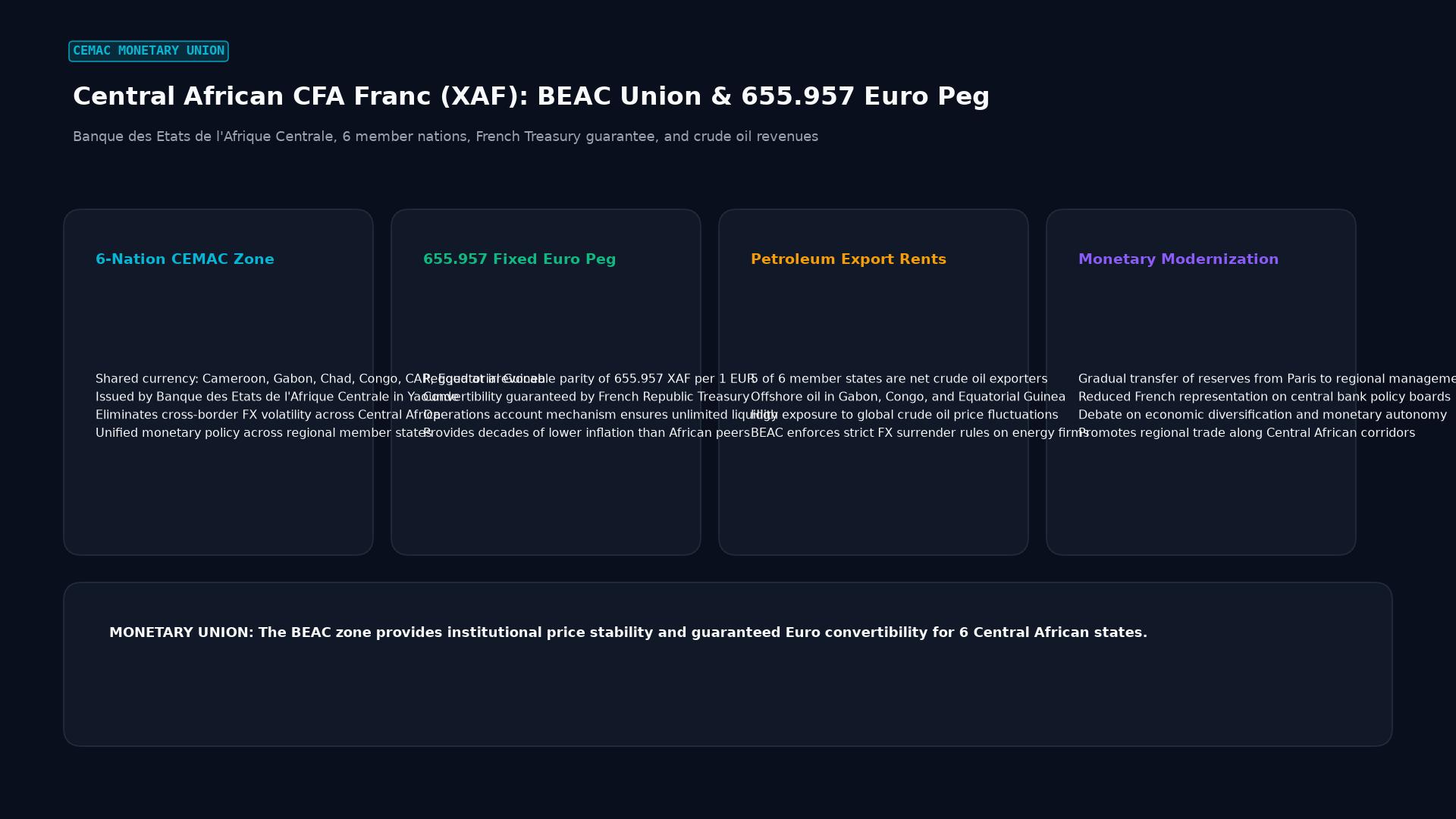 Figure: Banque des Etats de l’Afrique Centrale, 6 member nations, French Treasury guarantee, and crude oil revenues
Historical Genesis: From Colonial Empire to the Euro Link
The CFA franc was established on December 26, 1945, when France ratified the Bretton Woods Agreements:
- Origins of the Acronym: Originally, CFA stood for Colonies Françaises d’Afrique (French Colonies of Africa). Following post-colonial independence in the 1960s, the acronym was redefined for Central Africa as Coopération Financière en Afrique Centrale (Financial Cooperation in Central Africa).
- The French Franc Anchor (1945–1998): For over five decades, the CFA franc was pegged directly to the French franc (FRF):
- 1945: 1 CFA = 1.70 FRF
- 1948: 1 CFA = 2.00 FRF
- 1958: Following the creation of the French “new franc”, 1 CFA = 0.02 FRF (or 50 CFA = 1 FRF).
- The 1994 Devaluation: During the late 1980s and early 1990s, collapsing commodity export prices and the overvaluation of the French franc severely depressed the CFA economies. On January 12, 1994, in Dakar, with the backing of the IMF and France, the CFA franc was devalued by 50%: $$1 \text{ French Franc (FRF)} = 100 \text{ CFA Francs (XAF)}$$ While painful for consumers relying on imported medicine and wheat, the devaluation restored external price competitiveness to Central African timber, cocoa, and cotton exports.
- Transition to the Euro (January 1, 1999): When France adopted the euro, the peg was automatically transferred without altering real parity. At the fixed conversion rate of 1 EUR = 6.55957 FRF: $$1 \text{ EUR} = 655.957 \text{ XAF}$$ This exact mathematical parity remains in effect today.
The Institutional Architecture: BEAC and the French Treasury
The monetary stability of the XAF is underpinned by four fundamental legal principles established in monetary cooperation treaties:
1. Fixed Parity with the Euro
The exchange rate between the euro and the Central African CFA franc is permanently fixed at 655.957 XAF per 1 EUR. Commercial transactions conducted between Paris and Yaoundé do not face bilateral exchange rate risk.
2. Unlimited French Treasury Convertibility Guarantee
The French Treasury (not the European Central Bank) guarantees the unlimited convertibility of the XAF into euros. If the BEAC’s foreign exchange reserves fall into deficit during severe regional trade crises, the French Treasury provides overdraft facilities to ensure payment obligations are honored.
3. The Operations Account (Compte d’Opérations)
In exchange for the convertibility guarantee, the BEAC was historically treaty-bound to deposit a substantial portion of its foreign exchange reserves in an interest-bearing “operations account” held at the French Treasury:
- In the 1970s, the requirement was 65% of total reserves.
- In 2007, the requirement was lowered to 50%.
- Recent monetary reform discussions across the CEMAC zone have mirrored developments in the West African union (UEMOA), aiming to repatriate external reserves and phase out mandatory French Treasury escrow deposits.
4. Supranational Central Banking
The six member states have completely surrendered national monetary sovereignty to the BEAC. Individual national governments cannot print money to finance domestic fiscal deficits. The BEAC enforces strict limits on statutory direct central bank advances to member treasuries.
+------------------------------------------------------------------------+
|          Comparison: Central African (XAF) vs. West African (XOF)      |
+------------------------------------------------------------------------+
| Dimension                | Central African CFA (XAF)  | West African CFA (XOF)  |
| Regional Organization    | CEMAC                      | UEMOA / ECOWAS          |
| Supranational Bank       | BEAC (Yaoundé, Cameroon)   | BCEAO (Dakar, Senegal)  |
| Member States            | 6 nations                  | 8 nations               |
| Fixed Peg Ratio to Euro  | 1 EUR = 655.957 XAF        | 1 EUR = 655.957 XOF     |
| Dominant Export Driver   | Crude Oil & Minerals (~75%)| Agri (Cocoa), Gold (~40%)|
| Mutual Fungibility       | **Non-fungible with XOF**  | **Non-fungible with XAF**|
+------------------------------------------------------------------------+
(Note: Although both currencies share the exact same euro peg and “CFA Franc” name, XAF and XOF banknotes are legally distinct and cannot be spent interchangeably in the other currency union.)
Macroeconomic Dynamics: Hydrocarbon Dominance and Asymmetry
Unlike the West African monetary zone (XOF), which is anchored heavily by agricultural exports (cocoa in Côte d’Ivoire, cotton in Mali) and gold, the Central African CEMAC zone is characterized by heavy hydrocarbon dependence:
- Oil Exporters: Five of the six CEMAC nations (Equatorial Guinea, Gabon, Republic of the Congo, Chad, and Cameroon) are net petroleum exporters. Crude oil accounts for roughly 70% to 80% of total regional export receipts.
- Cameroon as Economic Anchor: Cameroon represents the largest, most diversified economy in CEMAC, producing timber, cocoa, bananas, aluminum, and agricultural staples, while operating the primary transit logistics corridor (Port of Douala) for landlocked Chad and the Central African Republic.
- The Asymmetric Shock Dilemma: When global crude oil prices collapse (as in 2014–2016), the CEMAC zone faces a severe balance-of-payments crisis. Because the XAF is pegged to the euro, the currency cannot depreciate to absorb the oil shock. If the euro happens to appreciate against the US dollar at the same time, CEMAC oil exporters suffer a double blow: their dollar-denominated oil revenues drop while their euro-pegged domestic cost structure remains artificially elevated.
       CEMAC Hydrocarbon Balance of Payments Shock:

       Oil Price Drops ($/bbl) -> Dollar Revenues Contract
       If EUR/USD Rises -> XAF Appreciates Against USD

       Result: Severe Local Currency Revenue Contraction + Rapid Reserve Depletion at BEAC
Foreign Exchange Regulations and Capital Controls
In June 2019, the BEAC implemented comprehensive new foreign exchange regulations (Règlement N° 02/18/CEMAC/UMAC/CM) to halt capital flight and rebuild regional foreign reserves:
- Mandatory Repatriation of Export Proceeds: Exporters (including international oil and mining companies operating within CEMAC) are legally required to repatriate 100% of their foreign currency export receipts to a commercial bank inside the CEMAC zone within 35 days of invoicing.
- Surrender of Foreign Currency: Domestic commercial banks must transfer excess foreign currency holdings to the BEAC.
- Strict Import Documentation: Cross-border foreign currency transfers exceeding 5,000,000 XAF (approx. $8,300) require extensive documentary validation, including commercial invoices, customs clearing certificates, and tax compliance declarations.
Practical Case Study: Multilateral Oil Service Forward Exposure
Consider Pointe-Noire Maritime Services (PNMS), a marine logistics contractor operating out of the Republic of the Congo, providing offshore support vessels to multinational oil majors.
Commercial Exposure
- PNMS signs a 1-year contract with a French offshore operator valued at EUR 6,000,000, invoiced in euros.
- PNMS also signs an equipment supply contract with a US subsea technology manufacturer valued at USD 4,000,000, payable in US dollars in 180 days.
- PNMS incurs local crew payroll and port docking fees in Pointe-Noire denominated entirely in XAF.
Financial Risk Analysis
- The Euro Contract (Zero FX Risk): $$\text{Local Value} = 6,000,000 \times 655.957 = \text{XAF } 3,935,742,000$$ Because the XAF is permanently pegged to the euro, PNMS faces zero currency risk on the EUR contract. The local currency cash flow is mathematically guaranteed.
- The US Dollar Contract (Unhedged FX Risk):
- On contract signing, the EUR/USD exchange rate is 1.08.
- Initial spot rate: $$\text{USD/XAF} = \frac{655.957}{1.08} \approx 607.37$$
- Projected liability in local currency: $$4,000,000 \times 607.37 = \text{XAF } 2,429,480,000$$
- Adverse Currency Movement:
- Over the next 180 days, global inflation and Fed rate hikes drive EUR/USD down to 1.00 (parity).
- Revised spot rate: $$\text{USD/XAF} = \frac{655.957}{1.00} = 655.957$$
- New liability cost: $$4,000,000 \times 655.957 = \text{XAF } 2,623,828,000$$
- Unhedged foreign exchange loss: $$\text{Loss} = 2,623,828,000 - 2,429,480,000 = \text{XAF } 194,348,000 \quad (\approx $320,000)$$
To eliminate this volatility, PNMS executes a forward foreign exchange purchase through a licensed commercial bank in Douala or Brazzaville, locking in the USD/XAF rate via a EUR/USD forward derivative.
Frequently Asked Questions
Can Central African CFA Francs (XAF) be spent in West African countries using the XOF?
No. Despite sharing identical parity with the euro (1 EUR = 655.957 CFA) and identical historical origins, the XAF (Central Africa) and XOF (West Africa) are legally distinct currencies issued by two separate supranational central banks (BEAC and BCEAO). They are not mutually legal tender. A traveler taking XAF banknotes into Senegal or Côte d’Ivoire must convert them through commercial exchange counters, often incurring a commission.
What is the ongoing reform debate surrounding the CFA Franc?
Critics of the CFA franc argue that the fixed peg to the euro overvalues the currency, harms regional export competitiveness, and that French Treasury oversight limits monetary sovereignty. Supporters counter that the CFA franc has delivered exceptionally low inflation (historically 2% to 4%, compared to double-digit inflation in neighboring Nigeria and Ghana), eliminated intra-regional transaction costs, and provided absolute exchange stability for foreign direct investment.
Who guarantees the convertibility of the XAF?
The convertibility of the Central African CFA franc is guaranteed directly by the French Treasury through a specialized operational account credit line, not by the European Central Bank or the European Union. The treaty arrangement remains a bilateral sovereign financial agreement between France and the CEMAC member states.
Ready to trade forex?
Open a free demo account with a regulated broker. Practice with virtual funds before risking real money.