Y-Share
In asset management, a Y-share (Class Y share) is an institutional mutual fund share class designed for institutional investors, defined-contribution retirement plans, and fee-based advisory platforms, characterized by the complete absence of front-end sales loads, back-end deferred sales charges, and 12b-1 distribution fees.
Y-Share (Class Y Mutual Fund Shares)
In mutual fund investing, wealth management, and retirement plan administration, a Y-share (commonly designated on fund prospectuses as Class Y) represents an institutional share class of an open-end management investment company. Distinct from traditional retail share classes sold through commission-compensated brokers, Class Y shares are engineered specifically for institutional investors, large corporate defined-contribution retirement platforms (such as 401(k) and 403(b) plans), university endowments, foundations, and fee-only Registered Investment Advisers (RIAs).
The primary economic appeal of Class Y shares lies in their minimal cost structure: they carry zero front-end sales loads, zero contingent deferred sales charges (CDSC), and zero 12b-1 marketing and distribution fees. In exchange for eliminating intermediary commissions and distributor kickbacks, fund managers traditionally mandate high minimum initial investment thresholds, ranging from $250,000 to $1,000,000 or more, though these minimums are routinely waived when shares are purchased through aggregated employer retirement plan omnibus accounts.
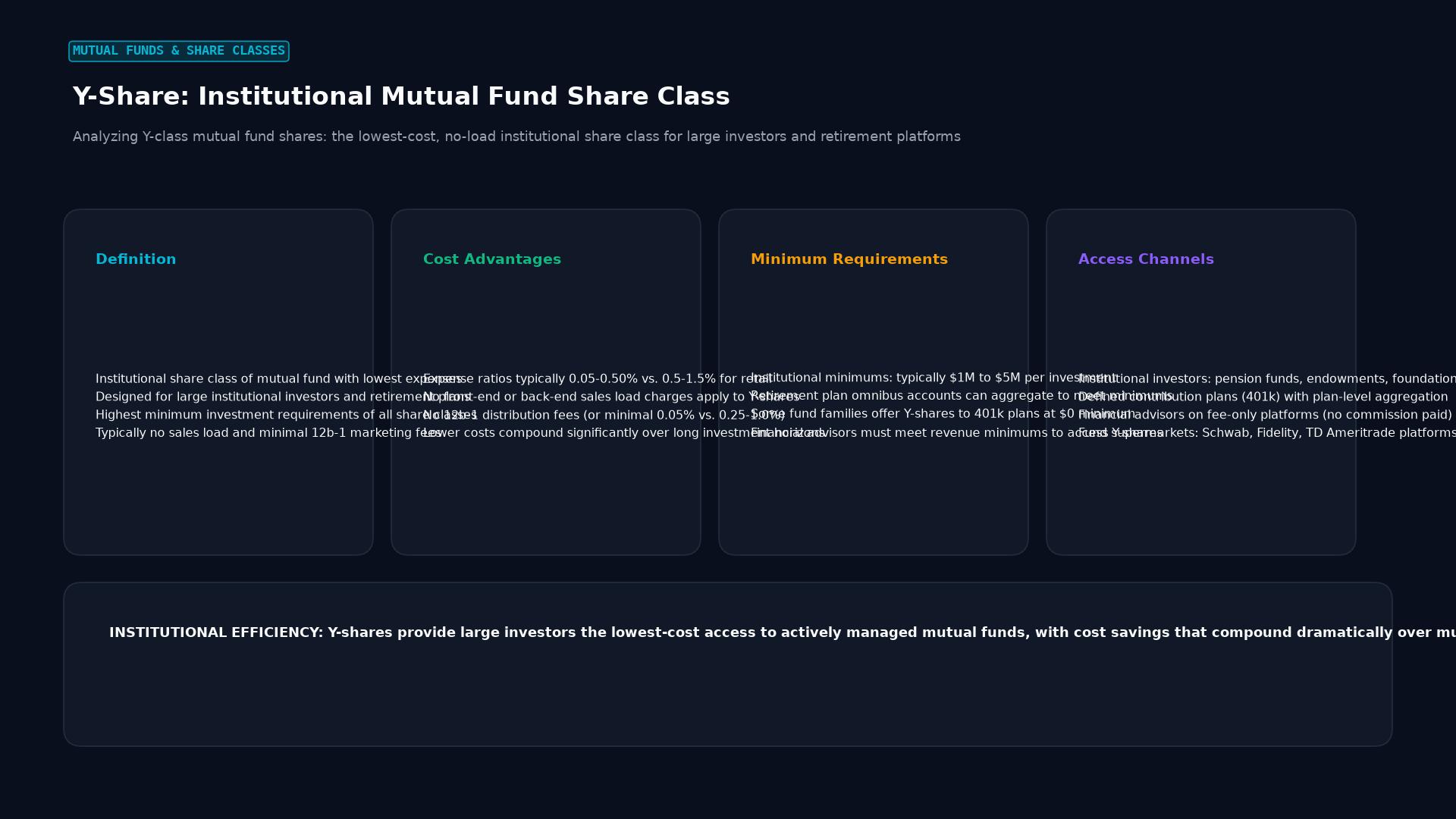 Figure: Analyzing Y-class mutual fund shares: the lowest-cost, no-load institutional share class for large investors and retirement platforms
The Economics of Share Class Segmentation
Modern mutual funds operate under a multi-class structure authorized under Rule 18f-3 of the Investment Company Act of 1940. Under this architecture, every share class holds an identical proportional claim on the same underlying pool of portfolio assets:
- Every shareholder, whether holding Class A, Class C, or Class Y, owns the exact same underlying stocks or bonds.
- The fundamental difference between classes lies entirely in distribution expenses, intermediary commissions, and administrative servicing fees subtracted from gross portfolio returns.
- Because Class Y shares bypass broker commissions and broker-dealer revenue-sharing payments, their Total Expense Ratio (TER) is substantially lower than retail counterparts.
       Net Asset Value (NAV) Performance Divergence Equation:

       R_net,Y = R_gross - TER_Y
       R_net,Retail = R_gross - TER_Retail

       Annual Performance Advantage of Class Y:
       Alpha_Y = TER_Retail - TER_Y
If a retail Class A or C share carries an ongoing total expense ratio of 1.25% and the equivalent Class Y share carries an expense ratio of 0.50%, the Class Y investor captures an automatic 75 basis points (0.75%) of annualized outperformance, compounding into hundreds of thousands of dollars in added wealth over multi-decade retirement horizons.
Detailed Comparison: Class Y vs. Traditional Retail Classes
| Metric / Feature | Class Y (Institutional) | Class A Shares | Class C Shares | Class I Shares |
|---|---|---|---|---|
| Front-End Sales Load | 0.00% (None) | 2.50% – 5.75% | 0.00% | 0.00% |
| Contingent Deferred Load (CDSC) | 0.00% (None) | 0.00% (typically) | 1.00% (if sold <1 yr) | 0.00% |
| 12b-1 Distribution Fee | 0.00% (None) | 0.25% annually | 0.75% – 1.00% annually | 0.00% |
| Minimum Initial Investment | $250k – $1,000,000+ (or 401k) | $1,000 – $2,500 | $1,000 – $2,500 | $500k – $5,000,000 |
| Target Audience | Institutions, 401(k) plans, RIAs | Traditional retail | Short-term retail | Sovereign funds, large pens. |
| Net Compounding Drag | Lowest | Moderate to High | Highest long-term | Lowest |
(Note: While some fund complexes use Class I and Class Y interchangeably to denote institutional pricing, other fund families reserve Class I for direct corporate institutional mandates and Class Y for employer retirement platforms and wrap-fee consultant programs.)
Institutional Channels Accessing Class Y Shares
Because individual retail investors walking into a traditional brokerage firm rarely possess the $500,000+ liquid capital required for a single fund minimum, Class Y shares are predominantly accessed through three institutional conduits:
1. Defined-Contribution Employer Retirement Plans (401k / 403b)
Under the Employee Retirement Income Security Act of 1974 (ERISA), corporate plan sponsors and retirement investment committees act as named fiduciaries. They are legally mandated to select the lowest-cost available share class for plan participants:
- When a 401(k) plan pools the payroll contributions of thousands of employees, the cumulative plan assets easily surpass institutional threshold minimums.
- Fund companies establish omnibus accounts for the plan, waiving the individual minimum investment requirement and allowing rank-and-file workers to invest small bi-weekly contributions directly into Class Y shares.
2. Fee-Only Registered Investment Advisers (RIAs)
Modern wealth management has shifted away from commission-based broker-dealer models toward fee-only fiduciary advisory models:
- RIAs charge clients a direct advisory fee (e.g., 0.50% to 1.00% of AUM) rather than receiving product sales commissions.
- RIAs aggregate their client accounts through custodian institutional platforms (such as Charles Schwab, Fidelity Institutional, or BNY Mellon Pershing), satisfying fund minimums in the aggregate and allocating low-cost Class Y shares across client portfolios.
3. Institutional Wrap Accounts
In institutional wrap-fee programs operated by private banks and trust institutions, clients pay a single bundled management fee covering investment advice, custodial services, and trade execution. Fiduciary guidelines prohibit the fund manager from double-charging clients with internal 12b-1 marketing fees, necessitating the use of clean institutional Class Y or Class I shares.
Compounding Impact: Mathematical Analysis of Expense Drag
To visualize the real-world financial consequences of share class selection, consider an institutional retirement committee evaluating two share classes of the same Global Large-Cap Growth Fund for an employee 401(k) lineup:
Scenario Parameters
- Initial Portfolio Allocation: $10,000,000.
- Holding Period: 25 Years.
- Gross Underlying Portfolio Return ($R_{\text{gross}}$): 8.00% annualized.
- Option 1 (Class A Retail):
- Upfront Sales Load: 3.50% (Net initial investment: $9,650,000).
- Ongoing Annual Expense Ratio: 1.15% (Net return: $8.00% - 1.15% = 6.85%$).
- Option 2 (Class Y Institutional):
- Upfront Sales Load: 0.00% (Net initial investment: $10,000,000).
- Ongoing Annual Expense Ratio: 0.45% (Net return: $8.00% - 0.45% = 7.55%$).
Future Value Compounding Calculation
$$\text{Future Value} (FV) = PV \times (1 + R_{\text{net}})^n$$
- Class A Portfolio Terminal Value: $$FV_A = $9,650,000 \times (1 + 0.0685)^{25} = $9,650,000 \times 5.2104 \approx $50,280,360$$
- Class Y Portfolio Terminal Value: $$FV_Y = $10,000,000 \times (1 + 0.0755)^{25} = $10,000,000 \times 6.1822 \approx $61,822,000$$
+------------------------------------------------------------------------+
|               Terminal Wealth Comparison Over 25 Years                 |
+------------------------------------------------------------------------+
| Share Class        | Net Initial   | Net Annual Return | Ending Wealth |
| Class A (Retail)   | $9,650,000    | 6.85%             | $50,280,360   |
| Class Y (Instit.)  | $10,000,000   | 7.55%             | $61,822,000   |
| Institutional Gain | +$350,000     | +0.70% / year     | +$11,541,640  |
+------------------------------------------------------------------------+
By securing Class Y shares, the retirement plan generates an additional $11,541,640 in terminal wealth for its participants from the exact same underlying portfolio investments, demonstrating why ERISA litigation heavily targets plan sponsors that fail to transition to institutional share classes.
Frequently Asked Questions
Can an individual retail investor buy Class Y shares directly?
Generally, an individual investor cannot purchase Class Y shares directly through a retail discount brokerage account unless they meet the statutory minimum investment threshold (typically $250,000 to $1,000,000 in a single fund). However, individual investors can easily access Class Y shares through their employer’s 401(k) or 403(b) retirement plan, or by engaging a fee-only Registered Investment Adviser (RIA) who possesses institutional platform access.
What is the difference between Class Y shares and Class I shares?
In most fund complexes, Class Y and Class I shares are functionally identical in economic terms: both represent institutional share classes with zero front-end loads, zero CDSCs, and zero 12b-1 fees. However, fund families sometimes distinguish them operationally: Class I may be reserved for ultra-high-net-worth direct corporate mandates with multi-million-dollar minimums, while Class Y is earmarked for employer retirement platforms, wrap accounts, and financial consultant intermediary networks.
What happens if an employee rolls over a 401(k) holding Class Y shares into an individual IRA?
When an employee leaves an employer and rolls over their 401(k) into a retail Individual Retirement Account (IRA), the receiving brokerage platform may not support Class Y shares if the rolled-over balance does not meet the fund family’s retail institutional minimum. In such cases, the position is either transferred into an equivalent low-cost retail share class (such as Investor or Admiral shares) or liquidated into cash for reinvestment into low-cost index ETFs.
Ready to trade forex?
Open a free demo account with a regulated broker. Practice with virtual funds before risking real money.