YER
The ISO 4217 currency code for the Yemeni Rial, the official legal tender of the Republic of Yemen, characterized by acute monetary fragmentation between competing central banking authorities in Aden and Sana'a.
YER (Yemeni Rial)
The Yemeni Rial (ISO code: YER, symbol: ﷼) is the official sovereign currency of the Republic of Yemen, located at the southern tip of the Arabian Peninsula. Subdivided into 100 fils (which have been entirely obsolete in circulation for decades due to severe currency depreciation), the modern unified rial was introduced in May 1990 following the political unification of the Yemen Arab Republic (North Yemen) and the People’s Democratic Republic of Yemen (South Yemen).
In modern international finance, humanitarian economics, and conflict macroeconomics, the Yemeni rial represents one of the world’s most acute case studies in monetary and central banking fragmentation. Following the outbreak of civil war in 2014–2015, Yemen experienced an institutional split: the internationally recognized government relocated the official headquarters of the Central Bank of Yemen (CBY) to the southern port city of Aden, while the de facto authorities retained control of the historical central bank headquarters in the northern capital of Sana’a. This institutional rupture created two competing central banks, two mutually incompatible banknote regimes, and a severe currency divergence that fractured the national economy.
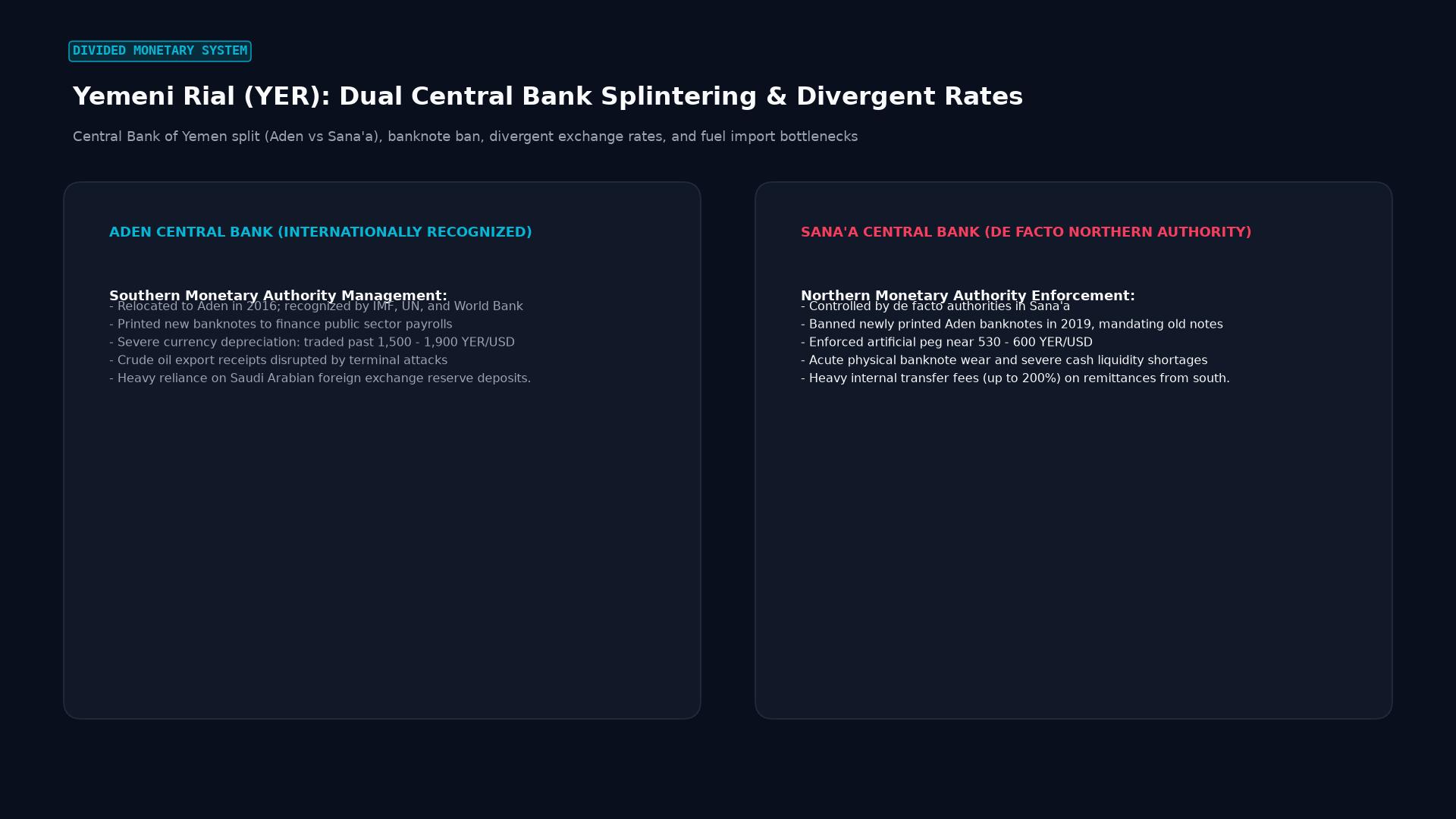 Figure: Central Bank of Yemen split (Aden vs Sana’a), banknote ban, divergent exchange rates, and fuel import bottlenecks
Historical Context: From Ancient Trade to 1990 Unification
Yemen has a rich monetary history spanning thousands of years:
- The Maria Theresa Thaler Era: For centuries, the silver Maria Theresa Thaler (Al-Riyal Al-Fransi) was the dominant commercial trade currency throughout Yemen and the Red Sea basin, prized for its reliable silver content.
- North vs. South Currency Division (Pre-1990):
- North Yemen (YAR): Operated the North Yemeni Rial, issued by the Central Bank of Yemen in Sana’a.
- South Yemen (PDRY): Operated the South Yemeni Dinar (YDD), a British colonial legacy currency pegged historically to sterling and subdivided into 1,000 fils.
- The 1990 Unification Reform: On May 22, 1990, North and South Yemen merged to establish the modern Republic of Yemen. The monetary systems were unified:
- The Yemeni Rial became the single sovereign currency.
- The South Yemeni dinar was phased out at an exchange ratio of 1 Dinar = 26 Rials.
- The Pre-War Floating Managed Peg: Throughout the 2000s and early 2010s, backed by modest crude oil exports from the Marib and Masila basins, the CBY in Sana’a maintained a managed peg, keeping the rial trading in a relatively stable range around 214 to 215 YER per 1 US dollar.
The Institutional Schism and the “Banknote War”
The macroeconomic stability of the rial collapsed following the escalation of military conflict in late 2014 and 2015:
1. Relocation of the Central Bank to Aden (September 2016)
In September 2016, President Abdrabbuh Mansur Hadi issued a presidential decree transferring the legal headquarters and international recognition of the Central Bank of Yemen from Sana’a to Aden:
- The Aden CBY retained official international SWIFT access, sovereign foreign exchange reserve accounts held abroad, and recognition by the IMF, World Bank, and foreign central banks.
- However, the Sana’a CBY retained control over the physical banking infrastructure, corporate head offices, and roughly 70% of the country’s population and commercial trade volume.
2. The Banknote Printing Campaign and the Sana’a Ban
Confronted with empty vaults and unpaid public sector salaries, the internationally recognized government in Aden contracted Russian state mint Goznak to print massive quantities of new Yemeni rial banknotes (in denominations of 100, 250, 500, and 1,000 rials):
- Physical Differentiation: The newly printed notes were physically distinct from legacy notes, featuring modified dimensions, updated serial numbers, and different color saturations.
- The Northern Ban (December 2019): The de facto authorities in Sana’a declared the newly printed Aden banknotes illegal contraband, banning their circulation across northern territories under penalty of arrest and confiscation.
3. The Resulting Dual-Currency Reality
This decree effectively split Yemen into two completely distinct monetary regimes using the exact same nominal currency name:
- Northern Yemen (Sana’a Control): Only old, worn pre-2016 banknotes were permitted to circulate. Because no new physical banknotes could legally enter, physical paper currency became scarce. The Sana’a authorities enforced strict price controls, fixing the exchange rate at approximately 530 YER per 1 USD.
- Southern Yemen (Aden Control): The flooded supply of newly printed banknotes drove rapid monetary inflation and currency depreciation. The exchange rate in Aden collapsed from 600 YER/USD to over 1,600 to 1,900 YER per 1 USD.
+------------------------------------------------------------------------+
|          Comparison: Northern vs. Southern Yemeni Rial (YER)           |
+------------------------------------------------------------------------+
| Operational Metric       | Northern Zone (Sana'a)   | Southern Zone (Aden)     |
| Governing Institution    | CBY Sana'a (De Facto)    | CBY Aden (Recognized)    |
| Circulating Banknotes    | Old, worn pre-2016 notes | New Goznak-printed notes |
| Exchange Rate vs USD     | ~530 YER / USD           | ~1,600 - 1,900 YER / USD |
| Money Supply Policy      | Strict currency scarcity | Monetized public deficits|
| Interbank SWIFT Access   | Completely severed       | Active international     |
| Commercial Population    | ~70% of national market  | ~30% of national market  |
+------------------------------------------------------------------------+
Macroeconomic Consequences and Internal Remittance Fees
The divergence between the two rial rates created severe friction for ordinary commerce and humanitarian relief:
1. Internal Remittance Surcharges (The Internal Transfer Fee)
Because a merchant or citizen in Aden holding new banknotes cannot spend them in Sana’a, funds transferred from south to north through commercial money transfer networks (Hawala agencies) face massive conversion surcharges:
- To wire 100,000 rials from an Aden account to a family member in Sana’a, the sender must pay an internal transfer fee of 100% to 200%.
- In practical terms, sending $1,000 worth of rials from the south arrives in the north with half its nominal purchasing power absorbed by exchange rate equalization fees.
2. Collapse of Hydrocarbon Export Receipts
Historically, crude oil and liquefied natural gas (LNG from the Yemen LNG facility in Balhaf) generated over 70% of government budgetary revenues and nearly 90% of national foreign exchange earnings. Drone strikes and political blockades on southern export terminals (such as Ash Shihr and Bir Ali) halted crude exports, completely starving the Aden government of organic US dollar inflows and accelerating the collapse of the southern rial.
3. Complete Dollarization of Commercial Wholesaling
Due to extreme domestic currency volatility, domestic businesses have largely abandoned the rial for wholesale contracts:
- Wholesale imports (wheat, rice, fuel, pharmaceuticals) are priced strictly in US Dollars (USD) or Saudi Riyals (SAR).
- The domestic rial functions merely as a volatile transactional currency for immediate retail market purchases.
       Internal Financial Fragmentation Formula:

       Transfer_Cost = [(Exchange_Rate_Aden - Exchange_Rate_Sanaa) / Exchange_Rate_Sanaa] * 100

       With Aden = 1,600 YER/USD and Sana'a = 530 YER/USD:
       Transfer_Cost = [(1,600 - 530) / 530] * 100 = 201.8% Fee
Practical Case Study: Humanitarian Relief Logistics and Currency Risk
Consider Global Food Relief Initiative (GFRI), an international non-governmental organization (INGO) delivering emergency food supplies across Yemen.
Humanitarian Mission Parameters
- GFRI receives an institutional grant of USD 10,000,000 deposited into an offshore account in New York.
- Operational mandate: Purchase basic food baskets (wheat flour, cooking oil, lentils) and distribute them equally across beneficiaries in Aden (south) and Sana’a/Hodeidah (north).
Execution Friction and Regulatory Compliance
- Southern Procurement (Aden):
- GFRI converts $5,000,000 via authorized commercial banks in Aden at the market rate of 1,650 YER/USD.
- Total domestic liquidity generated: $$$5,000,000 \times 1,650 = \text{YER } 8,250,000,000$$
- Local food packages cost roughly 82,500 YER per basket, enabling GFRI to feed 100,000 families in the south.
- Northern Procurement (Sana’a):
- If GFRI wires rials from Aden to Sana’a, it loses over 65% of the capital in internal transfer equalization fees.
- To avoid this catastrophic loss, GFRI must maintain completely segregated funding pipelines: it wires US dollars directly into commercial import accounts in Sana’a, clearing local vendor invoices directly in USD or converting at the northern rate of 535 YER/USD.
- In Sana’a, the local food basket costs roughly 26,750 old rials, feeding an equivalent 100,000 families.
Frequently Asked Questions
Why does Yemen have two different exchange rates for the same currency?
Yemen has two different exchange rates because the central bank split into two competing authorities in 2016 following the outbreak of civil war. The internationally recognized government in Aden printed vast amounts of new, physically redesigned banknotes to pay salaries, causing massive currency depreciation in the south (~1,600+ YER/USD). The authorities in Sana’a banned these new banknotes, preserving an artificial currency shortage of old pre-2016 notes that kept the northern exchange rate fixed around 530 YER/USD.
What is the role of the Saudi Riyal (SAR) in Yemen?
Because of extreme volatility and shortages of the domestic Yemeni rial, the Saudi Riyal (SAR) has become the primary secondary currency and store of value across both northern and southern Yemen. Many local merchants, real estate landlords, and cross-border traders quote prices, settle contracts, and maintain physical cash reserves in Saudi riyals, which are viewed as stable and readily convertible throughout the region.
Can international investors trade YER on retail forex brokerage platforms?
No. The Yemeni rial is completely unavailable for trading on international retail forex platforms, currency futures exchanges, or offshore derivative markets. It is an illiquid, fragmented conflict currency subject to severe capital controls, international sanctions, and central banking distress. Currency exchange is conducted strictly within physical money transfer networks and authorized exchange bureaus inside Yemen.
Ready to trade forex?
Open a free demo account with a regulated broker. Practice with virtual funds before risking real money.