Callable Bond
A callable bond is a debt instrument that incorporates an embedded call option granting the issuer the legal privilege to redeem the bond prior to its scheduled maturity date at a predetermined call price.
What Is a Callable Bond?
A callable bond (frequently termed a redeemable bond) is a fixed-income security that embeds a contractual call option allowing the issuing corporation or sovereign agency to repurchase and retire the debt before its formal stated maturity date.
Issuers incorporate call features into bonds to preserve financial agility across shifting macroeconomic regimes. If prevailing market interest rates decline significantly below the bond’s contractual coupon rate, or if the issuer’s corporate balance sheet improves sufficiently to secure cheaper financing, the issuer can exercise the option, call the bonds back at a stated call price, and reissue new debt at a lower cost of capital.
To induce investors to accept this embedded reinvestment risk and price truncation, callable bonds are issued with an attractive yield premium over otherwise identical non-callable (bullet) bonds.
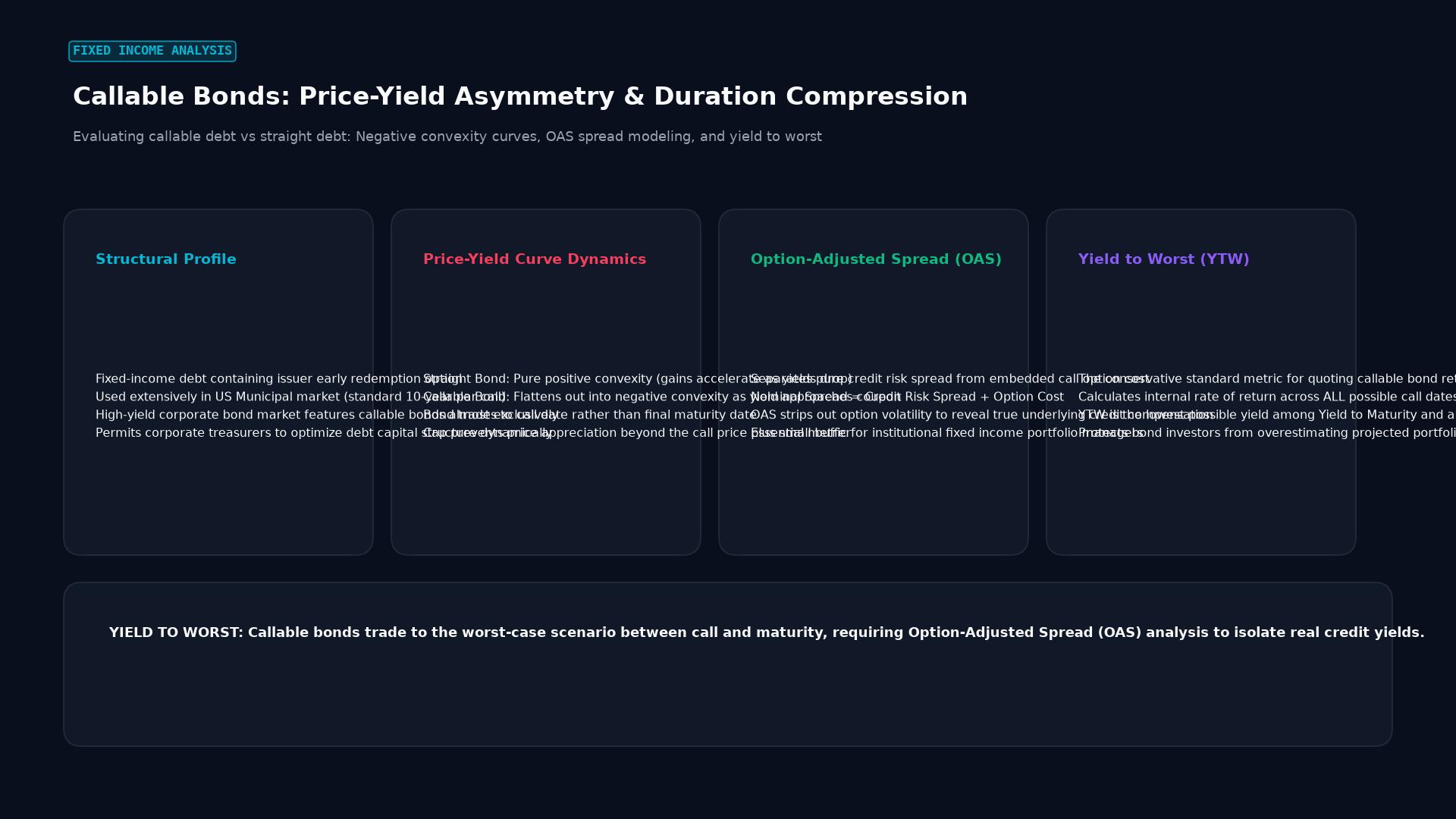 Figure: Evaluating callable debt vs straight debt: Negative convexity curves, OAS spread modeling, and yield to worst
Technical Mechanics & Binomial Lattice Valuation
In institutional quantitative finance, a callable bond cannot be evaluated using traditional discounted cash-flow formulas because future cash flows are path-dependent on interest rate trajectories. Instead, analysts utilize a Binomial Interest Rate Tree (such as the Black-Derman-Toy or Hull-White models).
Backward Induction on an Interest Rate Tree
At each terminal node at maturity $T$, the bond’s value equals its par value plus the final coupon:
$$V_T = F + C$$
At any intermediate node $(i, j)$ prior to maturity, the provisional continuation value ($V_{\text{cont}}$) discounted at the node’s forward rate ($r_{i,j}$) is:
$$V_{\text{cont}} = \frac{0.5 \times V_{i+1, j+1} + 0.5 \times V_{i+1, j} + C}{1 + r_{i,j}}$$
Because the issuer is assumed to act rationally to minimize its liability, the bond’s value at that node is capped at the scheduled call price ($P_{\text{call}}$):
$$V_{i,j} = \min\left( P_{\text{call}}, V_{\text{cont}} \right)$$
Option-Adjusted Spread (OAS)
To compare a callable bond against non-callable debt, institutional desks calculate the Option-Adjusted Spread (OAS). The OAS measures the pure credit and liquidity spread after mathematically stripping away the value of the embedded call option:
$$\text{Nominal Spread} = \text{Option-Adjusted Spread (OAS)} + \text{Option Cost}$$
A callable bond offering a nominal spread of 250 basis points over Treasuries might have an OAS of only 160 basis points, revealing that 90 basis points of the apparent yield represents compensation for selling the call option to the issuer.
Comparative Matrix: Bond Indenture Structures
| Feature | Callable Bond | Bullet Bond | Puttable Bond | Convertible Bond |
|---|---|---|---|---|
| Embedded Option | Call option (Held by Issuer) | None | Put option (Held by Investor) | Call on company’s equity |
| Convexity Profile | Negative convexity as yields drop | Pure positive convexity | High positive convexity | Dynamic hybrid convexity |
| Yield Comparison | Higher than bullet | Baseline benchmark yield | Lower than bullet | Lowest coupon yield |
| Primary Risk | Reinvestment / Call Risk | Interest rate duration risk | Credit default risk | Equity volatility risk |
| Investor Benefit | Attractive cash-flow coupon | Guaranteed tenure to maturity | Downside floor protection | Unlimited equity upside |
Real-World Case Study: The Corporate Refinancing Wave (2020–2021)
During the unprecedented monetary stimulus following the COVID-19 pandemic shock, the Federal Reserve reduced the Fed Funds rate to near-zero and launched the Secondary Market Corporate Credit Facility.
Anatomy of a Corporate Bond Redemption:
1. Historical Issuance: In 2015, multinational energy company Chevron issued 10-year senior notes yielding 4.25% with a 5-year call protection window (10NC5).
2. The Rate Environment (2020): By late 2020, investment-grade corporate borrowing costs for 5-year maturities plummeted to 1.85%.
3. Exercising the Call: With the 5-year call lockout having expired in 2020, Chevron formally called the remaining $1.5 billion of 4.25% bonds at the contractual call price of Par ($100.00).
4. Refinancing: The company immediately issued replacement 5-year notes at a 1.80% coupon, saving over $36 million annually in cash interest expense.
5. Bondholder Impact: Institutional investors who purchased the bonds expecting 10 years of steady 4.25% income received their cash back at par, forced to deploy that liquidity into bonds yielding less than half the previous rate.
Frequently Asked Questions (FAQ)
Why would an investor buy a callable bond instead of a standard bullet bond?
Investors choose callable bonds because they pay a higher stated coupon rate and higher Yield to Maturity than non-callable bonds with identical credit ratings and maturities. For investors who anticipate that interest rates will remain stable or rise moderately, the embedded call option is unlikely to be exercised, allowing the investor to capture the higher yield premium throughout the holding period.
What is the difference between Yield to Maturity (YTM) and Yield to Worst (YTW)?
Yield to Maturity (YTM) calculates the annualized rate of return assuming the bond remains outstanding until its final stated maturity date. Yield to Worst (YTW) is the lowest potential yield an investor can receive across all possible redemption scenarios—including every scheduled call date and the final maturity date. When a callable bond trades at a premium to its call price, Yield to Worst is almost always the Yield to Call (YTC), which professional investors treat as the true expected return.
What is a “deferred call” in a callable bond indenture?
A deferred call (or call protection period) is a contractual clause that prohibits the issuer from redeeming the bond for an initial period—typically the first 3, 5, or 10 years following issuance. This ensures that the bondholder receives guaranteed coupon payments for at least that designated timeframe before becoming vulnerable to early redemption.
Ready to trade forex?
Open a free demo account with a regulated broker. Practice with virtual funds before risking real money.