Z-Bond
In mortgage-backed securitization and structured finance, a Z-bond (accretion bond or zero-tranche) is the final tranche in a sequential-pay Collateralized Mortgage Obligation (CMO), where coupon interest is accrued and added to principal rather than paid out in cash until all preceding tranches are fully retired.
Z-Bond (Accretion Bond / Zero-Tranche in CMOs)
In structured finance, mortgage securitization, and fixed-income portfolio management, a Z-bond (also widely termed an accretion bond, accrual bond, or zero-tranche) is a specialized tranche engineered within a sequential-pay Collateralized Mortgage Obligation (CMO). Representing the final or deeply subordinated debt tranche in a mortgage cash-flow waterfall, the Z-bond receives zero cash coupon payments and zero cash principal distributions during the initial lifespan of the securitization structure.
Instead of paying cash to Z-bondholders, the contractual interest that accrues on the Z-bond is capitalized (accreted) onto its outstanding principal balance, compounding over time. The physical cash flow generated by the underlying residential mortgage collateral that would have funded the Z-bond’s interest is redirected to accelerate the retirement and principal amortization of preceding senior tranches (such as Tranches A, B, and C). Once all prior tranches are completely paid off, the Z-bond awakens: it begins receiving regular cash coupon payments based on its expanded, accreted principal balance alongside all remaining principal prepayments until final liquidation.
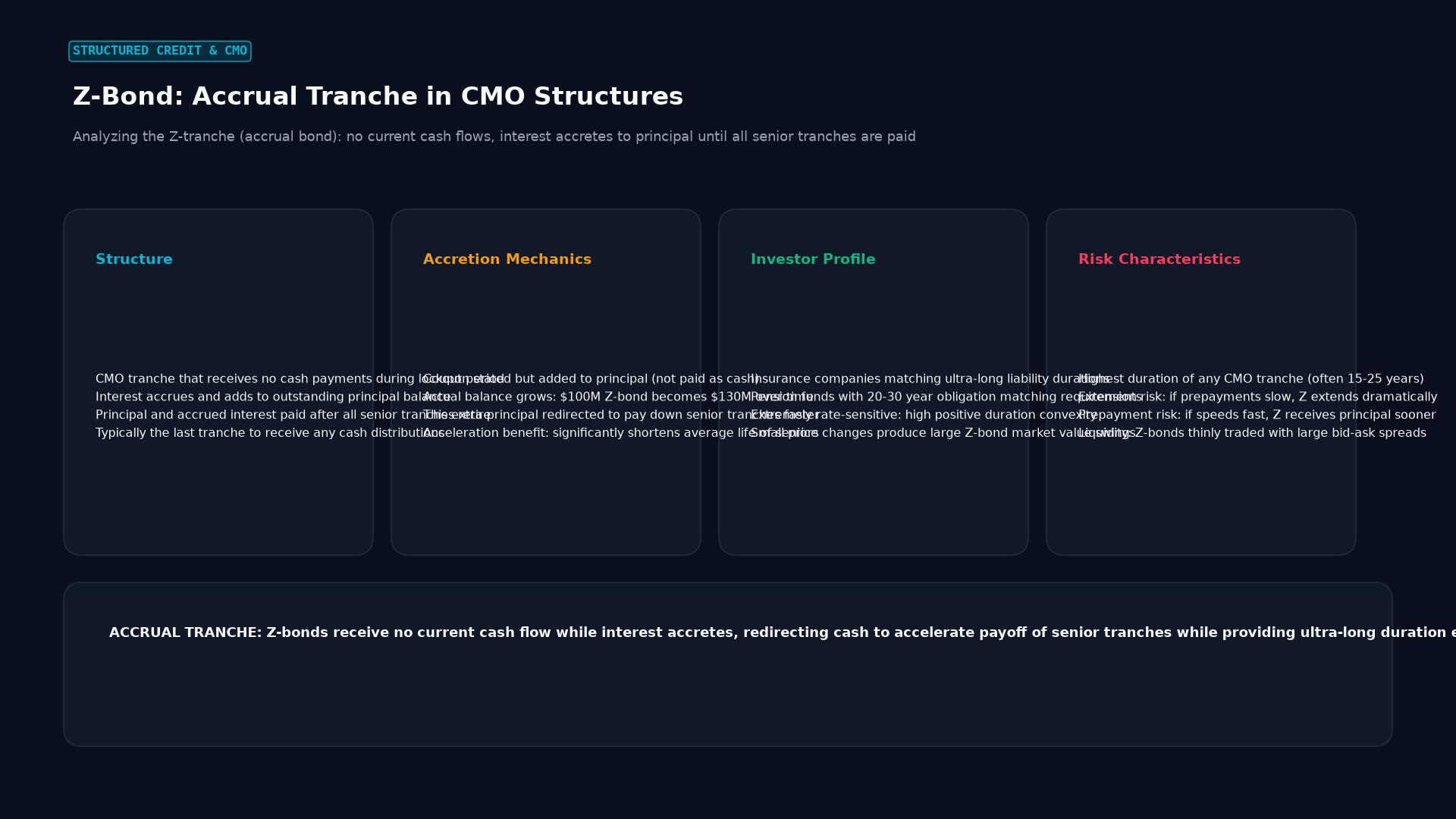 Figure: Analyzing the Z-tranche (accrual bond): no current cash flows, interest accretes to principal until all senior tranches are paid
The Mathematics of Accretion and Principal Expansion
The defining structural feature of the Z-bond is the exponential expansion of its face value during the accrual period:
1. Principal Accretion Equation
During the period in which senior tranches remain outstanding, the principal balance of the Z-bond grows at the stated coupon rate: $$P_t = P_0 \times \left(1 + \frac{r_z}{m}\right)^{m \times t}$$
Where:
- $P_0$: Initial stated face value (original par amount) of the Z-bond at the time of securitization closing.
- $P_t$: Accreted principal balance at elapsed time $t$.
- $r_z$: Stated annual coupon rate of the Z-bond.
- $m$: Compounding frequency per year (typically $m=12$ for monthly mortgage-backed securities).
- $t$: Elapsed time in years prior to the retirement of all preceding senior tranches.
2. Cash Redirection Acceleration
The monthly interest generated by the Z-bond that is diverted to pay down senior debt equals: $$\Delta \text{Principal Paydown to Senior Tranche} = P_t \times \left(\frac{r_z}{12}\right)$$ By injecting this shadow interest cash into Senior Tranche A, Tranche A is retired much faster than would be possible under a standard pro-rata mortgage pass-through structure, significantly reducing extension risk for senior short-duration investors (such as commercial banks).
+------------------------------------------------------------------------+
|          Hypothetical Principal Accretion Schedule of a Z-Bond         |
+------------------------------------------------------------------------+
| Month | Beginning Principal | Stated Coupon (6% Annual)| Accreted Ending Principal |
| Month 0| $10,000,000         | 0.50% / month            | $10,050,000               |
| Month 12| $10,563,000        | 0.50% / month            | $10,615,815               |
| Month 36| $11,833,000        | 0.50% / month            | $11,892,165               |
| Month 60| $13,354,000        | 0.50% / month            | $13,420,770               |
| Month 84| **$15,069,000**    | **Tranches A-C Retired** | **Begins Cash Payouts**   |
+------------------------------------------------------------------------+
(In this example, an initial $10M Z-bond accretes to over $15M in principal by Year 7, at which point the investor receives coupon interest and principal amortizations based on the new $15,069,000 balance.)
Risk Profile: Extreme Duration and Negative Convexity Interaction
Because the Z-bond receives zero cash flow during its initial multi-year lifespan, its structural behavior closely resembles a zero-coupon bond, introducing distinct risk dynamics:
1. Elevated Effective Duration
A standard mortgage pass-through security has a low duration (typically 3 to 6 years) due to ongoing monthly principal and interest amortizations. In contrast, a Z-bond exhibits exceptionally high duration (frequently 12 to 20+ years during its accrual phase). A small movement in benchmark market interest rates triggers massive swings in the secondary market price of a Z-bond.
2. Prepayment Extension and Contraction Risk
The performance of a Z-bond is tied to the prepayment velocity (measured by the Constant Prepayment Rate, CPR, or PSA benchmark) of the underlying residential mortgage borrowers:
- Contraction Risk (Falling Rates): When mortgage rates plummet, homeowners refinance their mortgages in waves. Senior Tranches A, B, and C are retired years ahead of schedule. The Z-bond “awakens” much earlier than expected, forcing the investor to receive cash principal early in a low-interest-rate environment (severe reinvestment risk).
- Extension Risk (Rising Rates): When interest rates surge, homeowners stop refinancing. Preceding tranches amortize very slowly. The Z-bond’s accrual phase is extended by years or decades, trapping the investor in an illiquid instrument while bond market yields are rising.
       Interest Rate Shock Transmission on Z-Bond Duration:

       Rates Drop -> Prepayments Surge -> Senior Debt Cleared -> Z-Bond Awakens Early (Duration Contracts)
       Rates Rise -> Prepayments Freeze -> Senior Debt Stalls -> Z-Bond Trapped in Accretion (Duration Explodes)
Detailed Comparison: Z-Bond vs. Other Structured CMO Tranches
| Feature / Tranche Type | Z-Bond (Accretion Tranche) | Sequential Tranche A (Senior) | Planned Amortization (PAC) | Companion / Support Tranche |
|---|---|---|---|---|
| Initial Cash Coupon | Zero (Accrues into Principal) | Full monthly cash coupon | Full monthly cash coupon | Full monthly cash coupon |
| Initial Cash Principal | Zero | Receives 100% of principal | Receives scheduled sinking fund | Absorbs excess prepayments |
| Effective Duration | Highest (12 – 22+ Years) | Lowest (1 – 3 Years) | Highly Stable (3 – 5 Years) | Highly Volatile (2 – 10 Years) |
| Target Institutional Base | Life Insurers, Pension Funds | Commercial Banks, Money Mkt | Conservative Institutions | Hedge Funds, High-Yield Funds |
| Reinvestment Risk | Low initially; High on call | High ongoing reinvestment | Minimal within PSA collar | Extreme prepayment risk |
Target Investor Base and Institutional Applications
Due to its unique cash-flow profile, the Z-bond is not suitable for investors seeking immediate income, but fulfills specialized functions for specific institutional asset allocators:
- Life Insurance Companies and Defined-Benefit Pensions: Institutions with long-tail liabilities maturing 15, 20, or 30 years in the future (such as payout annuities or pension retirements) invest in Z-bonds. The absence of interim cash flows eliminates the operational burden of reinvesting monthly coupon checks during the accrual period, providing a locked-in compounding rate.
- Defeasance and Structured Settlement Trusts: Trustees funding future liabilities (such as legal structured settlements or environmental remediation covenants due in 10 to 15 years) match Z-bonds against future liability dates.
- Speculative Convexity Trading: Macro hedge funds trade Z-bonds as high-beta plays on interest rates and mortgage prepayment convexity models, using their high duration to capture leveraged capital gains when yields decline.
Applied Valuation Case Study: Z-Bond Sensitivity Analysis
Consider Atlantic Institutional Mortgage Fund, evaluating an investment in a freshly structured Fannie Mae Collateralized Mortgage Obligation Z-Bond:
Baseline Structure
- Initial Stated Principal ($P_0$): $25,000,000.
- Stated Coupon: 6.50% (Compounded monthly).
- Senior Tranches: $175,000,000 in Senior Sequential Tranches A, B, and C.
- Expected Prepayment Speed: 150% PSA.
- Expected Senior Retirement Date: End of Year 6 (Month 72).
Accretion Valuation at Awakening
Over the 72-month period, monthly interest is capitalized at $\frac{6.50%}{12} \approx 0.54167%$ per month: $$P_{72} = $25,000,000 \times \left(1 + \frac{0.065}{12}\right)^{72} = $25,000,000 \times 1.4746 \approx \mathbf{$36,865,000}$$ When the Z-bond awakens in Year 7:
- The fund holds $36,865,000 in principal (an un-taxed, capitalized gain of $11,865,000).
- The new monthly coupon cash flow begins paying out at: $$\text{Monthly Coupon Cash} = $36,865,000 \times \left(\frac{0.065}{12}\right) \approx \mathbf{$199,685 \text{ per month}}$$ plus all incoming principal prepayments, generating substantial institutional cash flow during the secondary phase.
Frequently Asked Questions
Is a Z-bond the same thing as a traditional Zero-Coupon Treasury Bond?
No. While both instruments pay zero cash coupons initially and experience principal accretion, their structures are fundamentally different. A US Treasury zero-coupon bond (STRIP) is backed by the US sovereign government, has a guaranteed fixed redemption date, and carries zero prepayment risk. A Z-bond is backed by private residential mortgages, its retirement date fluctuates with homeowner prepayment speeds, and it transitions into an active, cash-paying coupon bond once senior tranches are retired.
How is a Z-bond taxed during the accrual period under US tax law?
Under US Internal Revenue Code regulations governing Original Issue Discount (OID) and Real Estate Mortgage Investment Conduits (REMICs), the accretion of interest on a Z-bond is treated as taxable phantom income. Even though the investor receives zero cash distributions during the accrual phase, they must report the monthly accreted interest as ordinary interest income on their annual tax returns. Consequently, Z-bonds are held almost exclusively in tax-deferred or tax-exempt accounts (such as pension funds, life insurance reserves, or 401k plans) to avoid unfunded annual tax liabilities.
What is a “Jump Z-Bond”?
A Jump Z-Bond (also called a trigger Z-bond) is a specialized structural variant that includes a covenant allowing the Z-bond to “jump” ahead of other tranches in the priority queue if a specific external trigger event occurs, such as benchmark interest rates crossing a designated ceiling or mortgage prepayment rates breaching an agreed threshold. This provides conditional protection against extreme extension risk.
Ready to trade forex?
Open a free demo account with a regulated broker. Practice with virtual funds before risking real money.