Accretion
Accretion in finance describes the incremental growth in asset value, earnings, or balance sheet carrying amounts, most prominently through the gradual amortization of bond purchase discounts or post-merger earnings per share expansion.
What Is Accretion?
Accretion is a foundational financial concept that describes the gradual, systematic accumulation or growth of value, capital, or earnings over time. The term originates from the Latin accretio (to increase) and operates across three major sectors of the financial industry:
- Fixed-Income Securities: The upward adjustment of a discounted bond’s book value toward its face value (par value) as it nears maturity.
- Mergers and Acquisitions (M&A): The net expansion in pro-forma earnings per share (EPS accretion) resulting from a corporate buyout or strategic combination.
- Corporate Asset Accounting: The organic or physical enlargement of capital assets, such as natural resource replenishment, timberland maturation, or compound capital accumulation.
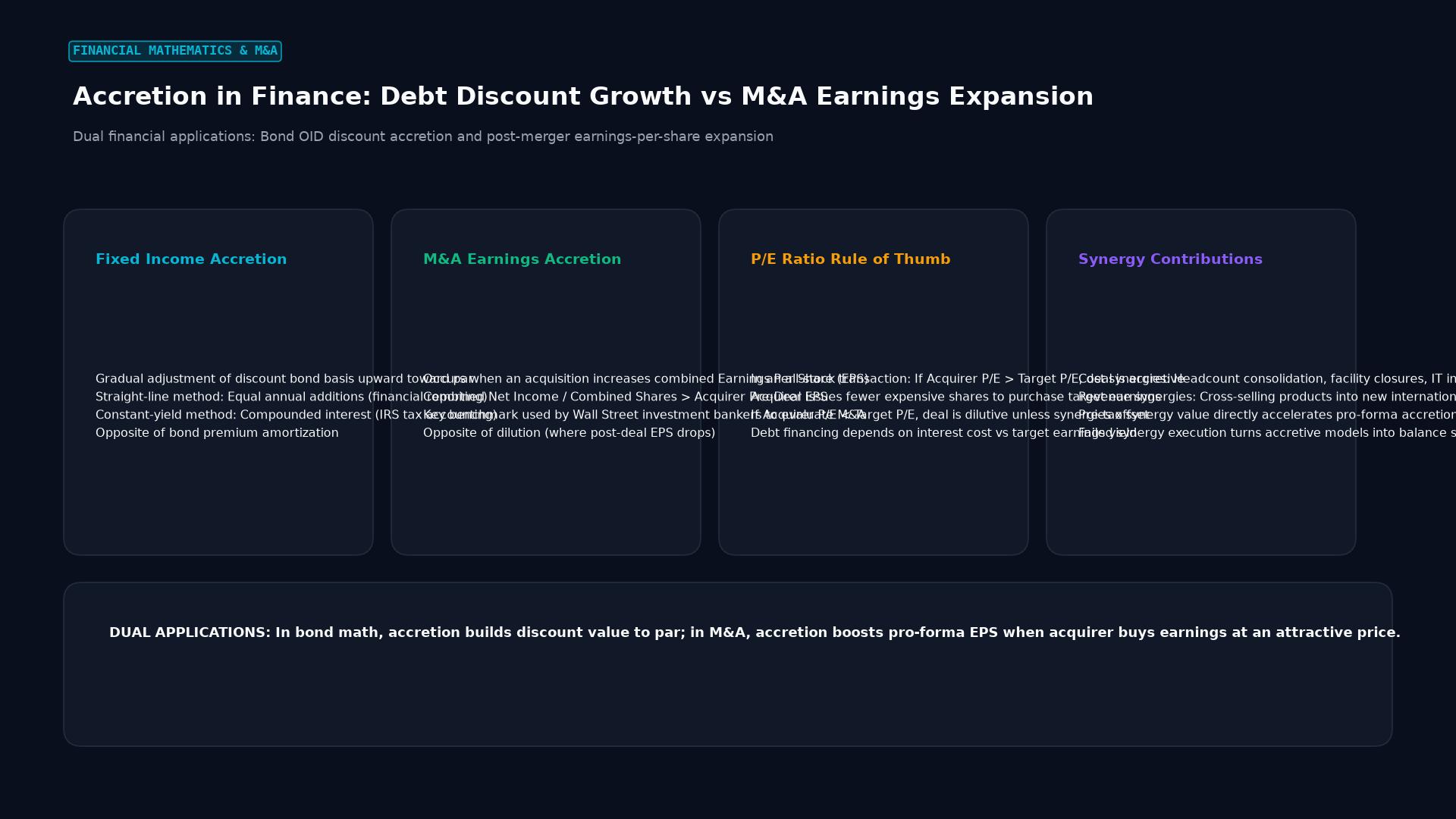 Figure: Dual financial applications: Bond OID discount accretion and post-merger earnings-per-share expansion
Technical Mechanics Across Core Disciplines
Understanding accretion requires analyzing how the mechanism functions in both bond mathematics and corporate valuation:
1. Fixed-Income Accretion (Accretion of Discount)
When an investor purchases a bond below par (for example, buying a $1,000 bond for $880 in secondary trading), the $120 discount represents capital yield that must be recognized over the remaining lifespan:
Annual Accretion = (Par Value - Purchase Price) / Remaining Years to MaturityUnder the constant yield method mandated by institutional accounting standards (ASC 310 / IFRS 9), annual accretion is calculated using compound interest:
Accretion_t = (Carrying Value_t-1 × Market Yield at Purchase) - Coupon Interest Paid_tThis annual accretion increases the carrying basis of the bond on the investor’s balance sheet and is recognized as taxable or accounting interest income. It is the direct mathematical opposite of amortization of premium, where a bond purchased above par is systematically written down.
2. Corporate Finance & M&A Accretion
In investment banking, an acquisition is classified as accretive when the combined entity’s pro-forma earnings per share (EPS) exceed the acquirer’s standalone EPS prior to the transaction:
Accretion ($) = Pro-Forma Combined EPS - Standalone Acquirer EPS
Accretion (%) = [(Pro-Forma Combined EPS / Standalone Acquirer EPS) - 1] × 100
An all-stock deal is mathematically accretive whenever the acquirer’s Price-to-Earnings (P/E) multiple is higher than the effective acquisition P/E multiple paid for the target company.
Comparative Matrix: Accretion vs. Amortization vs. Dilution
| Dimension | Accretion | Amortization | Dilution |
|---|---|---|---|
| Primary Direction | Upward value or earnings growth | Downward asset write-down / reduction | Downward reduction in per-share metrics |
| Fixed Income Role | Pulls discounted bond carrying value UP to par | Writes bond premium carrying value DOWN to par | Not applicable to fixed debt instruments |
| M&A Context | Increases pro-forma EPS post-transaction | Non-cash expense writing off intangible goodwill | Decreases pro-forma EPS post-transaction |
| Tax Impact | Generates taxable annual imputed income | Generates tax deductions against taxable earnings | Reduces shareholder equity ownership percentage |
| Balance Sheet Effect | Expands carrying value of financial assets | Shrinks carrying value of intangible/fixed assets | Expands share count; divides earnings pool |
Real-World Case Study: Healthcare Corporate Acquisition
In 2024, a diversified medical technology corporation trading at $120 per share with a Price-to-Earnings multiple of 24.0x ($5.00 standalone EPS on 100 million outstanding shares) agreed to acquire a specialized surgical device firm for $1.8 billion.
The target company generated $100 million in annual net net income, translating to an effective acquisition multiple of 18.0x P/E. The acquirer financed the transaction entirely by issuing 15 million new shares at $120 each:
- Pre-Deal Net Income: Acquirer ($500M) + Target ($100M) = $600 million combined net income.
- Post-Deal Share Count: 100M original shares + 15M newly issued shares = 115 million shares.
- Pro-Forma EPS Calculation:
Combined Pro-Forma EPS = $600,000,000 / 115,000,000 shares = $5.217 per share
Net EPS Accretion = $5.217 - $5.000 = +$0.217 per share (+4.34% Accretion)
Because the acquirer deployed its high-multiple equity (24x) to purchase lower-multiple earnings (18x), the transaction generated immediate 4.34% accretion to earnings per share without factoring in projected operational supply-chain synergies.
Frequently Asked Questions (FAQ)
Can an acquisition be accretive to cash flow but dilutive to GAAP earnings?
Yes. When an acquirer buys a company with heavy non-cash intangible asset amortization, depreciation, or stock-based compensation, reported GAAP EPS may decline (dilutive), while actual free cash flow per share expands significantly (cash accretive). Wall Street analysts frequently track “Cash EPS” to account for this divergence.
How is accretion treated under capital gains tax rules?
For taxable debt instruments purchased on secondary markets at a market discount, tax codes generally require the accumulated accretion to be taxed as ordinary interest income rather than lower-rate capital gains upon bond sale or final redemption at par.
What is natural asset accretion?
Natural asset accretion occurs in resource industries where physical assets grow without human manufacturing. In commercial forestry, for example, the biological volume growth of timber stands over time is recorded on balance sheets as asset accretion under biological asset accounting standards (IAS 41).
Ready to trade forex?
Open a free demo account with a regulated broker. Practice with virtual funds before risking real money.