Z-Share
In asset management, a Z-share (Class Z share) is a specialized mutual fund share class typically reserved for employees, directors, and retirees of the fund management company, or designated for fee-only institutional advisory and wrap-fee platforms with zero sales loads and zero 12b-1 distribution fees.
Z-Share (Class Z Mutual Fund Shares)
In mutual fund architecture, investment management governance, and financial advisory compensation, a Z-share (commonly designated on fund prospectuses as Class Z) represents a specialized, restricted share class of an open-end management investment company. Historically established by major mutual fund complexes, Class Z shares serve two primary institutional functions depending on the fund family’s structural guidelines:
- Employee and Insider Benefit Class: Originally, Class Z shares were created as an executive and employee perk, allowing portfolio managers, fund analysts, corporate executives, board directors, and retired employees of the fund management company (and their immediate family members) to invest directly in the firm’s mutual funds without paying sales charges, front-end loads, or intermediary marketing expenses.
- Fee-Based Advisory and Institutional Platform Class: In modern wealth management, many fund families (such as Loomis Sayles, Alger, or MFS) deploy Class Z shares as clean, institutional-style vehicles on fee-only Registered Investment Adviser (RIA) custodial platforms, multi-manager wrap-fee accounts, and corporate retirement programs.
Like institutional Class Y and Class I shares, Class Z shares feature zero front-end sales loads, zero back-end deferred sales charges (CDSC), and zero 12b-1 distribution and marketing fees, ensuring that gross portfolio returns flow directly to the shareholder with minimal operational friction.
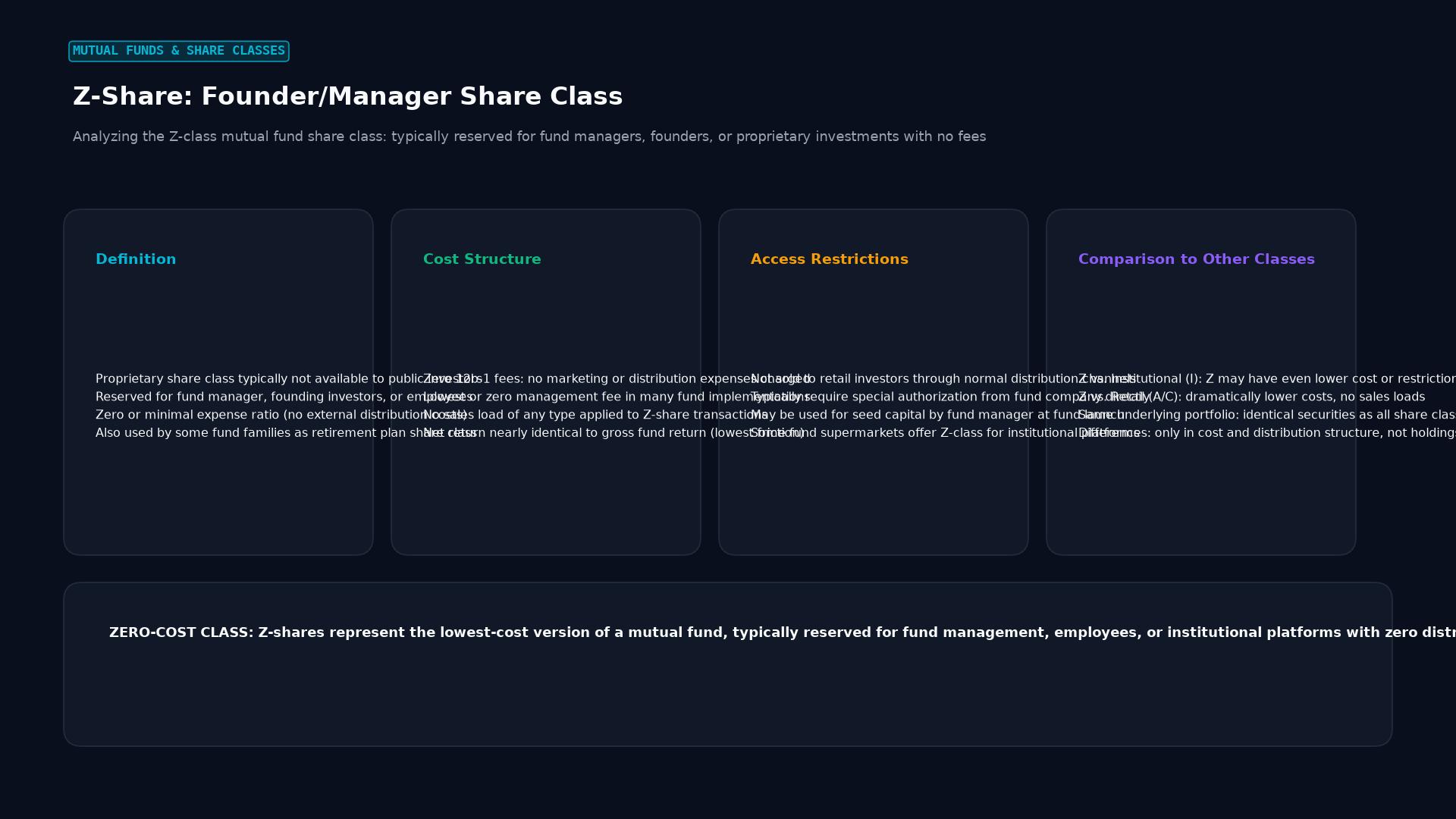 Figure: Analyzing the Z-class mutual fund share class: typically reserved for fund managers, founders, or proprietary investments with no fees
The Dual Evolution of Class Z Shares
The operational definition of Class Z shares has evolved across two distinct eras of asset management regulation:
1. The Historical Employee and Alignment Mandate
In the 1980s and 1990s, fund management companies established Class Z shares to promote internal employee ownership:
- Portfolio managers and corporate employees were encouraged to “eat their own cooking” by investing personal capital alongside fund shareholders.
- Traditional retail share classes forced investors to pay front-end sales commissions (often 5.75% on Class A shares) to external broker-dealers.
- Creating the dedicated Class Z share class allowed asset managers to grant internal personnel direct access at Net Asset Value (NAV) with zero transaction loads, aligning the financial interests of investment analysts directly with fund performance.
2. The Modern Fiduciary Shift: Clean Shares for RIAs
With the rise of fiduciary wealth management and regulatory scrutiny from the Securities and Exchange Commission (SEC) regarding mutual fund share class selection (such as the SEC’s Share Class Selection Disclosure Initiative), fund families repurposed or expanded Class Z shares:
- Fee-only financial planners and institutional consultants demanded “clean shares” unbundled from broker-dealer revenue-sharing kickbacks.
- Many fund complexes opened Class Z shares to unaffiliated fee-based advisory accounts, wrap programs, and defined-contribution retirement plans (401k), positioning Class Z alongside Class I and Class Y shares as premier low-expense institutional vehicles.
Detailed Comparison: Class Z vs. Other Common Share Classes
To evaluate how Class Z shares function within an open-end fund complex, consider the following structural comparison:
| Dimension / Metric | Class Z Shares | Class A Shares | Class C Shares | Class Y / I Shares |
|---|---|---|---|---|
| Front-End Sales Load | 0.00% (Zero) | Up to 5.75% | 0.00% | 0.00% |
| Back-End CDSC Exit Fee | 0.00% (Zero) | 0.00% (typical) | 1.00% (< 1 year hold) | 0.00% |
| 12b-1 Distribution Fee | 0.00% (Zero) | 0.25% annually | 0.75% – 1.00% annually | 0.00% |
| Sub-Transfer Agency Fees | Minimal to None | Moderate | High | Minimal |
| Eligibility Restrictions | Fund employees, RIAs, wrap platforms | Open to general retail | Open to general retail | Institutions, large 401(k)s |
| Net Compounding Drag | Lowest | Moderate to High | Highest long-term | Lowest |
       Annual Net Expense Ratio Equation:

       TER = Management_Fee + 12b-1_Distribution_Fee + Other_Operating_Expenses

       For Class A: TER = 0.65% + 0.25% + 0.15% = 1.05%
       For Class C: TER = 0.65% + 1.00% + 0.20% = 1.85%
       For Class Z: TER = 0.65% + 0.00% + 0.08% = 0.73%  <-- 32 bps to 112 bps Advantage
Regulatory and Fiduciary Governance (SEC Rule 18f-3)
The operation of Class Z shares within a multi-class mutual fund is governed under Rule 18f-3 of the Investment Company Act of 1940:
1. Equal Rights and Proportional Claims
Under SEC regulations, all share classes (whether A, C, Y, or Z) hold an identical, undivided interest in the underlying investment securities of the fund:
- Class Z shares do not hold a superior or privileged claim on portfolio assets.
- If the fund’s underlying stock portfolio appreciates by 10% in gross terms, all share classes experience that exact same 10% gross asset appreciation.
- The only variation in daily Net Asset Value (NAV) growth between classes arises from the differential expenses deducted for distribution, shareholder servicing, and transfer agency operations.
2. The SEC Share Class Selection Disclosure Initiative
In recent years, the SEC Enforcement Division has targeted registered investment advisers that placed client assets into higher-cost retail share classes (carrying 12b-1 fees) when lower-cost institutional share classes (such as Class Z, Class Y, or Class I) of the exact same fund were available on the custodial platform. Fiduciary wealth managers are legally obligated under the Investment Advisers Act of 1940 to select the lowest-cost available share class for their advisory clients, cementing Class Z as an essential institutional vehicle.
Applied Wealth Management Case Study: Eliminating Distribution Friction
Consider Horizon Fiduciary Wealth (HFW), an independent Registered Investment Adviser managing $400,000,000 in fee-based client assets.
Client Allocation Scenario
- A new institutional client deposits $5,000,000 for allocation across core equity strategies.
- The advisory team selects the Loomis Sayles Global Growth Strategy, which offers multiple share classes across custodial clearing networks:
- Option A (Class A - Retail): 5.75% front-end load (waivable at NAV for large blocks), plus a 0.25% annual 12b-1 distribution fee. Total Net Expense Ratio = 1.18%.
- Option B (Class C - Level Load): Zero upfront load, but a 1.00% annual 12b-1 fee. Total Net Expense Ratio = 1.93%.
- Option C (Class Z - Institutional Advisory): Zero front-end load, zero 12b-1 fee, discounted custodial clearing. Total Net Expense Ratio = 0.88%.
20-Year Compounding Analysis
- Initial Principal: $5,000,000.
- Horizon: 20 Years.
- Assumed Gross Portfolio Return: 8.50% annualized.
- Net Return Under Class A: $8.50% - 1.18% = 7.32%$. $$FV_A = $5,000,000 \times (1 + 0.0732)^{20} \approx $20,530,000$$
- Net Return Under Class Z: $8.50% - 0.88% = 7.62%$. $$FV_Z = $5,000,000 \times (1 + 0.0762)^{20} \approx $21,715,000$$
+------------------------------------------------------------------------+
|          Terminal Value Comparison on $5,000,000 Over 20 Years         |
+------------------------------------------------------------------------+
| Share Class        | Annual Expense Drag | Net Annual Return | Terminal Wealth |
| Class A (Retail)   | 1.18%               | 7.32%             | $20,530,000     |
| Class Z (Clean)    | 0.88%               | 7.62%             | $21,715,000     |
| Client Wealth Gain | **-30 basis points**| **+0.30% / year** | **+$1,185,000** |
+------------------------------------------------------------------------+
By selecting the clean Class Z share, Horizon Fiduciary Wealth secures an additional $1,185,000 in net compounded terminal wealth for the client, fulfilling its legal fiduciary duty and optimizing long-term capital efficiency.
Frequently Asked Questions
Can an ordinary individual investor purchase Class Z shares?
Generally, an individual retail investor opening a self-directed discount brokerage account cannot buy Class Z shares directly unless they meet specific criteria:
- They are an employee, executive, or director of the fund management company.
- They invest through a fee-only Registered Investment Adviser (RIA) or institutional wrap-fee program that has negotiated custodial access to Class Z shares.
- They participate in an employer-sponsored 401(k) retirement plan that has selected Class Z for its investment lineup.
What is the primary difference between Class Z and Class Y shares?
Both Class Z and Class Y shares are low-cost, institutional-style share classes carrying zero loads and zero 12b-1 fees. The primary difference lies in the fund family’s specific naming conventions and historical origins: Class Y was historically established for corporate defined-contribution retirement plans and institutional consultants, whereas Class Z often originated as an employee/insider class or was designated for specific institutional wrap-fee advisory platforms. In modern practice, both offer near-identical low expense ratios.
Do Class Z shares pay higher dividends than Class A or C shares of the same fund?
Yes. Because all share classes own the exact same underlying dividend-paying stocks and bonds, but Class Z shares deduct lower internal expenses (zero 12b-1 fees and lower administrative overhead), the net investment income per share available for distribution to Class Z shareholders is higher. This results in a higher net dividend yield on Class Z shares compared to retail Class A or Class C shares.
Ready to trade forex?
Open a free demo account with a regulated broker. Practice with virtual funds before risking real money.