Zero-Coupon Certificate of Deposit (Zero-Coupon CD)
A bank-issued time deposit sold at a steep discount to its face par value that distributes zero periodic interest payments, maturing at full face value while subjecting taxable investors to annual original issue discount phantom taxation.
What Is a Zero-Coupon Certificate of Deposit?
A Zero-Coupon Certificate of Deposit (Zero-Coupon CD) is a specialized fixed-income banking instrument that does not pay periodic cash interest during its term. Instead, it is issued at a substantial discount to its nominal face value (par) and matures at full par value on a specified future date. The investor’s return represents the compounded appreciation between the discounted purchase price and the full principal payment collected at maturity.
Zero-coupon CDs are commonly issued by commercial banks and thrift institutions, often distributed through brokerage networks as brokered CDs. These instruments feature extended maturities ranging from 1 year to as long as 20 or 30 years, appealing to long-term savers seeking a guaranteed sum of money at an exact future date without facing periodic reinvestment decisions.
In the United States, zero-coupon CDs issued by depository institutions carry federal deposit insurance through the Federal Deposit Insurance Corporation (FDIC) up to the statutory limit of $250,000 per depositor, per insured institution. However, they possess a unique tax characteristic known as phantom income, which makes them particularly well-suited for tax-advantaged retirement accounts rather than standard taxable accounts.
Cash Flow Mechanics and Valuation Formula
To understand the operational profile of a zero-coupon CD, compare its cash flow structure against a traditional coupon-bearing certificate of deposit:
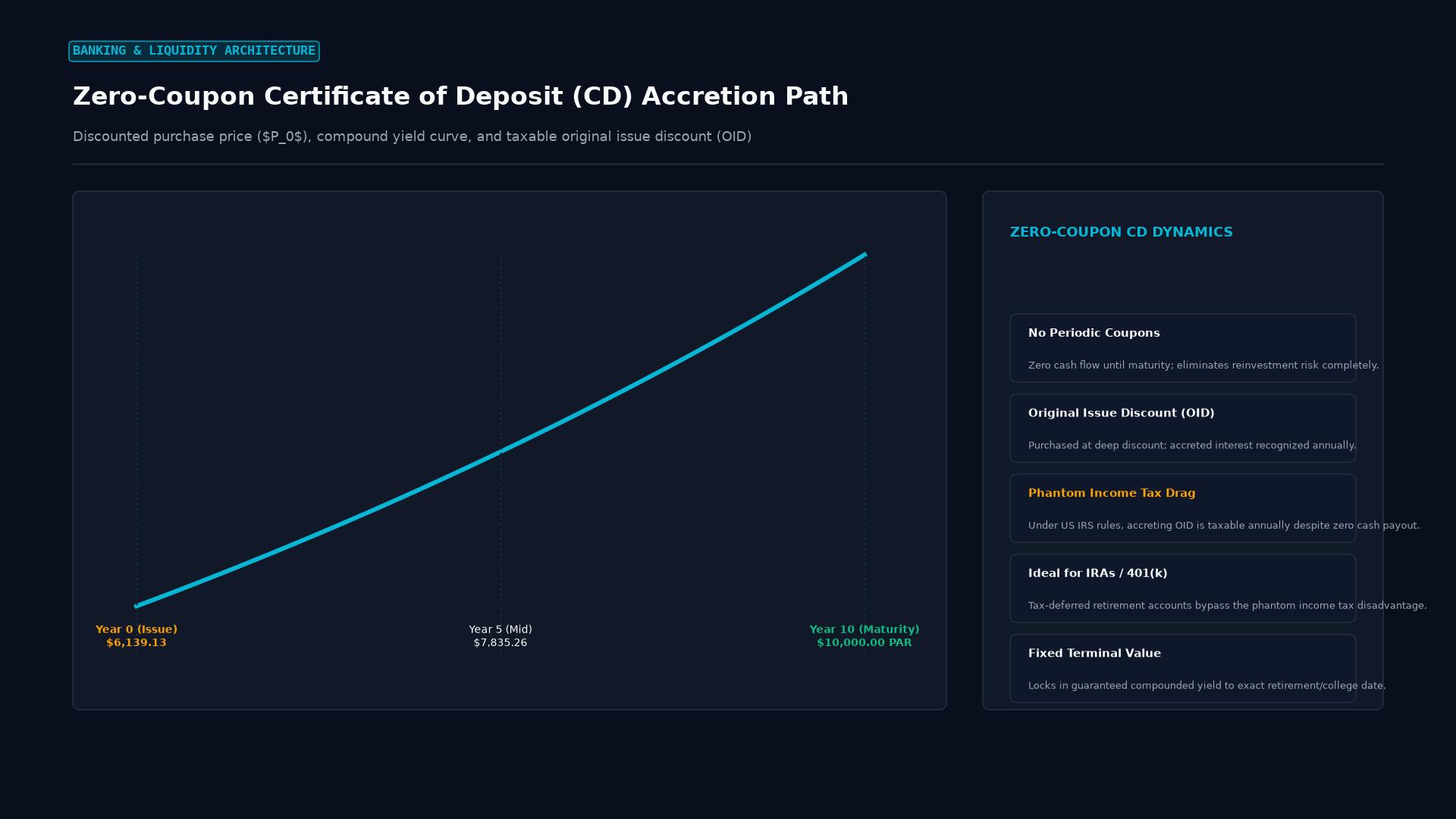 Figure: Zero-coupon deposit economics: deep discount purchase price accreting to full par value at maturity, eliminating reinvestment risk while navigating phantom income taxation.
Valuation and Pricing Formula
The purchase price ($P$) of a zero-coupon CD is determined by discounting the par value ($M$) by the required annual yield to maturity ($r$) across maturity horizon ($t$ years), assuming compounding frequency ($k$ times per year, typically semi-annual or annual):
$$P = \frac{M}{\left(1 + \frac{r}{k}\right)^{k \times t}}$$
Valuation Example:
An investor purchases a 10-year zero-coupon CD with a par maturity value of $20,000 offering an annual yield of 5.00% compounded semi-annually ($k = 2$):
$$P = \frac{$20,000}{\left(1 + \frac{0.05}{2}\right)^{2 \times 10}} = \frac{$20,000}{(1.025)^{20}} = \frac{$20,000}{1.6386} \approx $12,205.42$$
The investor commits $12,205.42 today and is contractually guaranteed to receive $20,000.00 in ten years, earning $7,794.58 in compounded interest.
The Phantom Tax Trap: Original Issue Discount (OID)
The defining structural complexity of zero-coupon CDs held in taxable investment accounts is the phantom income tax governed by IRS Original Issue Discount (OID) regulations.
Under US Internal Revenue Code Section 1272, the difference between the discounted purchase price and the maturity face value is classified as OID interest. The IRS treats this interest as earned incrementally across each tax year, even though the investor receives zero cash distributions until maturity:
                         THE PHANTOM TAX BURDEN (TAXABLE ACCOUNT)

  [Zero-Coupon CD Accrues Interest] ──► Bank Issues IRS Form 1099-OID
                 │
                 ▼
  [Investor Receives ZERO Cash Flow]
                 │
                 ▼
  [IRS Demands Cash Tax Payment on Accrued Amount]
                 │
                 ▼
  [Investor Must Pay Taxes Using Outside Cash from Checking Account]
Every January, the issuing bank or broker transmits an IRS Form 1099-OID reporting the imputed taxable interest. If an investor falls into the 24% federal tax bracket and their CD accrues $600 in OID interest during the tax year, they must pay $144 in cash taxes out of pocket that year, despite receiving zero liquidity from the investment.
Optimal Account Placement:
To neutralize the phantom tax burden, wealth advisors recommend holding zero-coupon CDs exclusively within tax-advantaged retirement accounts, such as:
- Traditional Individual Retirement Accounts (Traditional IRAs)
- Roth IRAs
- Simplified Employee Pension IRAs (SEP IRAs)
- 401(k) and Self-Employed Profit-Sharing Plans
Within these accounts, annual OID accruals compound on a tax-deferred or tax-free basis, eliminating the out-of-pocket cash drain.
Secondary Market Trading and Interest Rate Risk
When investors buy traditional bank CDs directly from local retail branches, early liquidation is subject to an early withdrawal penalty (typically 3 to 12 months of forfeited interest).
In contrast, zero-coupon CDs are predominantly purchased through brokerage firms (brokered CDs) and trade on an active over-the-counter secondary market. While this secondary market provides liquidity, it introduces market price volatility:
| Benchmark Interest Rate Movement | Impact on Secondary Market Price of Zero-Coupon CD |
|---|---|
| Market Rates Rise | The market price of the zero-coupon CD drops significantly. Selling prior to maturity results in capital losses. |
| Market Rates Fall | The market price of the zero-coupon CD rallies. Selling prior to maturity produces capital gains. |
| Held to Final Maturity | The investor receives 100% of par value, completely unaffected by intermediate market price fluctuations. |
Because a zero-coupon CD pays zero periodic cash coupons, its Macaulay duration equals its exact time to maturity. A 15-year zero-coupon CD has a duration of exactly 15 years, making it far more sensitive to interest rate fluctuations than a 15-year traditional coupon-bearing bond or CD.
FDIC Insurance Coverage Rules
Zero-coupon CDs issued by FDIC-insured depository institutions carry federal backing, but investors must monitor specific FDIC balance calculation rules:
              FDIC COVERAGE CALCULATION: ZERO-COUPON CD

Insured Deposit Balance = Discounted Purchase Price + Accrued OID Interest- Covered Amount: FDIC insurance covers the original discounted purchase amount plus all interest accrued up to the date of the bank’s failure. It does not insure the full future par value prior to maturity.
- Deposit Cap: The total aggregate of principal plus accrued interest across all accounts held at the same insured bank cannot exceed the statutory $250,000 threshold per ownership category.
- Brokered Diversification: Brokerage platforms allow large investors to spread multi-million-dollar deposits across dozens of separate insured institutions (up to $240,000 per bank), securing complete FDIC coverage across the entire portfolio.
Comparative Analysis: Zero-Coupon CD vs. Alternatives
| Investment Instrument | Periodic Cash Flow | Tax Treatment (Taxable Acct) | Default Risk / Backing | Reinvestment Risk | Duration Profile |
|---|---|---|---|---|---|
| Zero-Coupon CD | None (accrues to maturity) | Annual phantom tax (OID 1099) | FDIC Insured up to $250k | Zero (rate locked to maturity) | Equals exact maturity (high) |
| Standard Bank CD | Monthly, quarterly, or annual | Taxed annually as received | FDIC Insured up to $250k | High (coupons must be reinvested) | Intermediate |
| Treasury STRIPS | None (zero-coupon) | Annual phantom tax (OID 1099) | US Sovereign Backing | Zero (rate locked to maturity) | Equals exact maturity (high) |
| Municipal Zero-Coupon | None (zero-coupon) | Exempt from federal income tax | Municipal credit risk | Zero (rate locked to maturity) | Equals exact maturity (high) |
Frequently Asked Questions
What happens if an investor needs to cash out a zero-coupon CD before maturity?
Unlike a standard retail bank CD that permits early withdrawal by paying an administrative interest penalty, a brokered zero-coupon CD must be sold on the secondary market at prevailing bid prices. If prevailing interest rates have risen since the CD was purchased, the secondary market price will be lower than the accrued purchase value, resulting in a realized capital loss.
Why do retirees utilize zero-coupon CDs for liability matching?
Zero-coupon CDs eliminate reinvestment risk. When an investor buys a standard coupon-bearing bond, the realized yield depends on the interest rates available when reinvesting periodic coupon checks. With a zero-coupon CD, the entire compounding rate is locked in at purchase, allowing retirees to align exact dollar maturities with future milestone expenses, such as paying off a mortgage or funding a grandchild’s college tuition.
Are zero-coupon CDs exempt from state and local income taxes?
No. Unlike US Treasury STRIPS (which are exempt from state and local income taxes), zero-coupon CDs issued by commercial banks are fully subject to federal, state, and local income taxes on their annual OID interest accruals.
Ready to trade forex?
Open a free demo account with a regulated broker. Practice with virtual funds before risking real money.