Certificate of Deposit (CD)
A time deposit promissory product offered by commercial banks that pays a guaranteed interest rate across a specified holding tenor, restricting early capital withdrawals in exchange for yield backed by statutory deposit insurance.
What is a Certificate of Deposit (CD)?
A Certificate of Deposit (commonly abbreviated as a CD) is a financial savings and money market instrument issued by federally insured commercial banks and credit unions. When an investor purchases a CD, they agree to deposit a fixed principal sum for a predetermined duration (known as the term or tenor)—typically ranging from one month to five years.
In exchange for relinquishing immediate liquidity, the bank pays a higher interest rate than standard liquid demand deposit accounts. The financial institution utilizes this stable, locked-in capital to fund its loan book and satisfy regulatory liquidity coverage requirements. At the end of the agreed term (the maturity date), the investor receives their complete original principal alongside all accumulated interest earnings.
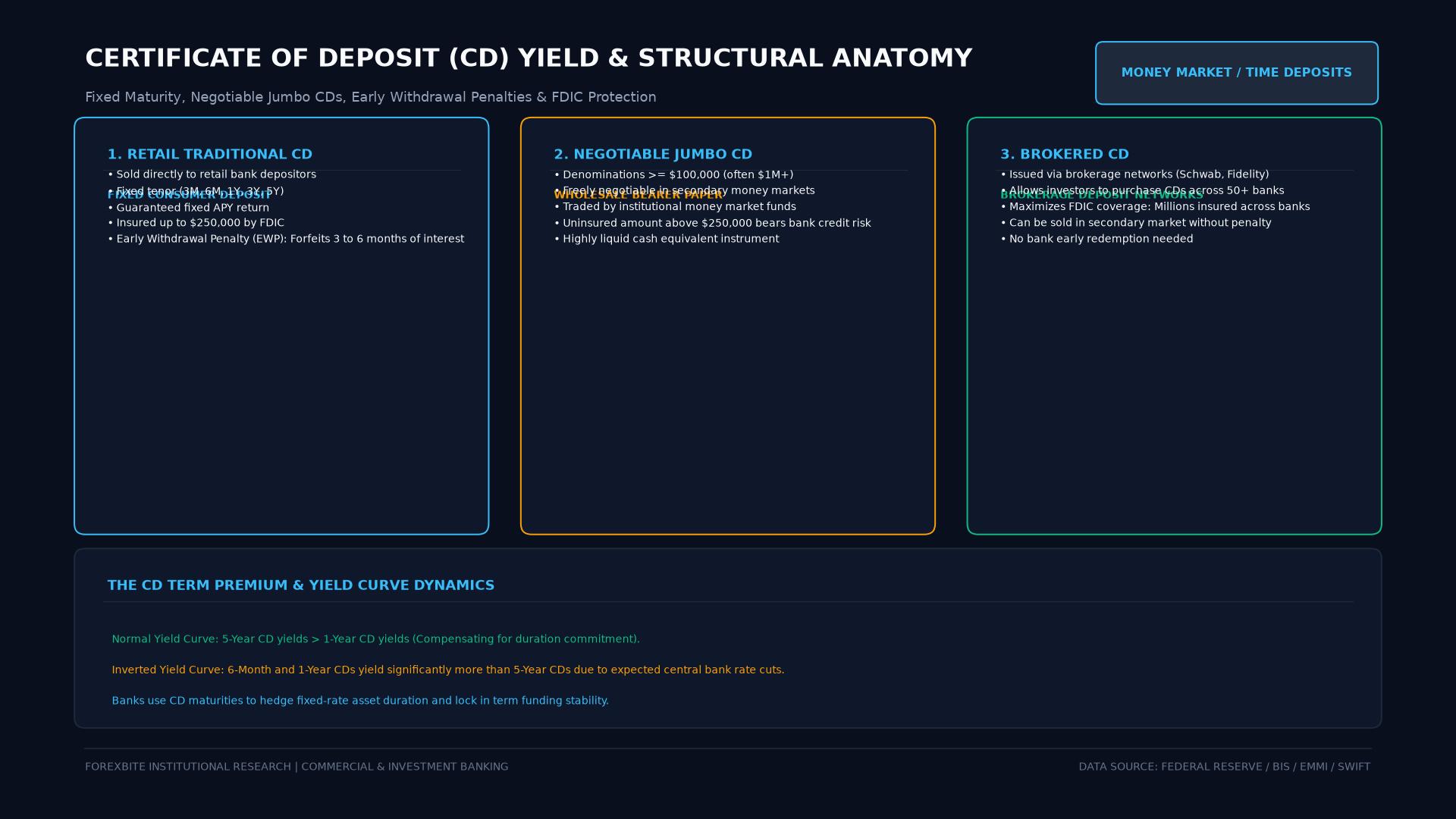 Figure: Fixed-term deposit agreement: principal deposit, guaranteed term interest accrual, early withdrawal penalty schedule, and maturity payout.
Retail CDs vs. Negotiable (Jumbo) CDs
Financial markets operate two distinct tiers of Certificates of Deposit:
1. Retail CDs (Consumer Banking)
- Denominations: Accessible amounts ranging from $500 to $250,000.
- Transferability: Non-negotiable; the certificate cannot be sold or transferred to another party.
- Early Withdrawal Penalty (EWP): If an investor needs to access cash before maturity, the bank assesses a forfeiture penalty (e.g., forfeiting 3 to 6 months of accrued interest).
- Insurance: Fully protected by statutory deposit guarantees (such as the FDIC up to $250,000 in the U.S. or the FSCS up to £85,000 in the UK).
2. Negotiable Certificates of Deposit (NCDs / Jumbo CDs)
- Denominations: Institutional blocks starting at $100,000 to $1,000,000+.
- Transferability: Fully negotiable bearer instruments that trade actively in secondary interbank money markets.
- Liquidity: If an institutional holder (such as a corporate treasury or money market mutual fund) needs cash before maturity, they do not pay a penalty to the bank; instead, they sell the NCD in the secondary market at prevailing market yields.
Interest Mechanics and Annual Percentage Yield (APY)
When comparing Certificates of Deposit, financial institutions quote the Annual Percentage Yield (APY), which accounts for the frequency of compound interest:
$$\text{APY} = \left( 1 + \frac{r}{n} \right)^n - 1$$
Where:
- $r$ = Stated nominal interest rate.
- $n$ = Number of compounding periods per year (e.g., $n = 365$ for daily compounding, $n = 12$ for monthly).
Maturity Value Calculation
$$\text{Total Maturity Payout} = P \times \left( 1 + \frac{r}{n} \right)^{n \times t}$$
Where $P$ is the initial deposit principal and $t$ is the investment duration in years.
Step-by-Step Wealth Preservation Strategy: The “CD Ladder”
To mitigate interest rate risk and preserve liquidity while capturing maximum yield, corporate treasurers and private wealth managers deploy a CD Laddering Strategy:
The Setup
An investor with $100,000 in liquid capital seeks high yields without locking all funds away for an entire year. The investor divides the capital into four equal tranches of $25,000:
- Tranche 1: 3-Month CD @ 4.80% APY
- Tranche 2: 6-Month CD @ 5.00% APY
- Tranche 3: 9-Month CD @ 5.15% APY
- Tranche 4: 12-Month CD @ 5.30% APY
The Rolling Execution Cycle
- At Month 3, Tranche 1 matures. The investor uses the liquidity or rolls the $25,000 into a new 12-Month CD.
- At Month 6, Tranche 2 matures and is rolled into a new 12-Month CD.
- The Outcome: After nine months, the investor has a mature 12-month top-tier yield CD expiring every three months, establishing a permanent rolling stream of quarterly liquidity and interest reinvestment.
Comparative Matrix: Cash and Fixed-Income Preservation Assets
| Asset Class | Yield Structure | Liquidity Access | Credit Risk | Secondary Market Tradable? |
|---|---|---|---|---|
| Retail Certificate of Deposit | Fixed APY | Restricted (Early penalty) | Zero (FDIC insured) | No (Bilateral bank contract) |
| Treasury Bill (T-Bill) | Discount yield to maturity | Liquid (Sold anytime on secondary) | Zero (U.S. Sovereign backed) | Yes (Deepest bond market) |
| High-Yield Savings (HYSA) | Variable (Changes with central bank) | Immediate (Instant transfer) | Zero (FDIC insured) | No |
| Commercial Paper | Short-term discount yield | Held to maturity | Corporate credit risk | Yes (Institutional only) |
Strategic Significance for Forex Traders and Macro Funds
- Parking Risk-Off Collateral: Professional currency traders and proprietary funds do not keep 100% of their capital actively deployed in leveraged spot forex. Surging interest rate environments incentivize funds to park reserve capital in short-term CDs or Treasury bills, earning 4%–5% guaranteed yield while allocating only 10%–20% of funds to leveraged margin trading.
- Yield Curve Barometer: Bank CD rates serve as a grassroots barometer of commercial bank competition for consumer liquidity. When bank CD rates surge above central bank policy rates, it signals liquidity strains within the domestic commercial banking system.
Key Takeaways
- A Certificate of Deposit (CD) is a bank time deposit that pays a guaranteed yield across a locked maturity term.
- Early withdrawal before maturity incurs financial interest forfeiture penalties.
- Retail CDs are non-transferable and federally insured, while Negotiable CDs (NCDs) trade in secondary wholesale money markets.
- CD laddering structures cash across staggered maturities to provide regular quarterly liquidity while capturing long-term yields.
- In financial portfolio design, CDs provide a risk-free baseline yield to preserve capital between active trading allocations.
Frequently Asked Questions
Can I lose my principal investment in a Certificate of Deposit?
No. Provided the issuing bank is an insured depository institution (such as an FDIC-insured bank in the U.S.) and your total deposits at that institution remain below statutory thresholds ($250,000), your principal and accumulated interest are 100% guaranteed by the government.
What is a “brokered CD”?
A brokered CD is a Certificate of Deposit issued by a commercial bank but purchased through a retail stock brokerage (such as Fidelity, Schwab, or Vanguard). Unlike bank-issued retail CDs, brokered CDs can be traded and sold on the secondary market prior to maturity without incurring early withdrawal penalties.
What is a “bump-up” CD?
A bump-up CD gives the investor the contractual right to increase their interest rate once or twice during the term if prevailing market interest rates rise, protecting the depositor from being locked into an inferior rate.
How are CD earnings taxed?
In most tax jurisdictions, the interest earned on a Certificate of Deposit is taxed annually as ordinary interest income at the investor’s marginal income tax rate, even if the interest is automatically reinvested and not withdrawn from the CD.
Ready to trade forex?
Open a free demo account with a regulated broker. Practice with virtual funds before risking real money.