Zero-Coupon Convertible
A hybrid corporate debt security issued at a deep discount with zero periodic coupon payments that grants the bondholder the right to convert the debt into a predetermined number of common shares, commonly structured as a Liquid Yield Option Note (LYON).
What Is a Zero-Coupon Convertible?
A zero-coupon convertible is a hybrid financial security that blends the deep-discount structure of a zero-coupon bond with the equity upside participation of a convertible debt instrument. The security pays zero periodic cash coupon interest throughout its operational life. Instead, it is issued at a steep discount to its nominal face value (par) and compounds toward full maturity value while providing the investor with an option to convert the bond into a specified quantity of the issuing company’s common stock.
The instrument was pioneered in 1985 by Merrill Lynch investment bankers Lee Cole and John Kelly under the trademarked name Liquid Yield Option Notes (LYONs), first issued for Waste Management, Inc. LYONs revolutionized corporate debt markets by incorporating multiple embedded options, including investor put options and issuer call options.
For corporate issuers, zero-coupon convertibles eliminate cash debt service requirements, allowing emerging technology, healthcare, and growth companies to fund expansion without draining working capital. For institutional investors, they deliver asymmetric risk-return profiles: a legally guaranteed capital floor backed by corporate debt, combined with uncapped participation in equity bull runs.
Structural Architecture: The Anatomy of a LYON
A standard zero-coupon convertible (or LYON) is an engineered package containing four distinct financial components:
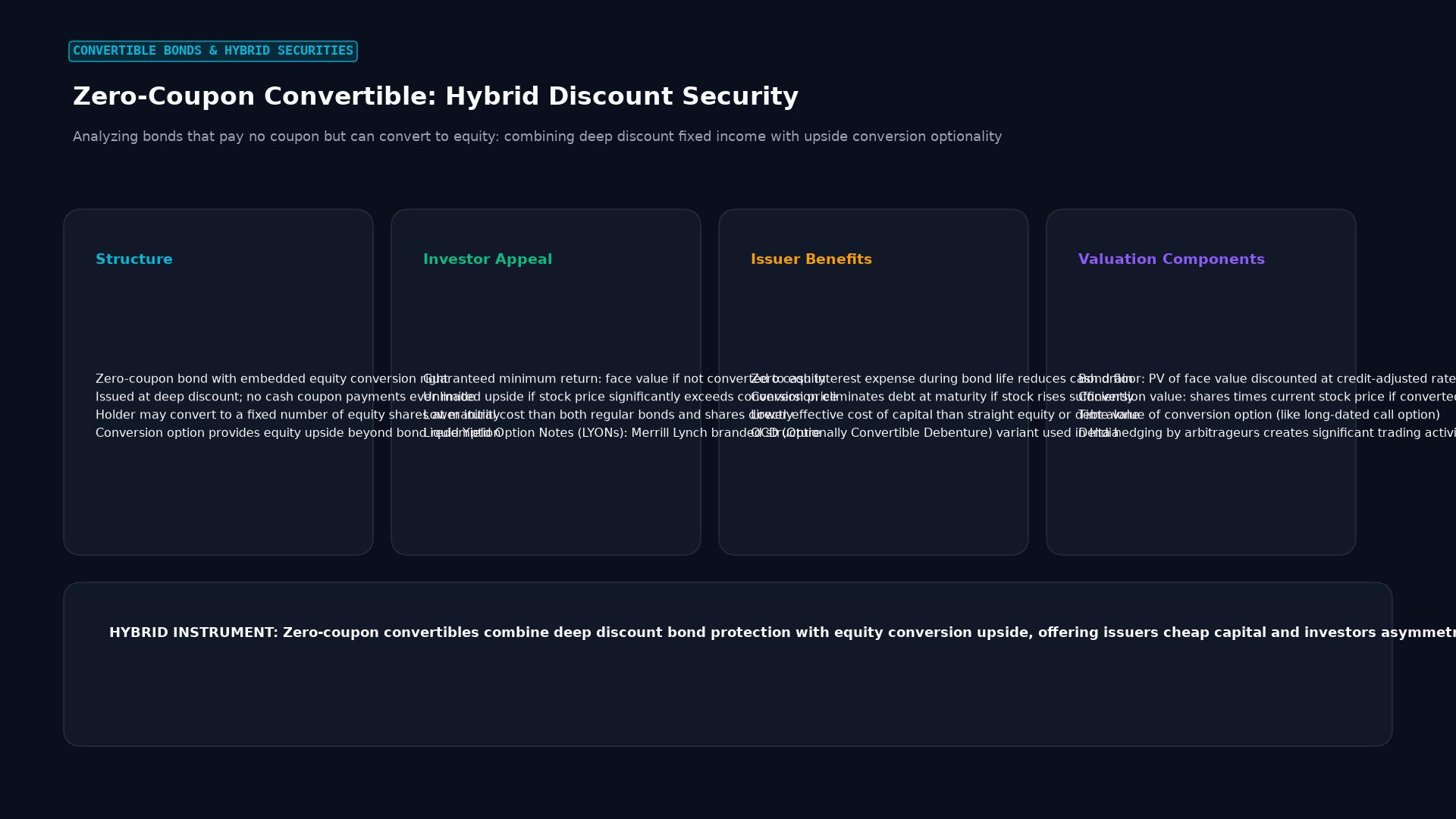 Figure: Analyzing bonds that pay no coupon but can convert to equity: combining deep discount fixed income with upside conversion optionality
- The Deep-Discount Zero-Coupon Debt: The bond is sold at an issue price well below its $1,000 face value (such as $350 for a 20-year maturity, implying a contractual compounding yield of roughly 5.4%). The bond accretes in accounting value every year toward $1,000.
- The Equity Conversion Option: The investor can surrender the bond at any time prior to maturity to receive a fixed number of common shares (the conversion ratio). The implicit price paid per share is known as the conversion price.
- The Embedded Investor Put Option: To protect the buyer against interest rate spikes or equity stagnation, the contract allows the investor to “put” (sell back) the bond to the issuer on specific anniversary dates (such as year 3, 5, 10, and 15) at the full accreted book value. The company can typically satisfy this put in cash or common stock.
- The Embedded Issuer Call Option: The issuing corporation retains the right to “call” (redeem) the bond after a hard lockout period (often 2 to 5 years), provided the common stock trades above a specified threshold (e.g., 130% of the conversion price). This enables the company to force bondholders to convert into equity, extinguishing the debt from its balance sheet.
Payoff Profile: Asymmetric Convexity
The payoff dynamic of a zero-coupon convertible exhibits favorable structural convexity across different equity market environments:
                    ZERO-COUPON CONVERTIBLE PAYOFF CURVE

    Bond Value ($)
         ▲
         │                                       Equity Parity Slope
         │                                       (Conversion Value)
         │                                       /
         │                                      /
         │                                     /
         │                                    /
         │                 Accreted Put Floor*
         │         ┌─────────────────────────*
         │        /  (Capital Protected)
         │       /
         │      /
         └─────┴────────────────────────────────► Common Stock Price ($)
0 Conversion Price- Bear Market / Equity Collapse: If the issuer’s common stock plunges by 50% or 70%, the equity conversion option expires worthless. However, the investor does not suffer total loss. The bond’s price is supported by its investment value (the value of a pure zero-coupon debt instrument) and the guaranteed investor put option floor, where the holder can demand repayment at accreted value.
- Bull Market / Equity Explosion: If the company’s common stock appreciates substantially above the conversion price, the market price of the zero-coupon convertible moves in lockstep with the common stock, delivering dollar-for-dollar equity upside without the dilution of early conversion.
Issuer Economics: Why Corporations Issue Zero-Coupon Convertibles
Corporate financial executives choose zero-coupon convertibles over conventional equity offerings or straight corporate debt due to distinct financial advantages:
1. Elimination of Immediate Cash Debt Service
Fast-growing enterprises often generate strong operating income but experience heavy reinvestment requirements. Paying 7% or 9% annual cash interest on straight corporate bonds drains scarce liquid reserves. A zero-coupon convertible requires zero cash disbursements until maturity or early put dates, conserving 100% of cash flow for capital expenditures.
2. Premium Pricing and Reduced Equity Dilution
When a company executes a secondary equity offering, shares are sold at a discount to current market prices, immediately diluting existing shareholders. With zero-coupon convertibles, the conversion price is established at a substantial premium (typically 15% to 30% above the current stock price). If conversion occurs, the company effectively sells equity at a substantial premium to past valuation.
3. Historical Tax Deductibility Advantages
Historically, under IRS regulations governing original issue discount debt, corporate issuers could deduct the annual non-cash accreted interest expense from their corporate income taxes. Although IRS Revenue Ruling 2002-31 and contingent payment debt instrument (CPDI) regulations modified the tax treatment of certain convertible structures, favorable after-tax cost of capital dynamics remain a core incentive.
Valuation Deconstruction
In quantitative derivatives pricing, a zero-coupon convertible cannot be valued using simple discounted cash flow models. Instead, quantitative desks employ binomial option trees or finite difference methods to decompose the hybrid into its underlying constituents:
$$V_{\text{LYON}} = V_{\text{Zero Debt}} + \text{Call}{\text{Stock}} + \text{Put}{\text{Bondholder}} - \text{Call}_{\text{Issuer}} + \text{Credit Premium}$$
| Component | Nature | Directional Impact on Value | Key Risk Drivers |
|---|---|---|---|
| Host Zero-Coupon Bond | Long debt position | Establishes base investment value | Risk-free interest rates, sovereign yield curve |
| Credit Spread | Risk premium | Decreases bond base value as credit risk rises | Corporate credit rating, default probability |
| Equity Call Option | Long embedded call | Increases value as stock rallies and volatility rises | Stock price ($S$), implied volatility ($\sigma$), dividends ($q$) |
| Bondholder Put Option | Long embedded put | Increases value; establishes hard floor | Rising interest rates, falling stock price |
| Issuer Call Option | Short embedded call | Reduces value; caps extreme upside duration | Corporate stock price appreciation, refinancing incentives |
Comparative Analysis: Straight Debt vs. Conventional vs. Zero-Coupon Convertible
| Feature / Metric | Straight Corporate Bond | Conventional Convertible Bond | Zero-Coupon Convertible (LYON) |
|---|---|---|---|
| Periodic Coupon Payments | Semi-annual cash coupons | Semi-annual cash coupons (lower rate) | Exactly zero cash coupons |
| Issue Price | Typically 100% of par | Near 100% of par | Steep discount (30% to 50% of par) |
| Downside Floor | Pure debt value (subject to credit risk) | Pure debt value + coupon stream | Accreted value supported by investor put |
| Conversion Premium | None (no conversion) | Moderate (10% to 20%) | High (15% to 35%) |
| Cash Drain on Issuer | High | Moderate | None during early life |
| Tax Impact on Investor | Annual tax on cash interest | Annual tax on cash interest | Annual phantom tax on accreted OID |
Frequently Asked Questions
What happens if an investor holds a zero-coupon convertible and the company’s stock never rises?
If the stock price fails to exceed the conversion price, the investor ignores the equity conversion option. At the scheduled put anniversary dates (or final maturity), the investor exercises the bondholder put option, demanding the company repay the full accreted face value in cash. The investor earns a locked-in compounding fixed-income return, fully insulated from the equity slump.
What is “forced conversion” in a zero-coupon convertible?
Forced conversion occurs when the issuing corporation exercises its embedded call option after the stock price has risen substantially above the conversion price. Because the conversion value into common shares is worth significantly more than the cash call price offered by the company, rational bondholders are “forced” to convert their bonds into common equity rather than accepting cash redemption.
How does the investor put option mitigate interest rate risk?
In a standard long-term zero-coupon bond, duration is exceptionally long, exposing the investor to severe price drops if market interest rates spike. In a zero-coupon convertible, the embedded put option allows the investor to surrender the bond back to the company at predetermined dates (such as every 3 or 5 years) at full accreted par. This effectively resets the bond’s duration to the nearest put date, truncating downside interest rate exposure.
Ready to trade forex?
Open a free demo account with a regulated broker. Practice with virtual funds before risking real money.