Put Option
A put option is a derivative financial contract that grants the buyer (holder) the legal right, but not the obligation, to sell a specified quantity of an underlying asset at a predetermined strike price on or before a designated expiration date, in exchange for paying an upfront cash premium to the seller (writer).
What Is a Put Option?
A put option is one of the two foundational types of financial options contracts (alongside the call option). It derives its value from an underlying reference asset—such as a single stock, an equity index (e.g., S&P 500), a physical commodity, or a foreign exchange currency pair.
The defining characteristic of a put option is that it provides bearish exposure or downside insurance:
- The Put Buyer (Holder): Pays an upfront cash premium. The buyer secures the right to sell the underlying asset at the fixed strike price ($K$), regardless of how far the asset’s market price ($S$) collapses. If the market crashes to zero, the buyer can still sell at the strike price. The buyer’s maximum financial risk is strictly capped at the upfront premium paid.
- The Put Writer (Seller): Collects the cash premium today. In exchange, the writer assumes the legal obligation to buy the underlying asset at the strike price if the holder exercises the contract. The writer faces substantial downside risk if the underlying asset plunges below the strike price minus the premium collected.
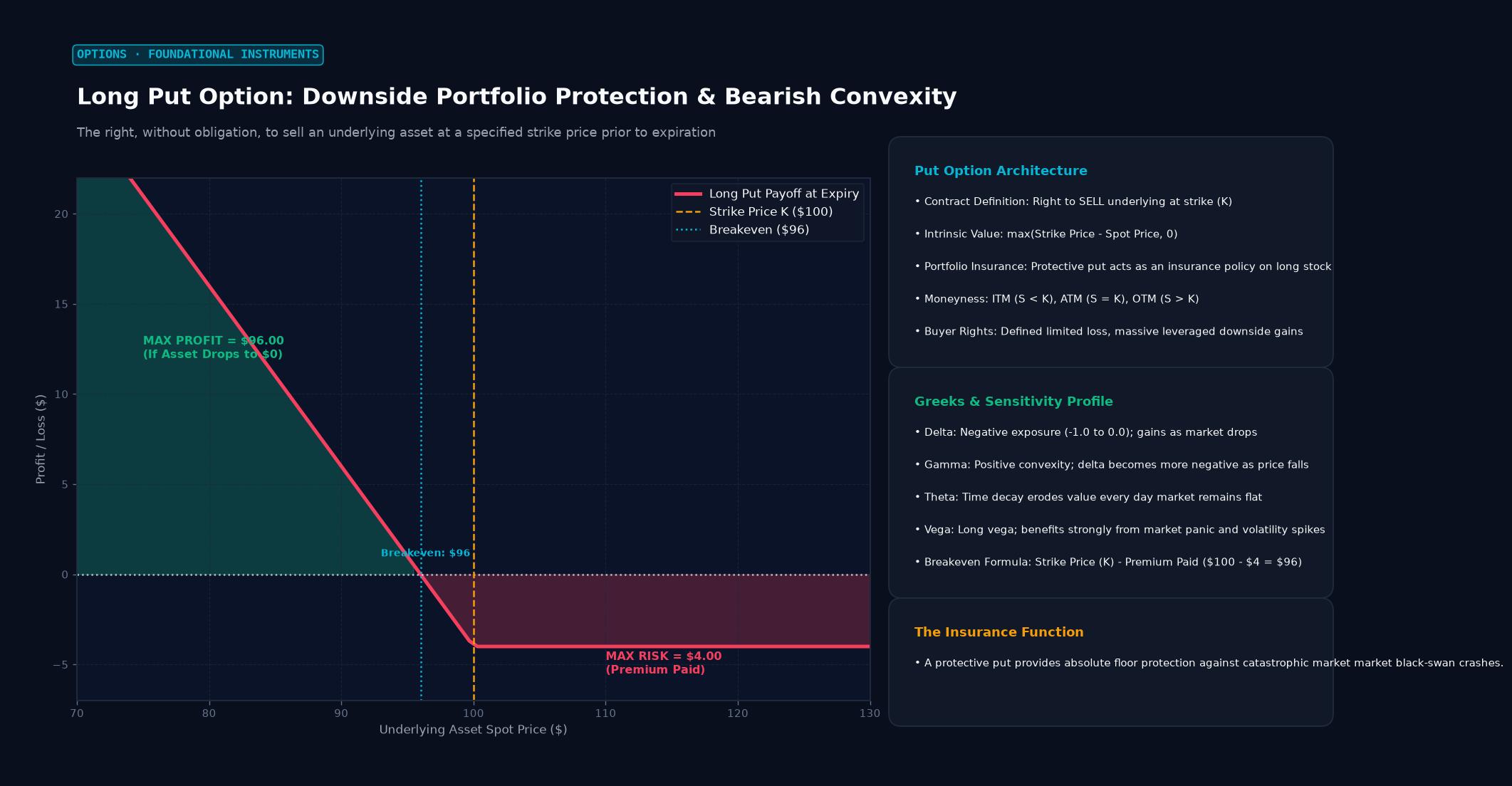 Figure: The right, without obligation, to sell an underlying asset at a specified strike price prior to expiration
The Payoff Profile of a Put Option
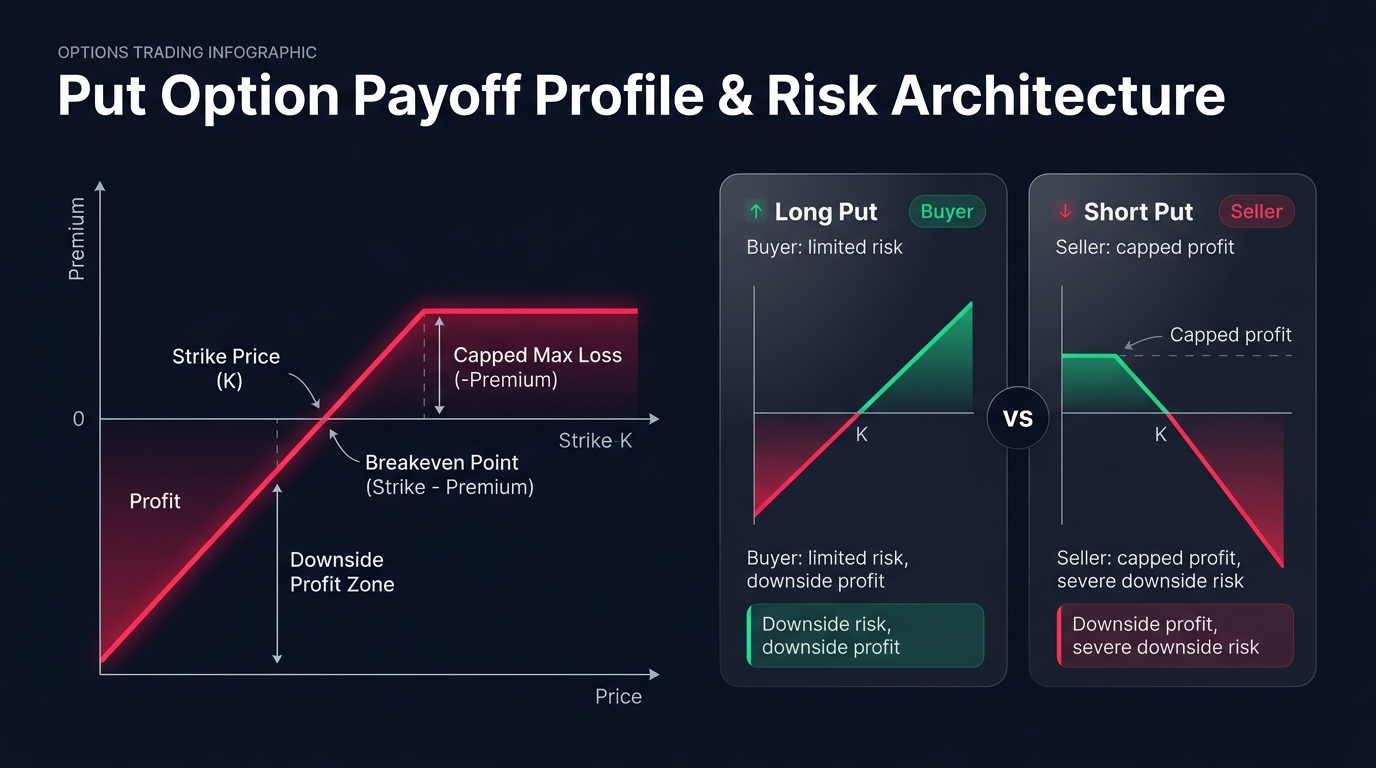
The financial payoff of an options contract at its expiration date depends entirely on the relationship between the underlying spot market price ($S$) and the strike price ($K$):
1. Intrinsic Value Formula
$$\text{Intrinsic Value}_{\text{Put}} = \max(0, K - S)$$
- In-the-Money (ITM): Underlying Price is below the Strike Price ($S < K$). The put option holds positive intrinsic value.
- At-the-Money (ATM): Underlying Price is equal to the Strike Price ($S = K$). Intrinsic value is zero; premium consists 100% of time value.
- Out-of-the-Money (OTM): Underlying Price is above the Strike Price ($S > K$). Intrinsic value is zero. Exercising the put would mean selling below market value, so it expires worthless.
2. Breakeven Price at Expiration
For a long put buyer, the trade becomes net profitable once the underlying asset drops below the strike price by more than the premium paid per share:
$$\text{Long Put Breakeven} = \text{Strike Price} - \text{Premium Paid}$$
$$\text{Short Put Breakeven} = \text{Strike Price} - \text{Premium Collected}$$
                     LONG PUT OPTION PAYOFF DIAGRAM

    Profit ($)
        ^
    +$35|                               * Max Profit if stock goes to $0 ($35)
        |                              /
        |                             /
      $0+----------------------------*---------+------------> Underlying Price ($)
        |                           / Breakeven| Strike ($40)
    -$5 |--------------------------*           |
        +                          (Paid $5)   |
     Loss                          Max Loss = $5
Core Trading Strategies Deploying Put Options
Institutional and retail market participants utilize put options across four primary strategic setups:
| Strategy | Construction | Primary Market Objective | Risk vs. Reward Profile |
|---|---|---|---|
| Long Put | Buy OTM or ATM Put contract. | Speculate on sharp price declines or black-swan crashes. | Risk strictly limited to premium; substantial profit potential as price drops. |
| Protective Put (Married Put) | Own 100 shares of underlying asset $+$ Buy 1 Put contract. | Portfolio insurance; establishes a hard floor against market crashes without selling stock. | Capped downside risk; retains unlimited upside in the underlying shares minus the put cost. |
| Cash-Secured Put | Sell (write) an OTM Put while holding 100% cash to buy shares. | Generate recurring cash premium income, or acquire shares at a deep discount. | Profit capped at premium collected; substantial downside risk if stock drops toward zero. |
| Bear Put Spread | Buy higher-strike Put $+$ Sell lower-strike Put. | Directional bearish speculation with reduced net upfront cost. | Defined capped risk (net debit paid); defined capped maximum profit. |
The Option Greeks of a Put Option
Quantitative trading algorithms model put option pricing sensitivities through the Greeks:
- Delta ($\Delta$): Always negative for put options, ranging between 0.00 and -1.00. A delta of -0.40 means the put option will gain $0.40 in value for every $1.00 decline in the underlying asset.
- Gamma ($\Gamma$): Always positive for long puts. It measures how fast Delta accelerates as the underlying price declines toward the strike.
- Theta ($\Theta$): Typically negative for long puts. It quantifies the daily erosion of extrinsic time value as the contract approaches expiration.
- Vega ($\nu$): Positive for long puts. A sudden surge in market fear and implied volatility (IV) increases the value of put options even if the underlying price remains flat.
Real-World Case Study: Hedging Currency Devaluation with FX Puts
In November 2021, an American multinational software enterprise was set to repatriate €50,000,000 from its European subsidiaries in June 2022. Prevailing spot EUR/USD was 1.1600.
- The Exposure: The corporate treasurer was concerned that European Central Bank stagnation would weaken the Euro toward 1.0500, which would reduce the USD value of their €50M revenue by $5.5 million.
- The Put Option Execution: Rather than executing a rigid forward contract that would lock out upside participation, the corporation bought an OTC European-style EUR Put / USD Call option covering €50,000,000 with a strike price of 1.1400 expiring in seven months, paying an upfront premium of 1.50% ($855,000 USD).
- The Macro Shock: By June 2022, the European energy crisis caused EUR/USD to plummet to 1.0400.
- The Payoff: $$\text{Put Intrinsic Value at Maturity} = (1.1400 - 1.0400) \times €50{,}000{,}000 = \mathbf{$5{,}000{,}000 \ \text{USD}}$$ $$\text{Net Hedging Benefit} = $5{,}000{,}000 - $855{,}000 \ \text{premium} = \mathbf{+$4{,}145{,}000 \ \text{USD}}$$
- The put option effectively guaranteed that the company converted its €50M at an effective minimum exchange rate of 1.1229 (strike minus premium), completely neutralizing the macro Euro crash.
Frequently Asked Questions
Can I sell a put option without owning any shares?
Yes. When you sell a put without holding an existing long position in the underlying asset, you are executing a short put. If you keep enough cash in your account to purchase the shares at the strike price if assigned, it is called a Cash-Secured Put. If you do not have the full cash collateral, it is a Naked Put, which requires a high-tier margin account due to substantial assignment risk.
What happens to my put option if the stock price never drops below the strike?
If the market price remains above the strike price throughout the life of the contract, the put option remains out-of-the-money. At 4:00 PM EST on the expiration date, the contract expires completely worthless ($0.00). The buyer loses 100% of the premium paid, and the seller retains 100% of the premium as profit.
What is the difference between a currency put option and a stock put option?
In equity markets, a put option is an asymmetric contract on a single stock against US dollars. In foreign exchange, all transactions are relative between two currencies; therefore, a Euro Put is simultaneously a US Dollar Call (the right to sell Euros is identical to the right to buy US Dollars at the agreed exchange rate).
Ready to trade forex?
Open a free demo account with a regulated broker. Practice with virtual funds before risking real money.