Call Option
A call option is a financial derivative contract that grants the buyer the right, but not the obligation, to purchase an underlying asset or currency pair at a specified strike price within a set timeframe or on a specific expiration date, in exchange for paying an upfront premium.
Understanding the Call Option
A call option represents one of the two foundational building blocks of the global options market (the other being the put option). When an investor or corporate treasury purchases a call option, they acquire an asymmetric financial right: the entitlement to buy a specific quantity of an underlying asset at an agreed-upon price—known as the strike price (or exercise price)—without being legally obligated to do so.
To secure this contractual right, the buyer pays a non-refundable upfront cash fee to the option seller (writer), known as the option premium.
The economic asymmetry of a call option creates a unique risk-reward profile:
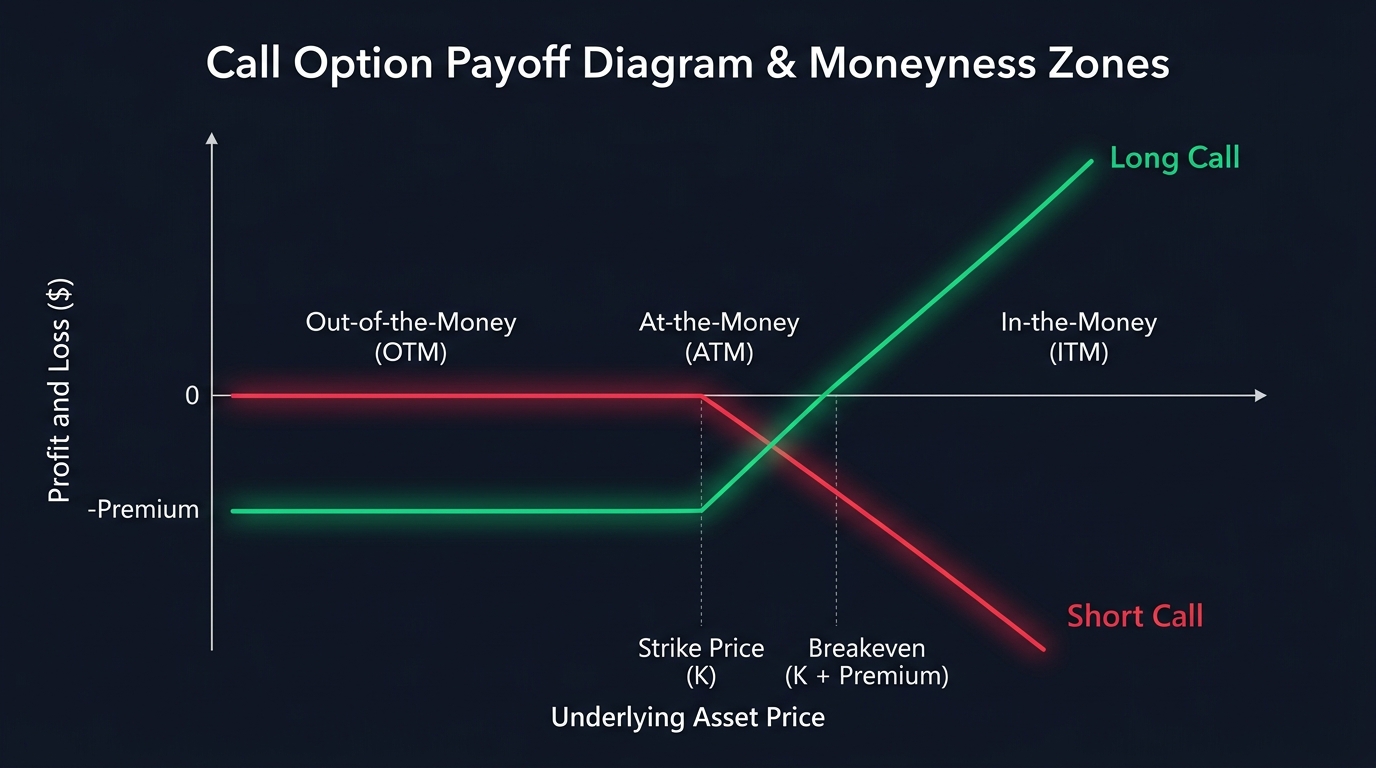
- For the Buyer (Long Call): The maximum downside risk is strictly capped at the initial premium paid. Conversely, the upside profit potential is theoretically unlimited as the market price of the underlying asset climbs higher.
- For the Seller (Short Call / Writing a Call): The maximum profit is strictly capped at the premium collected upfront. In return for this fee, the seller assumes the obligation to deliver the asset at the strike price if exercised, exposing themselves to theoretically unlimited financial risk if the market surges upward.
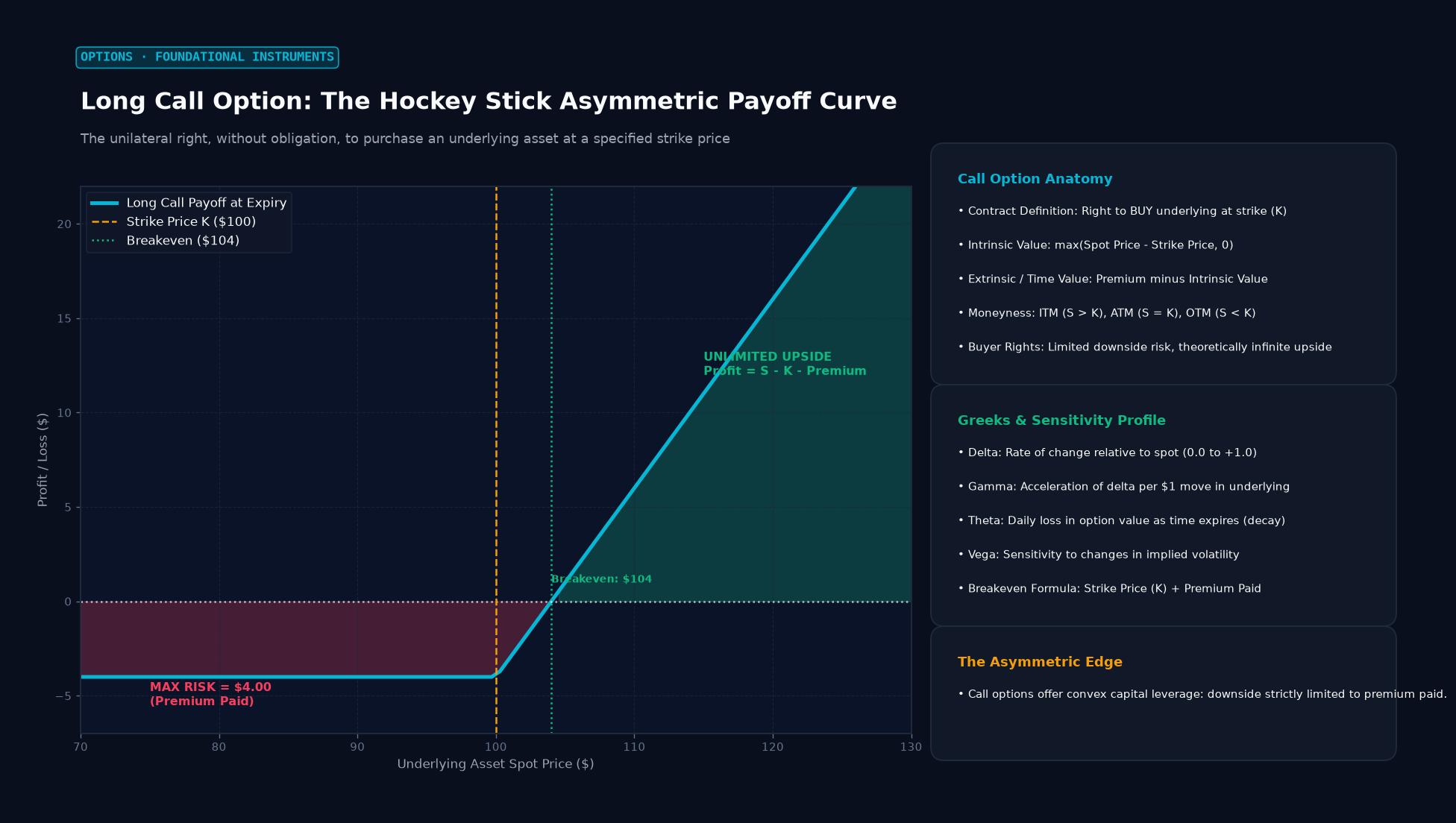 Figure: The unilateral right, without obligation, to purchase an underlying asset at a specified strike price
The Dual Nature of Currency Call Options
In equity markets, a call option represents a simple transaction: the right to buy shares of a company using cash. In the foreign exchange market, however, currencies are traded strictly in pairs. Because every currency transaction involves the simultaneous exchange of two monetary units, a currency option is intrinsically dual-sided:
A EUR/USD Call option (the right to buy Euros at a fixed dollar exchange rate) is mathematically and operationally identical to a EUR/USD Put on the US Dollar (the right to sell US Dollars to acquire Euros).
When an institutional desk buys a call on the base currency, they are purchasing protection against the appreciation of the base currency, or equivalently, against the depreciation of the quote currency.
Call Option Moneyness and Value Components
An option’s premium consists of two distinct components: Intrinsic Value and Extrinsic (Time) Value.
$$ \text{Total Option Premium} = \text{Intrinsic Value} + \text{Extrinsic (Time) Value} $$
An option’s moneyness describes the relationship between the underlying spot exchange rate and the option strike price:
1. In-the-Money (ITM) Call
A call option is in-the-money when the prevailing market spot price is higher than the strike price ($\text{Spot} > \text{Strike}$).
- If EUR/USD is trading at 1.0950, a 1.0800 strike Call is in-the-money by 150 pips.
- The option possesses positive intrinsic value ($1.0950 - 1.0800 = 0.0150$). If exercised immediately, it yields an instant financial gain.
2. At-the-Money (ATM) Call
A call option is at-the-money when the market spot price is equal (or virtually equal) to the strike price ($\text{Spot} = \text{Strike}$).
- An ATM call has zero intrinsic value; its entire market price consists of extrinsic time value and implied volatility expectations. Its Delta ($\Delta$) is approximately +0.50.
3. Out-of-the-Money (OTM) Call
A call option is out-of-the-money when the prevailing spot price is lower than the strike price ($\text{Spot} < \text{Strike}$).
- If EUR/USD is trading at 1.0850, a 1.1000 strike Call is out-of-the-money.
- The option possesses zero intrinsic value. It is priced strictly on the statistical probability that market volatility might drive the exchange rate above 1.1000 prior to expiration. If the option expires while still OTM, it expires completely worthless.
How Market Participants Utilize Call Options
Traders and corporate treasuries deploy call options for two primary objectives:
1. Corporate FX Hedging (Capping Import Costs)
Consider an American technology importer contracting to buy €10,000,000 worth of specialized semiconductor manufacturing equipment from a German vendor, with payment due in six months.
- The current EUR/USD spot rate is 1.0800.
- If the Euro surges to 1.1500 over the next six months, the importer’s equipment cost in US Dollars would balloon by $700,000, destroying their profit margin.
- To eliminate this currency risk, the corporate treasurer purchases a 6-month 1.0850 EUR Call option.
- If the Euro rockets to 1.1800, the importer exercises the call, purchasing the required Euros at the locked-in strike of 1.0850.
- If the Euro instead collapses to 1.0200, the importer simply allows the option to expire unexercised, purchasing cheaper Euros on the open spot market while losing only the initial premium paid.
2. Directional Speculation with Asymmetric Leverage
Retail and institutional speculators buy call options when they anticipate a powerful bullish breakout but wish to avoid the stop-out vulnerability of spot margin trading. During turbulent geopolitical events, an erratic market “whipsaw” might trigger a spot stop-loss before the anticipated rally occurs. A long call option cannot be liquidated prematurely by intraday volatility—the trader retains full upside participation until expiration day regardless of interim drawdowns.
Practical Trading Example: Long Call Payoff
Suppose a currency trader anticipates a strong rally in the British Pound (GBP/USD), currently trading at spot rate 1.2700.
- Option Purchase: The trader buys a 30-day 1.2800 OTM Call option for a premium of 80 pips ($0.0080 per pound).
- Capital Outlay: On a standard £100,000 contract, the upfront cost is: $$ 100,000 \times 0.0080 = $800.00 $$ This $800.00 represents the trader’s absolute maximum potential loss.
- Breakeven Calculation: At expiration, the trade achieves breakeven when the spot price covers the strike plus the premium paid: $$ \text{Breakeven} = \text{Strike} + \text{Premium} = 1.2800 + 0.0080 = 1.2880 $$
Potential Outcomes at Expiration:
- Scenario A (Bearish Outcome): GBP/USD drops to 1.2400. The call option expires out-of-the-money and completely worthless. The trader loses only the $800.00 premium (unlike a spot long position entered at 1.2700, which would have suffered a severe -$3,000 loss).
- Scenario B (Bullish Explosion): The Bank of England unexpectedly hikes rates, propelling GBP/USD to 1.3100.
- Intrinsic value at expiration: $$ 1.3100 - 1.2800 = 0.0300 \text{ (300 pips)} $$
- Gross value of the contract: $$ 100,000 \times 0.0300 = $3,000.00 $$
- Net profit after deducting initial premium: $$ $3,000.00 - $800.00 = $2,200.00 $$
- Return on Invested Capital (ROIC): +275% on the $800 risk budget.
Key Takeaways
- A call option grants the buyer the right, but not the obligation, to buy an asset at a predetermined strike price on or before expiration.
- The call buyer’s maximum loss is limited strictly to the upfront premium paid, while upside profit is theoretically unlimited.
- The call seller (writer) collects the premium upfront, but bears theoretically unlimited risk if the market advances aggressively.
- In forex, a call option on the base currency is simultaneously a put option on the quote currency.
- Call options are widely deployed for corporate import hedging and directional speculation with defined downside risk.
FAQ
When should I exercise a call option? An American-style call option can theoretically be exercised at any point before expiration, but it is rarely optimal to exercise early because doing so forfeits any remaining extrinsic time value. Instead, traders usually sell the profitable option back to the market to capture both its intrinsic value and remaining time value.
What is the difference between buying a call and buying the underlying asset? Buying the spot asset requires putting up full capital (or borrowing on margin), exposing the trader to dollar-for-dollar losses if the price drops. Buying a call option provides leveraged upside exposure while strictly capping total loss to the upfront premium paid, eliminating margin call risk.
What is a covered call? A covered call is an income-generating investment strategy where an investor holds a long position in the underlying asset (or currency) and simultaneously sells (writes) an out-of-the-money call option on the same asset to generate cash flow from the collected premium.
Ready to trade forex?
Open a free demo account with a regulated broker. Practice with virtual funds before risking real money.