Zero-Coupon Inflation Swap (ZCIS)
A bilateral over-the-counter derivative contract in which one counterparty pays a compounded fixed rate at maturity while the other pays the realized percentage change in an inflation index, settled as a single net bullet payment.
What Is a Zero-Coupon Inflation Swap (ZCIS)?
A Zero-Coupon Inflation Swap (ZCIS) is an over-the-counter (OTC) derivative agreement between two counterparties designed to transfer or hedge inflation risk. In a standard ZCIS contract, there are zero interim cash flows or periodic coupon payments during the life of the transaction. Instead, the entire financial obligation is settled as a single net cash payment at final maturity.
Under the contract terms:
- The Inflation Buyer (Fixed-Rate Payer) agrees to pay a predetermined, compounded fixed annual interest rate (the breakeven inflation rate, $K$) on a designated notional principal ($N$).
- The Inflation Seller (Inflation Payer) agrees to pay the actual cumulative percentage change in a reference consumer price index over the life of the swap.
Because the fixed leg rate is determined at inception by market supply and demand, the quote for a ZCIS directly represents the financial market’s pure, consensus expectation of average annualized inflation over the swap’s tenor. ZCIS contracts serve as the foundational building blocks for pricing inflation curves across global financial centers.
                  ZERO-COUPON INFLATION SWAP (ZCIS) AT MATURITY (T)

                  Pays Compounded Fixed Rate: [(1 + K)^T - 1]
         ┌─────────────────────────────────────────────────────────┐
         │                                                         ▼
   [Fixed Payer]                                            [Inflation Payer]
  (Inflation Buyer)                                        (Inflation Seller)
         ▲                                                         │
         └─────────────────────────────────────────────────────────┘
                 Pays Realized Cumulative Inflation: [(I_T / I_0) - 1]

               *Both legs are netted into a single bullet cash settlement*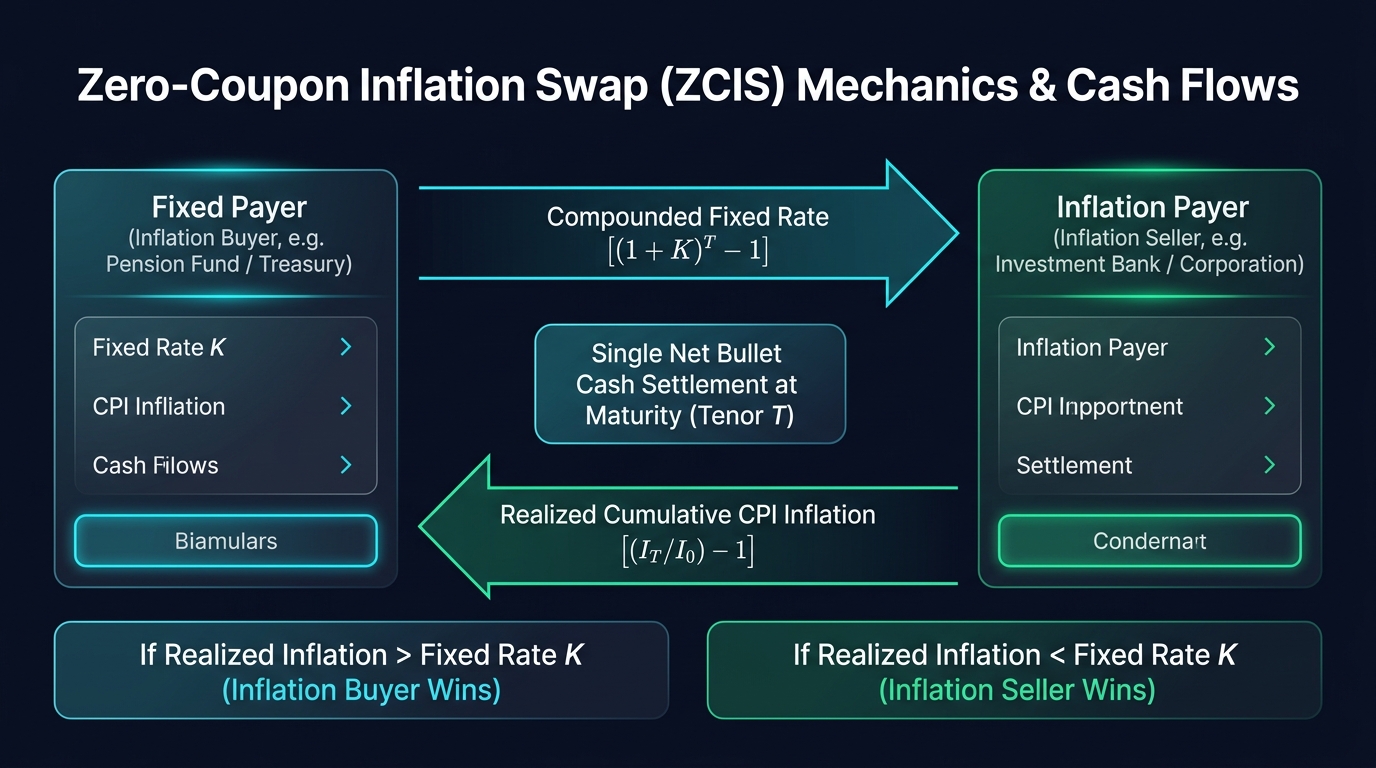
Mathematical Formulation and Payoff Mechanics
The financial mechanics of a ZCIS depend on three primary inputs: notional principal ($N$), swap tenor in years ($T$), and agreed annual fixed swap rate ($K$).
1. The Fixed Leg
The fixed cash obligation accumulates interest via annual compounding over $T$ years:
$$\text{Fixed Leg Payment} = N \times \left[ (1 + K)^T - 1 \right]$$
2. The Inflation (Floating) Leg
The floating leg payoff is linked directly to an official headline inflation benchmark, such as the US Consumer Price Index for All Urban Consumers (CPI-U), the Eurozone Harmonised Index of Consumer Prices excluding Tobacco (HICP-ex-Tobacco), or the UK Retail Price Index (RPI):
$$\text{Floating Leg Payment} = N \times \left[ \frac{I_T}{I_0} - 1 \right]$$
Where:
- $I_0$ is the base reference inflation index level at the start of the contract.
- $I_T$ is the final reference inflation index level at swap maturity.
3. Net Settlement at Maturity
At maturity date $T$, the two legs are netted against each other, requiring a single cash transfer:
$$\text{Net Settlement} = N \times \left( \left[ \frac{I_T}{I_0} - 1 \right] - \left[ (1 + K)^T - 1 \right] \right) = N \times \left( \frac{I_T}{I_0} - (1 + K)^T \right)$$
- If $\frac{I_T}{I_0} > (1 + K)^T$, actual inflation exceeded market expectations; the Inflation Seller pays the difference to the Inflation Buyer.
- If $\frac{I_T}{I_0} < (1 + K)^T$, actual inflation fell below market expectations; the Inflation Buyer pays the difference to the Inflation Seller.
The Three-Month Indexation Lag Convention
Because official government statistical agencies (such as the US Bureau of Labor Statistics or Eurostat) compile and publish consumer price indices with a time lag, inflation swaps cannot reference real-time daily price levels.
To provide legal clarity and operational certainty, global derivative markets adhere to a standardized three-month indexation lag:
                       THREE-MONTH INDEXATION LAG TIMELINE

   Swap Effective Date: June 1, 2026          Swap Maturity Date: June 1, 2031
              │                                          │
              ▼                                          ▼
   Base Index Date: March 2026                Final Index Date: March 2031
(Published in mid-April 2026) (Published in mid-April 2031)- For a swap commencing on June 1, 2026, the base index level ($I_0$) is taken from the official CPI published for March 2026.
- For a 5-year swap maturing on June 1, 2031, the final index level ($I_T$) is taken from the official CPI published for March 2031.
- This three-month offset ensures that when the swap reaches maturity, the relevant economic data has already been finalized and published, preventing settlement disputes.
Concrete Numerical Trade Example
An institutional pension fund manages a pool of inflation-indexed retirement liabilities and seeks to hedge against unexpected inflation surges over the next 10 years.
- Notional Principal ($N$): $100,000,000
- Swap Tenor ($T$): 10 Years
- Agreed Fixed ZCIS Rate ($K$): 2.50% per annum
- Base Inflation Index ($I_0$): 300.00 (March 2026 CPI-U)
At Maturity (Year 10):
The compounded fixed leg factor is calculated as: $$(1 + 0.025)^{10} = (1.025)^{10} \approx 1.2800845 \quad (+28.008%) $$ $$\text{Fixed Obligation} = $100,000,000 \times [1.2800845 - 1] = $28,008,450$$
Scenario A: High Inflation Surge (Final CPI = 410.00)
- Inflation Index Ratio: $$\frac{I_{10}}{I_0} = \frac{410.00}{300.00} = 1.366667 \quad (+36.667%)$$
- Inflation Obligation: $$$100,000,000 \times [1.366667 - 1] = $36,666,700$$
- Net Cash Settlement: The Inflation Seller pays $8,658,250 to the pension fund ($36,666,700 - $28,008,450). The hedge successfully covers the fund’s rising liability costs.
Scenario B: Low Inflation / Disinflation (Final CPI = 360.00)
- Inflation Index Ratio: $$\frac{I_{10}}{I_0} = \frac{360.00}{300.00} = 1.200000 \quad (+20.000%)$$
- Inflation Obligation: $$$100,000,000 \times [1.200000 - 1] = $20,000,000$$
- Net Cash Settlement: The pension fund pays $8,008,450 to the Inflation Seller ($28,008,450 - $20,000,000). Because real-world inflation was modest, the fund’s liabilities were smaller than budgeted, offsetting the derivative payment.
Comparative Analysis: ZCIS vs. Alternative Inflation Instruments
Institutional portfolio managers utilize several instruments to express inflation views or execute liability hedges:
| Feature / Metric | Zero-Coupon Inflation Swap (ZCIS) | Year-on-Year Inflation Swap (YYIS) | Treasury Inflation-Protected Securities (TIPS) |
|---|---|---|---|
| Cash Flow Schedule | Single bullet payment at maturity | Annual periodic cash settlements | Semi-annual real coupon payments |
| Balance Sheet Impact | Off-balance-sheet derivative | Off-balance-sheet derivative | Funded balance sheet asset (bond purchase) |
| Capital Outlay | Zero upfront cash (unfunded) | Zero upfront cash (unfunded) | Full face value purchase price (funded) |
| Deflation Floor | Optional structural floor (negotiable) | Typically unfloored | Statutory floor at par at maturity |
| Counterparty Risk | Bilateral OTC (mitigated by CSA collateral) | Bilateral OTC (mitigated by CSA collateral) | Zero default risk (backed by US Treasury) |
| Market Liquidity | Highest liquidity in inflation derivatives | Moderate liquidity | Deepest cash market liquidity |
Institutional Market Participants and Strategic Use Cases
                    ZCIS MARKET ECOSYSTEM & MOTIVATIONS

   [Defined-Benefit Pension Funds]       [Infrastructure & Utility Operators]
    Liability hedging: Liabilities        Revenue hedging: Future cash flows
    are legally tied to cost-of-living    are linked to inflation (toll roads);
    indices over multi-decade horizons    they sell inflation to pay fixed debt
                 │                                      │
                 ▼                                      ▼
           [Buy Inflation]                       [Sell Inflation]
                 │                                      │
                 └──────────────► [SWAP DEALER] ◄───────┘
                                  (Global Banks)
                                        │
                                        ▼
                             [Macro Hedge Funds]
                              Breakeven curve arbitrage;
TIPS vs Swap basis trades- Pension Funds and Life Insurers: Defined-benefit pension schemes guarantee retirement payouts that escalate with statutory inflation. To immunize their funded status against unanticipated purchasing power declines, pension trustees execute long-dated (10 to 30 year) ZCIS contracts as inflation buyers.
- Infrastructure and Real Asset Concessionaires: Private infrastructure consortia financing toll roads, renewable energy farms, and municipal water facilities frequently collect user tariffs indexed to national consumer price indices. Because their bank loans or bond debt carry fixed interest rates, they act as natural inflation sellers, locking in fixed revenues via ZCIS to ensure debt service coverage.
- Macro Hedge Funds and Relative Value Desks: Quantitative fixed-income funds exploit relative pricing discrepancies between sovereign inflation-linked debt and derivative markets (the TIPS-Swap Basis), taking long or short swap positions when market pricing diverges from fundamental fair value.
Frequently Asked Questions
Why are zero-coupon inflation swaps more liquid than year-on-year inflation swaps?
ZCIS contracts are significantly more liquid because their single-bullet cash flow structure directly mirrors the compounding mechanics of sovereign inflation-indexed bonds like US TIPS and UK Index-Linked Gilts. Market-making dealer banks can hedge a ZCIS position almost perfectly using government bonds and Treasury futures, minimizing dealer hedging costs and narrowing bid-ask spreads.
Can an inflation swap result in a negative payout for the inflation buyer?
Yes. If cumulative inflation over the swap horizon turns out to be lower than the compounded fixed rate agreed at inception (or if the economy experiences protracted deflation), the inflation buyer must pay the difference to the inflation seller at maturity. The contract hedges unexpected inflation volatility, not absolute investment downside.
How do swap dealers manage counterparty credit risk on a 20-year ZCIS?
Because a 20-year ZCIS involves no interim cash flows, large mark-to-market exposures can accumulate over decades. Counterparties execute transactions under an International Swaps and Derivatives Association (ISDA) Master Agreement accompanied by a Credit Support Annex (CSA). Under standard CSA rules, the party with a negative mark-to-market position must post daily cash or high-grade sovereign bond collateral to eliminate default risk.
Ready to trade forex?
Open a free demo account with a regulated broker. Practice with virtual funds before risking real money.