Zero-Plus Tick
A securities trade executed at the exact same price as the trade immediately preceding it, but at a higher price than the last preceding transaction of a differing price, serving as an eligible execution condition under historic short-sale regulations.
What Is a Zero-Plus Tick?
A zero-plus tick, also termed an uptick match or zero-uptick, is a market microstructure classification describing an executed transaction that occurs at the exact same price as the transaction immediately prior, but at a higher price than the most recent transaction that occurred at a different price level.
In securities and futures exchanges, prices do not fluctuate with every single trade execution. During active market sessions, dozens of separate orders often execute at an identical price level before the order book exhausts available depth and shifts to a new price. When an initial trade moves the market upward (an uptick or plus tick), all subsequent consecutive trades that execute at that same higher price are categorized as zero-plus ticks.
In the history of United States financial market regulation, the zero-plus tick served as a primary execution threshold under the Securities and Exchange Commission (SEC) Rule 10a-1 (The Uptick Rule). Under this rule, short sellers were legally permitted to execute short sales only on a plus tick or a zero-plus tick, ensuring that short-sale liquidity could only enter the order book when prevailing price momentum was positive or stable.
Market Microstructure Mechanics: Tracking Tick Sequences
To illustrate the mechanics of a zero-plus tick, consider the following chronological transaction sequence on an equity limit order book:
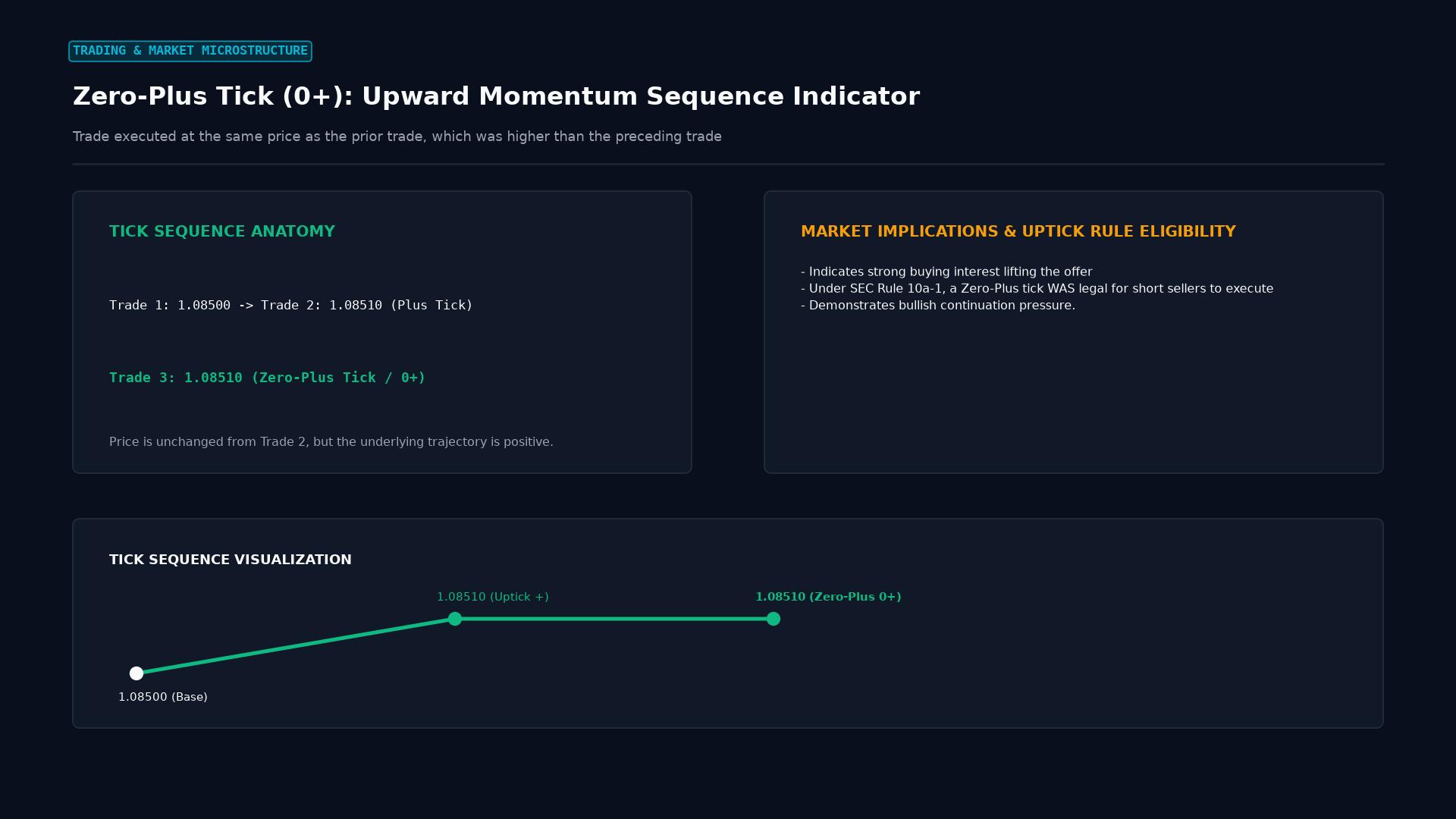 Figure: Microstructure tick sequence: trade price matching previous price following an uptick, confirming aggressive buying and short-sale eligibility.
The Microstructure Drivers of Zero-Plus Ticks:
- Aggressive Buyer Lifts the Offer: An institutional algorithmic buy order sweeps the lowest available ask (offer) price at $50.00, triggering an initial plus tick ($+$).
- Resting Depth and Liquidity Provision: Following the upward price jump, market makers and institutional sellers place limit sell orders at $50.00 to satisfy remaining buying interest.
- Execution at the Consolidated Price: Additional incoming market buy orders match against those resting limit orders at $50.00. Because these transactions match the price of Trade 2 ($50.00) and the price change preceding Trade 2 was positive ($49.80 to $50.00), Trades 3 and 4 are classified as zero-plus ticks ($0+$).
Regulatory Importance: SEC Rule 10a-1
From 1938 until its temporary suspension and formal modernization, SEC Rule 10a-1 governed all short-selling activity on US national securities exchanges:
                    RULE 10a-1 SHORT SALE ELIGIBILITY TEST

                         [Incoming Short-Sale Order]
                                      │
                                      ▼
                        Is Current Execution Tick?
                                      │
                     ┌────────────────┴────────────────┐
                     ▼                                 ▼
           [Plus Tick or Zero-Plus Tick]     [Minus Tick or Zero-Minus Tick]
                     │                                 │
                     ▼                                 ▼
             [ORDER EXECUTED]                  [ORDER BLOCKED]
            Lawful Short Sale                 Violates Rule 10a-1
Why Regulators Permitted Zero-Plus Ticks:
The primary policy goal of the 1934 Securities Exchange Act was to curb destabilizing short-selling panics. If the SEC had restricted short sales strictly to pure plus ticks, short sellers would have been severely constrained, starving the market of legitimate liquidity during sideways consolidation phases following an upward advance.
By classifying the zero-plus tick as a permissible entry point, regulators recognized that as long as the last directional price impulse was positive, allowing short sellers to add liquidity at that price would not artificially push the stock price down. The short seller was merely satisfying surplus buying interest at an elevated price level.
The Four Market Ticks Compared
Understanding the interplay between price changes and directional history is fundamental for algorithmic execution desks and market surveillance units:
| Tick Classification | Price vs. Immediate Prior Trade ($P_t \text{ vs } P_{t-1}$) | Prior Directional Move ($P_{t-1} \text{ vs } P_{\text{last diff}}$) | Rule 10a-1 Short Sale Status | Lee-Ready Trade Inference |
|---|---|---|---|---|
| Plus Tick (+) | Higher ($P_t > P_{t-1}$) | Not Applicable | Permitted | Buyer-Initiated |
| Zero-Plus Tick (0+) | Identical ($P_t = P_{t-1}$) | Higher ($P_{t-1} > P_{\text{last diff}}$) | Permitted | Buyer-Initiated |
| Minus Tick (-) | Lower ($P_t < P_{t-1}$) | Not Applicable | Prohibited | Seller-Initiated |
| Zero-Minus Tick (0-) | Identical ($P_t = P_{t-1}$) | Lower ($P_{t-1} < P_{\text{last diff}}$) | Prohibited | Seller-Initiated |
Quantitative Applications: The Lee-Ready Algorithm and Order Flow Analysis
In modern quantitative finance, tick rules are used beyond historical regulatory compliance. Quantitative researchers analyzing high-frequency data from exchange consolidated feeds use the Lee-Ready Algorithm (1991) to determine whether historical trades were initiated by buyers or sellers:
                      LEE-READY ALGORITHMIC LOGIC FLOW

                           [New Executed Trade (Pt)]
                                      │
                                      ▼
                    Does Pt differ from Quote Midpoint?
                                      │
                     ┌────────────────┴────────────────┐
                    YES                                NO (Midpoint Match)
                     │                                 │
                     ▼                                 ▼
          [Apply Quote Rule]                   [Apply Tick Rule]
      Pt > Midpoint ──► Buyer Active      Pt is (+) or (0+) ──► Buyer-Initiated
Pt < Midpoint ──► Seller Active Pt is (-) or (0-) ──► Seller-Initiated- Trade Sign Assignment: When a transaction prints precisely at the prevailing bid-ask midpoint, the quote rule cannot classify trade direction. The algorithm evaluates the tick test.
- Classifying Zero-Plus Trades: A trade printing on a zero-plus tick is signed as $+1$ (buyer-initiated).
- Informed Order Flow Tracking: By summing signed trade volume across zero-plus and zero-minus ticks, market microstructure algorithms compute metrics like order flow toxicity, Kyle’s Lambda (price impact coefficient), and Volume-Synchronized Probability of Toxicity (VPIN) to detect institutional accumulation before large breakouts occur.
Modern Relevance: SEC Rule 201 and Limit Order Execution
While the historic tick test of Rule 10a-1 was repealed in 2007, the economic principles underlying zero-plus ticks remain central to modern automated trading:
- Rule 201 Alternative Uptick Rule: When a stock triggers the 10% circuit breaker under modern Regulation SHO, short selling is restricted to prices above the prevailing National Best Bid (NBB). In practice, this forces short orders to rest on the offer, requiring aggressive buyers to lift the price, effectively generating plus ticks or zero-plus ticks before short orders can be filled.
- VWAP and TWAP Execution Desks: Institutional execution algorithms managing multi-million-share liquidations track zero-plus ticks to identify moments of high passive liquidity absorption, opportunistically executing client orders without triggering market impact.
Frequently Asked Questions
What causes a long series of zero-plus ticks to occur?
A series of zero-plus ticks occurs when a large institutional limit order is resting at an offer price after an initial upward tick, and multiple incoming market buy orders fill against that resting block over several seconds or milliseconds. Because the price remains identical while the trade preceding the block was higher than the prior price level, every fill within that block registers as a zero-plus tick.
How does a zero-plus tick differ from a regular plus tick?
A regular plus tick represents an active price increase; the trade executes at an absolute dollar price higher than the trade immediately before it (such as moving from $10.00 to $10.05). A zero-plus tick occurs at the exact same dollar price as the trade immediately before it ($10.05 to $10.05), but is categorized as positive because the last directional price shift was upward.
Can zero-plus ticks occur in cryptocurrency and decentralized exchange trading?
Yes, in terms of trade sequencing. On centralized cryptocurrency order book exchanges (such as Binance, Coinbase, or Kraken), trade sequence matching engines continuously produce plus, minus, zero-plus, and zero-minus ticks. Quantitative crypto market-making algorithms use these tick classifications to estimate real-time trade direction and inventory skew, even though regulatory uptick restrictions do not apply to digital asset markets.
Ready to trade forex?
Open a free demo account with a regulated broker. Practice with virtual funds before risking real money.