ZMK
The historical ISO 4217 currency code for the original Zambian Kwacha, the sovereign currency of Zambia from 1968 until its redenomination in January 2013 at a ratio of 1,000 old Kwacha to 1 new Kwacha (ZMW).
ZMK (Zambian Kwacha, Historical)
ZMK was the ISO 4217 three-letter currency code for the original Zambian Kwacha, the official sovereign legal tender of the Republic of Zambia from January 16, 1968, until its comprehensive redenomination on January 1, 2013. The word Kwacha derives from the Bemba and Nyanja languages, translating to “dawn” or “a new day begins,” symbolizing Zambia’s national liberation and sovereignty following its independence from British colonial rule in 1964.
Throughout its 45-year operational existence, the ZMK represented a textbook case study in commodity-dependent emerging market currencies. Heavily tied to the global copper mining super-cycle, the currency endured decades of structural depreciation, driven by copper price collapses, nationalized industrial inefficiency, external oil shocks, and unbacked central bank deficit monetization. By 2012, hyper-depreciation had rendered individual units of the ZMK practically worthless, prompting the Bank of Zambia to execute a historic structural currency redenomination, transitioning from the ZMK to the modern Zambian Kwacha (ISO code: ZMW) by slashing three zeros.
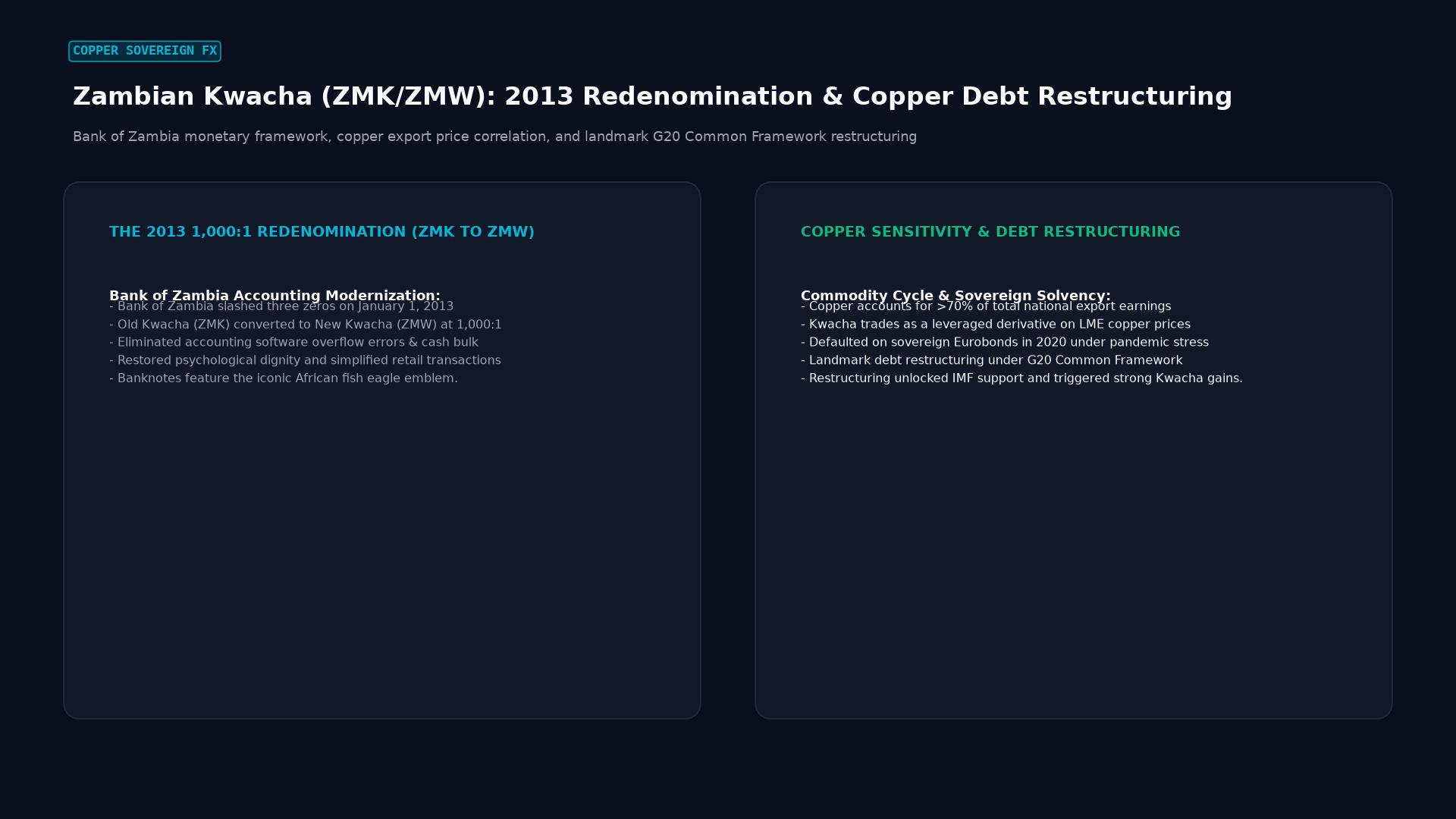 Figure: Bank of Zambia monetary framework, copper export price correlation, and landmark G20 Common Framework restructuring
The Copperbelt Commodity Monoculture
To understand the long-term trajectory and ultimate demise of the ZMK, macroeconomists must analyze Zambia’s underlying trade balance and natural resource endowments. Zambia is one of Africa’s premier copper producers, endowed with the vast mineral reserves of the Copperbelt:
+--------------------------------------------------------------------------+
|                  Zambian Macroeconomic Balance of Trade                  |
+--------------------------------------------------------------------------+
|  Primary Export Commodity    | Refined Copper & Cobalt Concentrates      |
|  Proportion of Total Exports | Historically 70% to 85% of Gross Exports  |
|  FX Reserve Generation       | Over 80% of Sovereign Hard Currency Inflows|
|  Vulnerability Profile       | Extreme Exposure to LME Spot Copper Swings|
|  Domestic Import Dependency  | Heavy: Capital Machinery, Fuel, Fertilizer|
+--------------------------------------------------------------------------+
When international copper prices on the London Metal Exchange (LME) surged, commercial mining conglomerates converted foreign exchange receipts into local currency, driving capital inflows and bolstering the external purchasing power of the ZMK. Conversely, whenever global industrial manufacturing contracted, copper prices plummeted, starving the Zambian treasury of foreign currency reserves and sparking catastrophic depreciation pressures against the US dollar and British pound.
Historical Genesis and the 1970s Nationalization Shock
At its launch in January 1968, the Zambian Kwacha replaced the colonial Zambian pound at a decimalized rate of 2 Kwacha per 1 Pound (pegging 1 Kwacha to 100 ngwee). Backed by high post-war copper prices and substantial foreign exchange reserves, the initial peg was set at 1 ZMK = 1.40 USD, establishing the kwacha as stronger than the US dollar.
However, macroeconomic mismanagement during the 1960s and 1970s destabilized the currency:
[ High Copper Prices at Independence: ZMK Trades at Premium to USD ]
                                │
                                ▼
[ 1969 Mulungushi Reforms: State Nationalizes 51% of Copper Mines (ZCCM) ]
                                │
                                ▼
[ 1973 Global Oil Crisis + Prolonged 1975 Copper Price Collapse ]
                                │
                                ▼
[ Sovereign Balance of Payments Deficit & Loss of Commercial Efficiency ]
                                │
                                ▼
[ Bank of Zambia Monetizes Fiscal Deficits: Inflation Spiral Begins ]
1. The Mulungushi Reforms and State Ownership
Under President Kenneth Kaunda’s 1968–1969 Mulungushi economic declarations, the Zambian government nationalized 51% of major commercial assets, consolidating copper mining under the state-owned monopoly Zambia Consolidated Copper Mines (ZCCM). Bureaucratic patronage, chronic underinvestment in mine modernization, and bloated operational payrolls depleted the productive output of the Copperbelt.
2. The 1973–1975 Macroeconomic Twin Shock
The 1973 OPEC oil embargo multiplied Zambia’s petroleum import costs fourfold, while the subsequent 1975 global recession cut world copper prices by more than 50%. Zambia’s current account balance shifted from massive surplus into acute deficit.
Unwilling to cut public sector subsidies or lay off workers, the government financed fiscal shortfalls through direct borrowing from the Bank of Zambia. Expanding the domestic money supply while physical copper export receipts were collapsing triggered a multi-decade structural inflation cycle.
Decades of Depreciation: The Road to Billions
Throughout the 1980s and 1990s, the ZMK experienced persistent devaluation:
+--------------------------------------------------------------------------+
|                     Decades of ZMK Currency Depreciation                 |
+--------------------------------------------------------------------------+
|  Year    | Indicative Exchange Rate (ZMK per 1 USD) | Macro Context      |
+----------+------------------------------------------+--------------------+
|  1968    | 0.71 ZMK                                 | Launch / Sovereign |
|  1975    | 0.64 ZMK                                 | Pre-Crash Peak     |
|  1985    | 2.20 ZMK                                 | FX Auction Debacle |
|  1990    | 30.00 ZMK                                | Debt Restructuring |
|  1995    | 850.00 ZMK                               | Free-Market Float  |
|  2000    | 3,100.00 ZMK                             | ZCCM Privatization |
|  2005    | 4,500.00 ZMK                             | HIPC Debt Relief   |
|  2012    | 5,200.00 ZMK                             | Pre-Redenomination |
+--------------------------------------------------------------------------+
1. The Breakdown of Subunits and Cash Handling Logistics
By the late 1990s, the ngwee (the one-hundredth subunit) was rendered obsolete. Minting a 50-ngwee coin cost dozens of times more than its face purchasing power. Physical coins disappeared from circulation entirely.
As the currency plunged past 4,000 ZMK per US dollar, daily cash transactions became physically cumbersome. A modest dinner at a restaurant or a tank of automobile gasoline required stacks of 10,000, 20,000, and 50,000 kwacha banknotes. Commercial enterprises and banks were forced to invest in high-speed cash-counting machines, while retail accounting software suffered buffer overflows attempting to process enterprise ledgers measured in trillions of ZMK.
The 2013 Redenomination: Retiring ZMK for ZMW
In 2012, recognizing that currency logistics were imposing heavy friction on the domestic economy, the Zambian government and the Bank of Zambia enacted the Currency Redenomination Act:
[ January 2012: Bank of Zambia Announces Redenomination Initiative ]
                                 │
                                 ▼
[ Core Equation: Divide Nominal ZMK Balances by 1,000 (Drop 3 Zeros) ]
                                 │
                                 ▼
[ January 1, 2013: Official Launch of the New Zambian Kwacha (ZMW) ]
  - 1,000 ZMK Banknote converts to 1 ZMW
  - 50,000 ZMK Banknote converts to 50 ZMW
  - 5,200 ZMK / USD exchange rate recalibrates to 5.20 ZMW / USD
                                 │
                                 ▼
[ Six-Month Dual-Currency Legal Tender Transition: Jan - June 2013 ]
                                 │
                                 ▼
[ Complete Demonetization of ZMK: ISO Code Permanently Retired ]
+--------------------------------------------------------------------------+
| Comparison: ZMK vs. Modern ZMW System |
+--------------------------------------------------------------------------+
| Operational Feature | Historical ZMK Legacy | Modern ZMW System |
+--------------------------+--------------------------+--------------------+
| ISO 4217 Currency Code | ZMK | ZMW |
| Subunit Status | Ngwee 100% Defunct | Ngwee Coins Revived|
| Highest Banknote | 50,000 ZMK | 100 ZMW |
| Cash Transport Burden | Heavy (Bundles/Bricks) | Standard Wallets |
| Bank ATM Dispensation | Chronic Physical Jams | Standardized Notes |
| Ledger Scaling | Millions / Billions | Normalized Digits |
+--------------------------------------------------------------------------+Technical and Banking Infrastructure Overhaul
The redenomination required massive technical coordination across the Zambian economy:
- Financial IT Ledgers: Core banking platforms (such as Flexcube and Finacle) and corporate enterprise resource planning (ERP) databases executed database migration scripts at midnight on December 31, 2012, dividing all account balances, credit lines, and customer deposits by 1,000.
- ATM and Vending Recalibration: Automated teller machines across Lusaka and the Copperbelt were re-engineered to dispense the newly printed, physically resized ZMW banknotes.
- Restoring Physical Coins: The redenomination revived coins for small change. The Bank of Zambia introduced new 5, 10, 50-ngwee coins and a 1-kwacha coin, eliminating retail rounding pricing distortions.
Frontier Market FX Trading and Commodity Hedging
For institutional foreign exchange traders, emerging market debt funds, and multinational corporations operating in southern Africa, the legacy of the ZMK provided critical operational lessons:
- LME Copper Beta: The Zambian kwacha trades as a high-beta proxy on global industrial production and Chinese infrastructure demand. In quantitative currency modeling, changes in spot copper prices lead quarterly shifts in the kwacha’s nominal exchange rate by approximately three to six weeks.
- Sovereign Debt and FX Liquidity Risk: In late 2020, Zambia became the first African sovereign to default on its Eurobonds during the COVID-19 pandemic, highlighting how sovereign dollar-denominated debt burdens compound domestic currency vulnerability. Modern traders deploying capital in ZMW frontier instruments continuously monitor sovereign external debt restructuring under the G20 Common Framework.
Frequently Asked Questions
What does the acronym ZMK stand for?
ZMK was the official ISO 4217 currency code for the original Zambian Kwacha. “ZM” represented Zambia under the International Organization for Standardization country code system, while “K” represented Kwacha.
Why was the ZMK replaced by the ZMW?
The ZMK was replaced because decades of high inflation had eroded its purchasing power, requiring thousands of kwacha for routine daily purchases. The Bank of Zambia slashed three zeros (1,000 ZMK = 1 ZMW) to simplify consumer accounting, reduce cash transportation and counting costs, prevent corporate software ledger errors, and restore dignity to the national currency.
Can old ZMK banknotes still be spent in Zambia?
No. ZMK banknotes were officially demonetized following the conclusion of the transition period in 2013 and 2014. Old notes cannot be spent in retail commercial transactions. However, historical high-denomination ZMK notes (such as the 50,000 kwacha bill) are actively collected as numismatic souvenirs.
Ready to trade forex?
Open a free demo account with a regulated broker. Practice with virtual funds before risking real money.