Zvi Griliches
A preeminent empirical econometrician and Harvard University professor whose pioneering research revolutionized hedonic price indexing, technological diffusion modeling, and the measurement of research and development (R&D) productivity.
Zvi Griliches
Hirsh Zvi Griliches (September 12, 1930 – November 4, 1999) was one of the twentieth century’s most influential empirical econometricians and a long-time professor of economics at Harvard University. Awarded the prestigious John Bates Clark Medal in 1965 (bestowed by the American Economic Association upon the most promising American economist under age forty), Griliches revolutionized applied microeconometrics. His empirical breakthroughs transformed how modern statistical agencies calculate inflation, how macroeconomists measure total factor productivity, and how corporate strategists evaluate research and development (R&D) investments.
Born into an assimilated Jewish family in Kaunas (Kovno), Lithuania, Griliches survived the Kovno Ghetto and the Dachau concentration camp during World War II. Following the liberation of Europe, he emigrated to Mandatory Palestine, worked on a kibbutz, and served in the Israeli military before pursuing higher education in the United States at the University of California, Berkeley, and the University of Chicago. Mentored by agricultural economist Theodore Schultz, Griliches dedicated his academic career to grounding economic theory in rigorous empirical data, confronting measurement errors, and illuminating the quantitative drivers of technological progress.
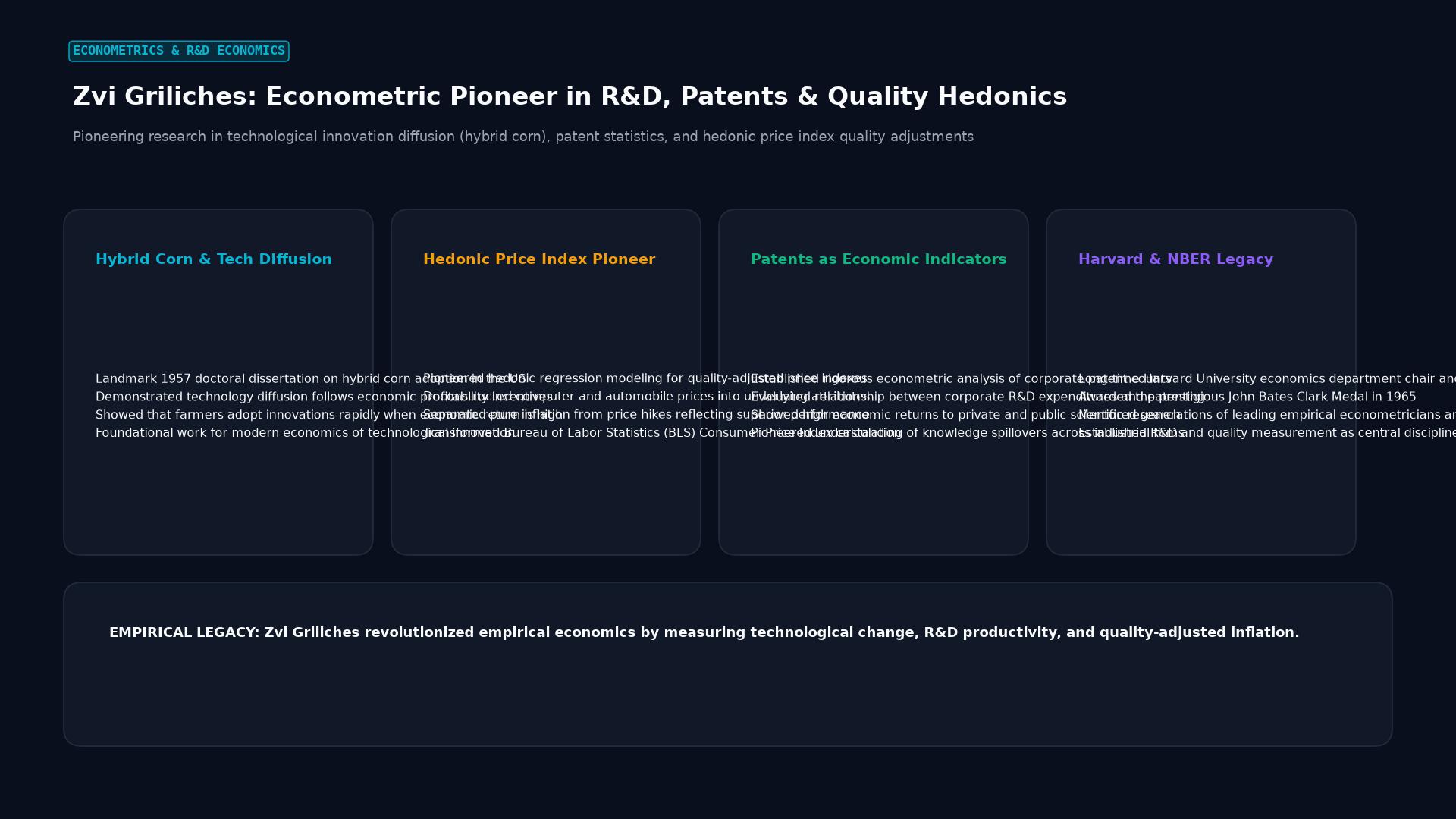 Figure: Pioneering research in technological innovation diffusion (hybrid corn), patent statistics, and hedonic price index quality adjustments
1. Technological Diffusion and the Hybrid Corn Breakthrough (1957)
Griliches’s doctoral dissertation, published in Econometrica in 1957 under the title “Hybrid Corn: An Exploration in the Economics of Technological Change,” is considered a masterpiece of applied economics. Prior to Griliches, sociologists argued that farmers adopted new agricultural technologies based primarily on cultural traditions, educational status, and social conformity.
Griliches challenged this consensus by gathering county-level empirical data across the American Midwest tracking the adoption of hybrid seed corn. He modeled the diffusion rate using a logistic growth function:
$$P(t) = \frac{K}{1 + e^{-(\alpha + \beta t)}}$$
Where:
- $P(t)$ represents the percentage of corn acreage planted with hybrid seeds at time $t$.
- $K$ denotes the long-run ceiling or equilibrium adoption level.
- $\alpha$ is a constant of integration reflecting the initial adoption origin date.
- $\beta$ measures the rate of adoption (the slope or velocity parameter).
                 Logistic S-Curve of Technological Diffusion
  Acreage (%)
   100%|                                              . . . Long-Run Ceiling (K)
       |                                      . . . *
    75%|                              . . . *
       |                      . . . *
    50%|              . . . *           <--- Point of Inflection (Max Velocity: β)
       |      . . . *
    25%|  . *
     0%+------------------------------------------------------------>
       Origin (α)                                               Time (t)
Griliches demonstrated that both the date of commercial availability ($\alpha$) and the velocity of adoption ($\beta$) were determined by expected economic profitability. Seed companies entered geographic regions where soil conditions and farm sizes maximized potential revenue, while farmers adopted hybrid seeds rapidly where yield premiums over traditional open-pollinated corn were highest.
This research established the fundamental principle that technological adoption is an endogenous economic response to commercial incentives, forming the bedrock of modern innovation economics.
2. Hedonic Price Measurement: Revolutionizing Inflation Statistics
In 1961, Griliches published a landmark paper titled “Hedonic Price Indexes for Automobiles: An Econometric Analysis of Quality Change.” At the time, government price statistics (such as the Consumer Price Index, or CPI) suffered from a systemic flaw known as quality bias:
When an automaker introduced a new car model priced 10% higher than the previous year, statistical agencies routinely recorded the entire 10% increase as price inflation. Griliches proved that much of the price increase reflected enhanced functional utility: higher horsepower, better fuel economy, superior braking, and longer vehicle lifespans. Failing to account for quality improvements caused governments to systematically overstate true inflation and understate real gross domestic product (GDP) growth.
The Hedonic Pricing Regression Engine
Griliches proposed decomposing a complex product’s market price into the implicit marginal valuations of its constituent attributes:
$$\ln(P_i) = \beta_0 + \sum_{k=1}^{K} \beta_k X_{ki} + \sum_{t=1}^{T} \delta_t D_{ti} + \epsilon_i$$
Where:
- $P_i$ is the observed market price of vehicle $i$.
- $X_{ki}$ represents the $k$-th measurable quality characteristic (e.g., horsepower, vehicle weight, braking distance, interior volume).
- $\beta_k$ represents the implicit shadow price or marginal valuation that consumers place on one additional unit of characteristic $k$.
- $D_{ti}$ is a dummy variable indicating whether model $i$ was sold in year $t$.
- $\delta_t$ captures pure price inflation between periods, holding all quality characteristics strictly constant.
+--------------------------------------------------------------------------+
|                  Hedonic Price Decomposition of a Tech Asset             |
+--------------------------------------------------------------------------+
|  Observed Retail Price ($2,000)                                          |
|  =                                                                       |
|  Base Chassis Cost               ($500)                                  |
|  + Processing Speed (GHz * β_1)   ($600)                                  |
|  + RAM Capacity (GB * β_2)        ($400)                                  |
|  + Battery Efficiency (Hrs * β_3) ($300)                                  |
|  + Pure Residual Price Change    ($200) <--- Actual Inflation Component  |
+--------------------------------------------------------------------------+
Today, the US Bureau of Labor Statistics (BLS) and international statistical bureaus apply Griliches’s hedonic regression methodologies to calculate quality-adjusted price indices for computers, smartphones, televisions, enterprise software, and automotive vehicles, preventing billions of dollars in miscalculated social security and inflation-indexed debt adjustments.
3. The Economics of R&D and Knowledge Capital
During the 1970s and 1980s, serving as Director of the Productivity Program at the National Bureau of Economic Research (NBER), Griliches turned his attention to the measurement of corporate research and development. Economists struggled to understand why some industries exhibited explosive productivity while others stagnated.
Griliches developed the Knowledge Capital Model, integrating cumulative R&D investments into an extended Cobb-Douglas production function:
$$Y_t = A e^{\lambda t} K_t^\alpha L_t^\beta R_t^\gamma$$
Where:
- $Y_t$ represents real corporate output or value added.
- $K_t$ is physical capital stock (plant, machinery, and commercial property).
- $L_t$ is total labor input.
- $R_t$ represents the accumulated stock of knowledge capital, constructed by capitalizing past R&D expenditures after deducting technological obsolescence depreciation.
- $\gamma$ measures the output elasticity of knowledge capital.
       Accumulation and Depreciation of Corporate Knowledge Capital
  Knowledge Stock (R_t)
     ^
     |                              Current-Period R&D Investment (I_t)
     |                                               |
     |                                               v
     |                       +-------------------------------+
     |                       |    Active Knowledge Assets    |
     |                       +-------------------------------+
     |                                               |
     |                                               v
     |                             Technological Obsolescence (δ * R_{t-1})
     +------------------------------------------------------------>
                                                               Time (t)
Social vs. Private Rates of Return
Griliches’s empirical estimations revealed a profound market failure:
- Private Rate of Return: Corporations earned a healthy private return on R&D investments, typically ranging between 15% and 25%.
- Social Rate of Return: Taking into account technological spillovers (knowledge that leaks out and allows competitors, suppliers, and unrelated industries to innovate), the broader societal return on R&D was calculated at 30% to 50%.
Because innovating firms cannot capture all the economic value created by their research, private markets systematically under-invest in basic scientific research. This empirical finding provides the intellectual foundation for modern public policy interventions, including the federal R&D Tax Credit, government research grants through DARPA and the NIH, and statutory patent protections.
Methodological Rigor: Confronting Econometric Traps
Griliches was renowned for his skeptical, uncompromising approach to econometric data. He warned economists against treating statistical software outputs as ground truth without auditing the underlying measurement quality:
+--------------------------------------------------------------------------+
|                  Griliches's Econometric Diagnostic Mantras              |
+--------------------------------------------------------------------------+
|  Methodological Trap     | Griliches's Insight & Analytical Prescription |
+--------------------------+-----------------------------------------------+
|  Errors-in-Variables     | Measurement error in explanatory variables    |
|                          | biases regression coefficients toward zero     |
|                          | (attenuation bias), disguising real impacts.  |
|  Unobserved Heterogeneity| Firm productivity differences often stem from |
|                          | unmeasured managerial quality; mandates fixed |
|                          | effects panel data estimation techniques.     |
|  Endogeneity / Reverse   | Successful firms invest more in R&D because   |
|  Causality               | they are profitable; requires instrumental    |
|                          | variables to prove R&D caused the growth.     |
+--------------------------------------------------------------------------+
Modern Legacy: The AI Productivity Paradox
Griliches’s work remains central to contemporary macroeconomic debates surrounding artificial intelligence, cloud infrastructure, and the Productivity Paradox (first articulated by Robert Solow as: “You can see the computer age everywhere but in the productivity statistics”).
When critics argue that multi-trillion-dollar corporate investments in generative AI and enterprise software have failed to generate a corresponding surge in national labor productivity statistics, contemporary economists apply Griliches’s analytical framework:
- Diffusion Lags: As Griliches proved in his hybrid corn research, foundational technologies require substantial gestation periods while enterprises re-engineer workflows, train personnel, and restructure business models before achieving the inflection point on the logistic S-curve.
- Measurement Errors: Much of the economic utility created by modern digital innovations (such as free search engines, digital maps, open-source software, and algorithmic efficiency gains) is not captured by conventional GDP metrics, which measure only direct market transactions.
Frequently Asked Questions
What is the difference between traditional CPI and a hedonic price index?
A traditional price index tracks the nominal shelf price of a fixed basket of goods over time. If a new smartphone costs $1,000 compared to a previous $800 model, traditional indexing records a 25% price increase. A hedonic price index isolates the value of technological upgrades (such as doubled processing speed, higher camera resolution, and larger storage). If the value of those upgrades equals $200, the hedonic index records zero pure inflation.
What is knowledge capital in the Griliches framework?
Knowledge capital represents the accumulated, unamortized balance of a corporation’s past investments in research, engineering, and product development. Unlike physical capital (such as manufacturing equipment), which wears out mechanically, knowledge capital depreciates through economic obsolescence when competitors invent superior technological alternatives.
Why did Griliches use the logistic curve to model innovation?
Griliches observed that new technologies encounter initial friction due to commercial uncertainty and high early production costs (slow start). Once the technology proves economically superior and economies of scale emerge, adoption accelerates exponentially through the middle phase (steep slope). Eventually, adoption tapers off as the market approaches complete saturation (the upper horizontal asymptote), creating a classic S-shaped curve.
Ready to trade forex?
Open a free demo account with a regulated broker. Practice with virtual funds before risking real money.