Forex Market Hours: When the Market Is Worth Trading
Forex runs 24 hours, five days a week — but most of that time is slow and expensive to trade. Learn the three major sessions, the best overlap windows, and which hours to avoid.
The forex market being open 24 hours sounds like an unconditional advantage. More time means more opportunity, right? Not exactly. Most of those 24 hours are quiet, illiquid, and expensive to trade. Understanding when the market is worth your attention is as important as understanding how to trade it.
The forex week runs from Sunday 22:00 UTC (when Sydney opens) through Friday 21:00 UTC (when New York closes). Within that window, activity is concentrated around three major geographic sessions — and the brief, highly active windows when they overlap.
The Three Major Trading Sessions
Asian Session (Tokyo)
Active hours: 00:00–09:00 UTC
Key currencies: JPY, AUD, NZD, USD (partially), SGD
The Asian session is the quietest of the three. Japan’s economy is large enough to generate meaningful yen movement, but overall volume is significantly lower than London or New York. AUD/USD and NZD/USD are popular during this session because Australian and New Zealand economic data releases hit during Asian hours.
What to expect: tighter ranges, lower volatility, and wider spreads on European pairs. EUR/USD and GBP/USD often drift sideways through Asian hours. Range-bound strategies — trading within identifiable support and resistance — work better here than trend-following approaches.
One exception: the Bank of Japan is an active market participant, and Japanese economic data (CPI, trade balance, Tankan surveys) can trigger sharp JPY moves regardless of the time.
European Session (London)
Active hours: 07:00–16:00 UTC
Key currencies: EUR, GBP, CHF, USD (from midday)
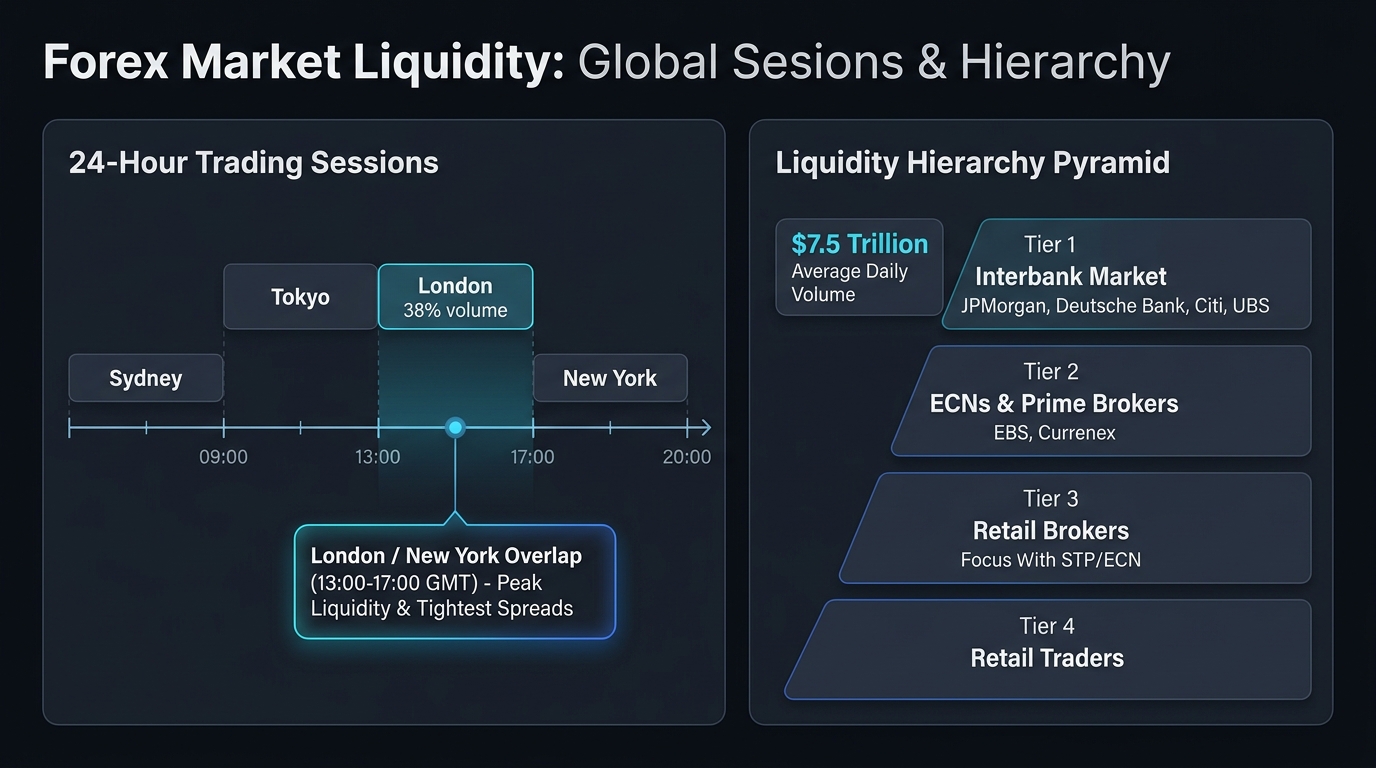
London is the largest forex trading center in the world, handling roughly 38% of global daily volume according to the BIS. When London opens at 07:00 UTC, spreads tighten noticeably, volume jumps, and trends often establish themselves for the day.
The first 90 minutes of the London session — 07:00 to 08:30 UTC — frequently sees decisive moves. European economic data (ECB decisions, German PMI, UK inflation figures) hits during this window, and institutional traders position for the day ahead. EUR/USD and GBP/USD come alive.
The European session sustains high activity through midday. By 14:00 UTC, attention begins shifting toward the New York open, creating the most active window in the entire trading week.
North American Session (New York)
Active hours: 12:00–21:00 UTC
Key currencies: USD, CAD, EUR (from overlap)
New York accounts for around 17% of global forex volume — significant, though smaller than London. The most important US economic releases — Non-Farm Payrolls (first Friday of the month), CPI, Fed announcements, retail sales — land at 12:30–14:00 UTC and frequently generate the week’s largest price swings.
USD/CAD is particularly active during New York hours because Canadian economic data also releases during this session. Oil price movements (Canada is a major oil exporter) influence CAD in ways that aren’t felt as strongly in other sessions.
The London-New York Overlap: The Most Important Window
Hours: 12:00–16:00 UTC (08:00–12:00 Eastern Time)
Four hours. This is where you should concentrate your attention if you’re going to day trade. Both London and New York are fully active simultaneously, creating the highest liquidity and tightest spreads of the week. Major economic releases from both continents have typically already hit by this point, but traders on both sides of the Atlantic are still actively positioned and repositioning.
EUR/USD and GBP/USD are at their most tradeable during this overlap. Trend moves established during the London morning often extend through the New York open, or reverse sharply when US data contradicts the European narrative. Either way, there’s movement.
After 16:00 UTC, the London session closes and New York winds down. Volume thins, spreads can widen, and price action becomes choppier. Holding positions through the New York close is fine from a risk management perspective — but initiating new positions in the 16:00–21:00 window requires more caution.
Practical Session Schedule by Time Zone
| Session | UTC | London (BST) | New York (ET) | Mumbai (IST) | Sydney (AEST) |
|---|---|---|---|---|---|
| Asian open | 00:00 | 01:00 | 20:00 (prev) | 05:30 | 10:00 |
| London open | 07:00 | 08:00 | 03:00 | 12:30 | 17:00 |
| London-NY overlap start | 12:00 | 13:00 | 08:00 | 17:30 | 22:00 |
| London close / overlap end | 16:00 | 17:00 | 12:00 | 21:30 | 02:00 |
| New York close | 21:00 | 22:00 | 17:00 | 02:30 | 07:00 |
Note: Times shift by one hour during daylight saving changes (clocks in London and New York change on different dates).
When Not to Trade
Certain periods in the trading week are consistently low-quality:
Late New York to Asian open (21:00–00:00 UTC): The liquidity gap between New York closing and Asia opening. Spreads widen, moves can be erratic, and any price action during this window can reverse sharply when proper liquidity returns.
Full Asian session (for EUR/USD traders): Unless you’re specifically trading JPY or AUD pairs, the Asian session offers little for European currency traders. Sitting through hours of sideways action is expensive emotionally and financially if you overtrade.
Major holiday periods: Christmas week, Golden Week in Japan (late April/early May), and US public holidays reduce volume significantly. Stop losses are less reliable, gaps are more common, and institutional participation is low. Reducing position size or sitting out entirely is a legitimate strategy during these windows.
Immediately before major news events: The 15 minutes before a high-impact news release (NFP, Fed rate decisions, ECB press conferences) see spreads widen dramatically as market makers protect themselves. Avoid entering new positions in this window unless news trading is your explicit strategy with carefully sized positions.
Weekend Gaps: A Hidden Risk
The forex market technically closes Friday at 21:00 UTC and reopens Sunday at 22:00 UTC. During this 25-hour window, news continues: geopolitical developments, natural disasters, unexpected political announcements. When the market reopens Sunday, prices frequently gap — jumping directly from Friday’s close to a new level without trading through the prices in between.
Stop-loss orders placed over the weekend may execute at a significantly worse price than specified (slippage on gaps is common). Professional traders who hold positions over weekends size them smaller than intraday positions, precisely to account for this gap risk.
The Sunday candle — the first 1-2 hours of the new week — also tends to be illiquid and unreliable. Many traders wait until 01:00 UTC or even until the London open before placing new positions to avoid the opening noise.
Next: Key Forex Players: Banks, Institutions, and Retail Traders
Previous: Currency Pairs
Related dictionary terms: Liquidity | Spread | Weekend Gap | Non-Farm Payrolls

Ready to Practice This Strategy?
Test what you learned on a free, risk-free demo account before risking real money.