How Forex Trading Works: Long, Short, Spreads, and Pips Explained
Before placing your first forex trade, understand the mechanics: going long vs. short, bid/ask spreads, how pips are calculated, and what happens when you open and close a position.
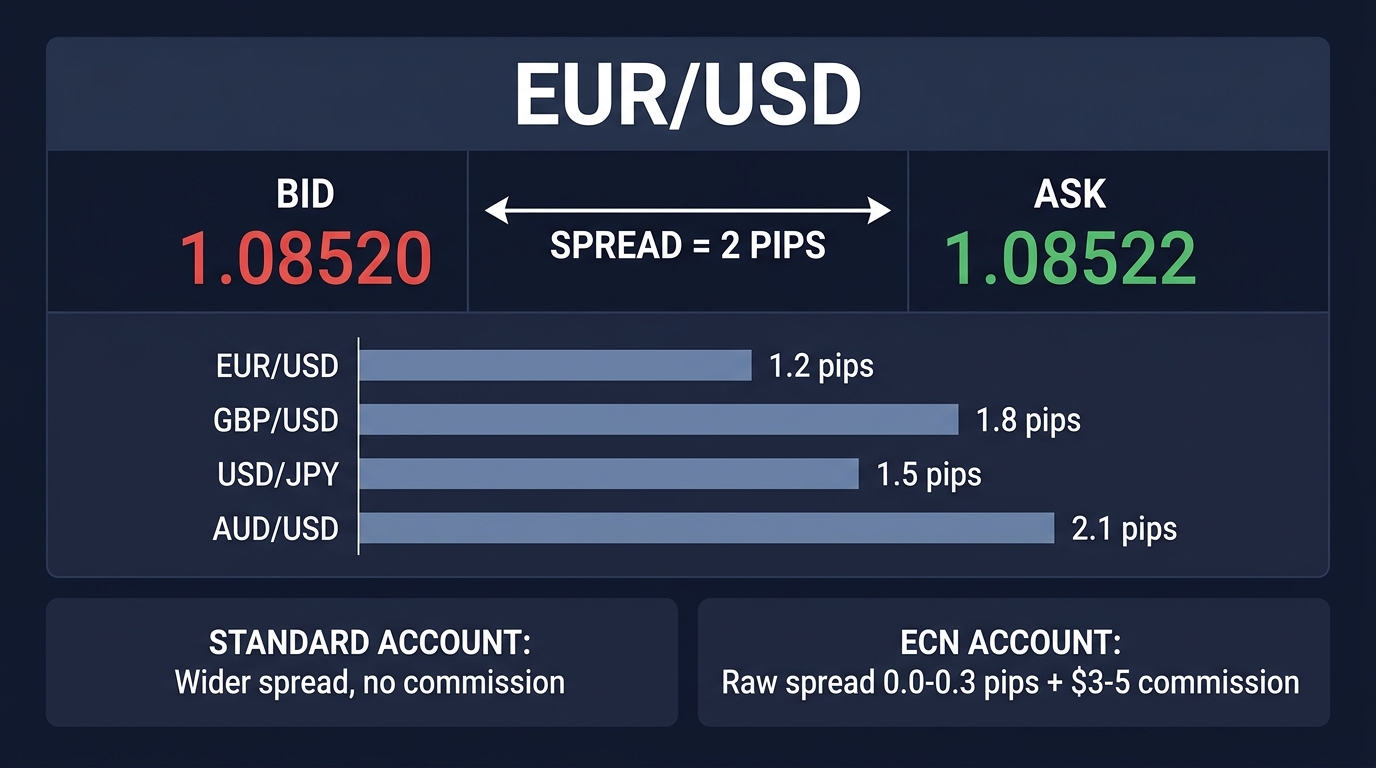
Understanding the mechanics of a forex trade before placing one is not optional — it’s the difference between knowing what’s happening to your account and watching numbers move without context. This lesson covers the essentials: going long and short, reading quotes, calculating pip values, and the sequence of events from trade entry to exit.
Going Long vs. Going Short
Every forex position is either long or short. These terms describe your directional bet:
Going long (buying) means you buy the base currency of a pair, expecting it to rise in value against the quote currency. If you go long EUR/USD at 1.0850 and the rate rises to 1.0920, you profit. You’re buying euros and selling dollars, expecting euros to strengthen.
Going short (selling) means you sell the base currency, expecting it to fall in value. If you go short EUR/USD at 1.0850 and the rate falls to 1.0780, you profit. You’re selling euros and buying dollars, expecting the dollar to strengthen against the euro.
In practice, both directions are executed with a single click — “Buy” or “Sell” on your broker’s platform. There’s no additional approval process for going short in forex (unlike stock markets where shorting requires borrowing shares). When you sell EUR/USD, you’re simultaneously long USD.
Your profit or loss is determined by the price difference between your entry and exit, multiplied by your position size.
Reading a Forex Quote
When you look at a currency pair on a trading platform, you see two prices:
EUR/USD 1.0847 / 1.0849
- 1.0847 is the bid price — what the broker will pay you if you sell (your selling rate)
- 1.0849 is the ask price — what the broker charges you to buy (your buying price)
You always buy at the ask and sell at the bid. The difference — 0.0002 in this case — is the spread. This is the broker’s implicit fee, built into every trade.
Starting a long trade at 1.0849, your position is immediately “underwater” by 0.0002 (2 pips) because if you exited immediately, you’d sell back at 1.0847. The market has to move at least 2 pips in your favor before you break even. This is why wide spreads on less liquid pairs matter significantly over time.
What Is a Pip?
A pip (percentage in point) is the standardized unit of price movement in forex. For most pairs quoted to four decimal places, one pip = 0.0001.
- EUR/USD moves from 1.0850 to 1.0870 = 20 pip move
- GBP/USD moves from 1.2630 to 1.2580 = -50 pips (50 pip loss if you were long)
Japanese yen pairs are quoted to two decimal places:
- USD/JPY moves from 148.50 to 149.00 = 50 pips
Some brokers quote to five decimal places (0.00001 for non-JPY pairs). These fractional increments are called pipettes or fractional pips.
Pip Value: What Each Move Is Worth
The dollar value of one pip depends on your position size. Standard lot sizes:
| Lot | Units | EUR/USD Pip Value |
|---|---|---|
| Standard | 100,000 | ~$10.00 per pip |
| Mini | 10,000 | ~$1.00 per pip |
| Micro | 1,000 | ~$0.10 per pip |
On EUR/USD with a standard lot, a 50-pip move = $500 gain or loss. On a micro lot, the same 50 pips = $5.
For pairs where USD is the quote currency (EUR/USD, GBP/USD), pip value is straightforward. For pairs where USD is the base currency (USD/JPY, USD/CAD), the pip value calculation involves the current exchange rate. Your broker’s platform calculates this automatically — but understanding the principle prevents surprises.
A Complete Trade: From Entry to Exit
Here’s how a trade looks mechanically:
Setup: You analyze EUR/USD and expect it to rise. Current price: 1.0847/1.0849.
Entry: You place a market order to buy 0.1 lots (10,000 units = mini lot). Your broker fills you at 1.0849 (the ask). Pip value: ~$1 per pip.
Position open: Required margin is held by your broker. Your account shows:
- Entry price: 1.0849
- Current price: varies with market
- Unrealized P&L: updates in real time
Price moves in your favor: EUR/USD rises to 1.0930.
- Move: 1.0930 − 1.0849 = 0.0081 = 81 pips
- Profit: 81 × $1.00 = $81.00 (gross, before any overnight swap if held)
Exit: You close the position by placing a sell order. Your broker fills you at the current bid price (approximately 1.0928 if the spread is 2 pips). Final profit is calculated based on the fill price.
Settlement: Your margin is returned, profit is added to your account balance.
Order Types You’ll Use Every Day
Market order — executes immediately at the current market price. Used when you want to enter or exit right now. The fill price may differ slightly from what you see (slippage) during fast-moving markets.
Limit order — executes at a specified price or better. Used to enter at a planned price if the market reaches it, or to take profit at a target level.
Stop-loss order — closes your position if price moves against you to a specified level, limiting your maximum loss on a trade.
Stop entry order — opens a position when price moves through a specified level (used when you want to enter on a breakout above resistance or below support).
Most trades use a combination: a market order to enter, and pending stop-loss and take-profit limit orders placed simultaneously to automate the exit.
Overnight Swap: The Cost of Holding Positions
When you hold a forex position overnight, your broker applies a swap rate — an interest adjustment based on the interest rate differential between the two currencies in your pair.
If you’re long AUD/USD, you’re effectively holding Australian dollars and lending US dollars. If Australian interest rates are higher than US rates, you receive positive swap — a small credit applied to your account. If US rates are higher, you pay negative swap.
Swap rates are applied at 17:00 New York time (22:00 UTC). On Wednesdays, the swap is typically triple (to account for the weekend settlement). For day traders who close all positions before 17:00, swap is irrelevant. For swing traders holding positions for days or weeks, it’s a factor in trade selection — especially on carry trades where the swap income is part of the strategy.
Next: Three Types of Forex Analysis
Previous: Forex Millionaires: Famous Currency Trades
Related lessons: Margin and Leveraged Trading | Risk Management Basics
Tools: Pip Calculator | Position Size Calculator
Related dictionary terms: Pip | Spread | Long Position | Short Position | Swap Rate

Ready to Practice This Strategy?
Test what you learned on a free, risk-free demo account before risking real money.